1. Search Result
Search Result
Pathways Recommended: Membrane Transporter/Ion Channel
Results for "

electrochemical ion transfer

" in MedChemExpress (MCE) Product Catalog:

5

Inhibitors & Agonists

2

Biochemical Assay Reagents

1

Isotope-Labeled Compounds

Cat. No. Product Name Target Research Areas Chemical Structure
  • HY-W014408

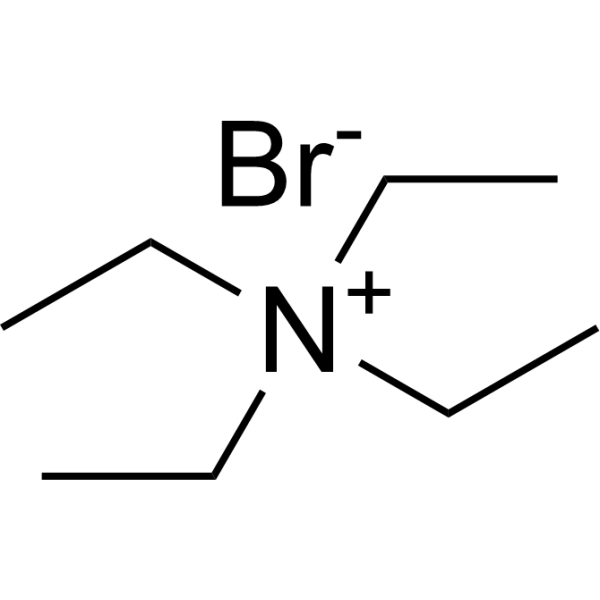
    TEA bromide

    Biochemical Assay Reagents Others
    Tetraethylammonium bromide is a quaternary ammonium salt consisting of a positively charged tetraethylammonium cation and a negatively charged bromide anion. This compound is commonly used as a phase transfer catalyst in organic chemical reactions, facilitating the transfer of reactants between immiscible phases. It can also be used as a reagent for the synthesis of various organic compounds, an electrolyte in electrochemical experiments, and a source of tetraethylammonium ions in biochemical and pharmacological research.
    Tetraethylammonium bromide
  • HY-W014106

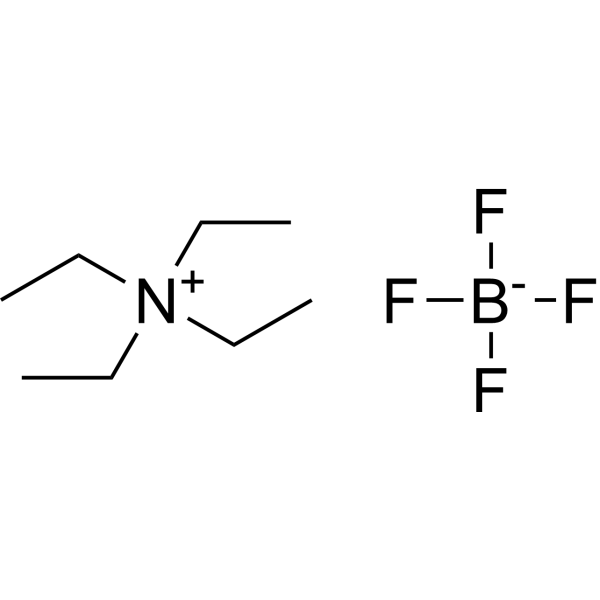
    N,N,N-Triethylethanaminium tetrafluoroborate

    Biochemical Assay Reagents Others
    Tetraethylammonium tetrafluoroborate is a quaternary ammonium salt consisting of a positively charged tetraethylammonium cation and a negatively charged tetrafluoroborate anion. This compound is commonly used as a phase transfer catalyst in organic chemical reactions, facilitating the transfer of reactants between immiscible phases. It can also be used as a reagent for the synthesis of various organic compounds, an electrolyte in electrochemical experiments, and a source of tetraethylammonium ions in biochemical and pharmacological research.
    Tetraethylammonium tetrafluoroborate
  • HY-W012232

    Biochemical Assay Reagents Drug Intermediate Others
    2,6-Diphenylpyridine is a proton acceptor (log(P) = 5) and a tridentate [C^N^C] dianionic ligand. 2,6-Diphenylpyridine efficiently transfers protons through a direct pathway at the interface of two immiscible electrolyte solutions. 2,6-Diphenylpyridine as a tridentate ligand and can form mononuclear and binuclear complexes with gold(III). 2,6-Diphenylpyridin is applicable to research in electrochemical ion transfer kinetics and organometallic chemistry .
    2,6-Diphenylpyridine
  • HY-W724370

    TEA bromide-d20

    Isotope-Labeled Compounds Biochemical Assay Reagents Others
    Tetraethylammonium bromide-d20 (TEA bromide-d20) is the deuterium labeled Tetraethylammonium bromide (HY-W014408). Tetraethylammonium bromide is a quaternary ammonium salt consisting of a positively charged tetraethylammonium cation and a negatively charged bromide anion. This compound is commonly used as a phase transfer catalyst in organic chemical reactions, facilitating the transfer of reactants between immiscible phases. It can also be used as a reagent for the synthesis of various organic compounds, an electrolyte in electrochemical experiments, and a source of tetraethylammonium ions in biochemical and pharmacological research.
    Tetraethylammonium bromide-d20
  • HY-W094110

    Environmental Pollutants Biochemical Assay Reagents Others
    Iron (III) sulfate is a stable rhombohedral NASICON compound. Iron (III) sulfate can serve as a sodium ion intercalation host, enabling sodium ion intercalation and deintercalation via a single-phase mechanism relying on the Fe 2+/Fe 3+ redox couple. Iron (III) sulfate exhibits reversible electrochemical behavior and moderate polarization in cyclic voltammetry tests, and its charge transfer resistance changes during charge-discharge cycles. Iron (III) sulfate possesses a high redox potential, excellent rate capability, and long-cycle stability .
    Iron(III) sulfate

Inquiry Online

Your information is safe with us. * Required Fields.

Salutation


Country or Region *

Applicant Name *


Organization Name *

Department *


Email Address *


Product Name *

Cat. No.


Requested quantity *

Phone Number *


Remarks

Inquiry Online

Inquiry Information

Product Name:
Cat. No.:
Quantity:
MCE Japan Authorized Agent:

