



11 Results for "

ischemic protection

" in MedChemExpress (MCE) Product Catalog:
Products (11)

11 Results for "ischemic protection" in MCE Product Catalog:

3
3 Cited Publications
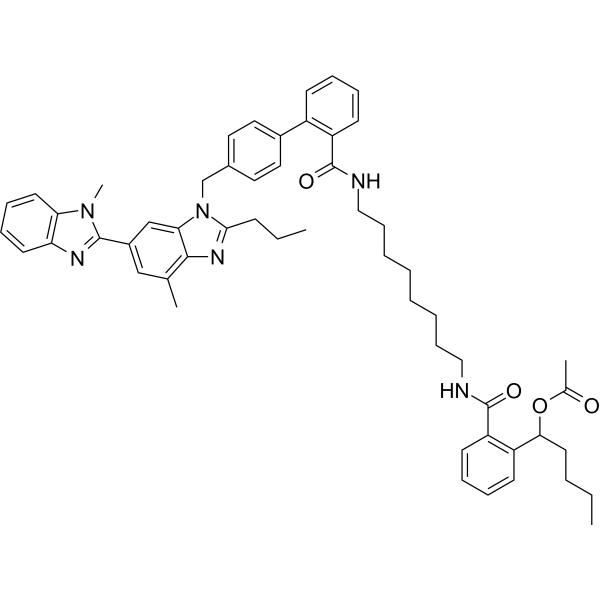
Cat. No.: HY-139598
CAS No.: 2102347-47-5
Purity:  98.01%
Target:  

Phospholipase

Research Areas:  

Cardiovascular Disease

LFHP-1c is an PGAM5 inhibitor with neuroprotective activity in brain ischemic stroke. LFHP-1c protects blood-brain barrier integrity from ischemia-induced injury. LFHP-1c binds to endothelial PGAM5 to inhibit the activity of PGAM5 phosphatase and the interaction of PGAM5 with NRF2. LFHP-1c exhibits in vitro and in vivo protection .
loading...
    loading...
1
1 Cited Publications
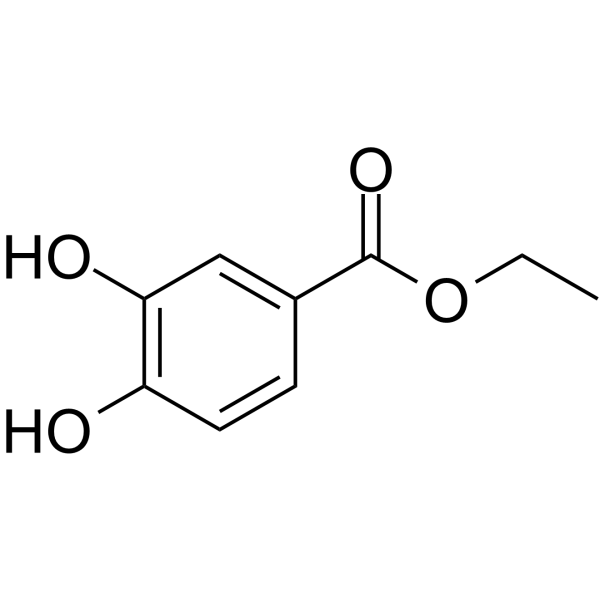
Cat. No.: HY-W016409
CAS No.: 3943-89-3
Synonyms: Protocatechuic acid ethyl ester
Ethyl 3,4-dihydroxybenzoate (Protocatechuic acid ethyl ester) is an orally effective, blood-brain barrier-permeable, competitive prolyl hydroxylase (PHD) inhibitor that inhibits the hydroxylation modification of hypoxia-inducible factor (HIF) by PHD. Ethyl 3,4-dihydroxybenzoate stabilizes HIF-1α by inhibiting PHD, activates downstream pathways to induce autophagy and apoptosis of tumor cells, and regulates inflammatory responses, inhibits the NF-κB pathway, improves vascular permeability, and promotes osteoblast differentiation. Ethyl 3,4-dihydroxybenzoate has anti-tumor, anti-hypoxic injury, and bone metabolism regulation effects. It can also be used in the research of cardiovascular protection (such as reducing myocardial ischemic damage), bone tissue engineering (promoting osteogenesis/inhibiting osteoclast differentiation), and prevention and treatment of high-altitude cerebral edema .
loading...
    loading...
Defibrotide sodium
0 Images
Defibrotide (sodium)
Cat. No.: HY-108746
CAS No.: 83712-60-1
Defibrotide sodium is a complex mixture of single stranded polydeoxyribonucleotides. Defibrotide sodium has liver protection, anti-inflammatory, antithrombotic, profibrinolytic, and anti-ischemic properties. Defibrotide sodium can be used for sinusoidal obstruction syndrome (SOS)/veno-occlusive disease (VOD) research .
loading...
    loading...
Cat. No.: HY-P5118A
Target:  

Peptides

Research Areas:  

Neurological Disease

Tat-peptide 190-208 TFA is a cell-permeable and Tat-labeled fusion peptide, corresponding to residues 190-208 of rat G3BP1. Tat sequence from HIV, is placed at the least conserved end of the sequence, for cell permeability. Tat-peptide 190-208 TFA increases axon growth and increases the number of neurites per neuron. Tat-peptide 190-208 TFA likely exhibits an axon intrinsic mechanism. Tat-peptide 190-208 TFA can be used for ischemic protection during endovascular repair for intracranial aneurysms .
loading...
    loading...
Cat. No.: HY-P5118
Target:  

Peptides

Research Areas:  

Neurological Disease

Tat-peptide 190-208 is a cell-permeable and Tat-labeled fusion peptide, corresponding to residues 190-208 of rat G3BP1. Tat sequence from HIV, is placed at the least conserved end of the sequence, for cell permeability. Tat-peptide 190-208 increases axon growth and increases the number of neurites per neuron. Tat-peptide 190-208 likely exhibits an axon intrinsic mechanism. Tat-peptide 190-208 can be used for ischemic protection during endovascular repair for intracranial aneurysms .
loading...
    loading...
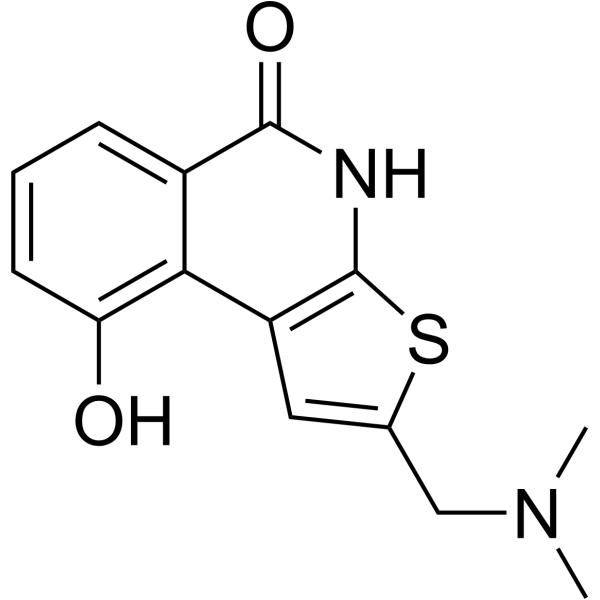
Cat. No.: HY-155458
CAS No.: 1201832-32-7
Target:  

PARP

Research Areas:  

Inflammation/Immunology Cancer

HYDAMTIQ is a PARP-1/2 inhibitor (IC50: 29-38 nM) with anticancer, anti-inflammatory, and ischemic protective effects. HYDAMTIQ inhibits pulmonary PARP activity, is effective against allergen-induced cough and dyspnea, and inhibits bronchial hyperresponsiveness to methacholine. HYDAMTIQ has broad-spectrum tumor suppressor effects, including ovarian and breast cancers, prostate and pancreatic tumors, and glioblastoma multiforme. HYDAMTIQ has demonstrated in vivo efficacy in animal models of cerebral ischemia, asthma, cancer, and more .
loading...
    loading...
Cat. No.: HY-125144
CAS No.: 265986-98-9
Research Areas:  

Cardiovascular Disease

BIIB 513 is an inhibitor of NHE 1 that protects against myocardial ischemia. BIIB 513 inhibits acid load recovery with an IC50 of 27 nmol/L in cells expressing wild-type NHE 1 under acute acid load .
loading...
    loading...
Cat. No.: HY-P5119
Target:  

Peptides

Research Areas:  

Neurological Disease

Tat-peptide 168-189 is a cell-permeable and Tat-labeled fusion peptide, corresponding to residues 168-189 of rat G3BP1. Tat sequence from HIV, is placed at the least conserved end of the sequence, for cell permeability. Tat-peptide 168-189 is the negtive control of Tat-peptide 190-208 (HY-P5118), as Tat-peptide 190-208 increases axon growth and increases the number of neurites per neuron .
loading...
    loading...
Cat. No.: HY-W016409R
CAS No.: 3943-89-3
Synonyms: Protocatechuic acid ethyl ester (Standard)
Ethyl 3,4-dihydroxybenzoate (Standard) (Protocatechuic acid ethyl ester (Standard)) is the analytical standard of Ethyl 3,4-dihydroxybenzoate (HY-W016409). This product is intended for research and analytical applications. Ethyl 3,4-dihydroxybenzoate (Protocatechuic acid ethyl ester) is an orally effective, blood-brain barrier-permeable, competitive prolyl hydroxylase (PHD) inhibitor that inhibits the hydroxylation modification of hypoxia-inducible factor (HIF) by PHD. Ethyl 3,4-dihydroxybenzoate stabilizes HIF-1α by inhibiting PHD, activates downstream pathways to induce autophagy and apoptosis of tumor cells, and regulates inflammatory responses, inhibits the NF-κB pathway, improves vascular permeability, and promotes osteoblast differentiation. Ethyl 3,4-dihydroxybenzoate has anti-tumor, anti-hypoxic injury, and bone metabolism regulation effects. It can also be used in the research of cardiovascular protection (such as reducing myocardial ischemic damage), bone tissue engineering (promoting osteogenesis/inhibiting osteoclast differentiation), and prevention and treatment of high-altitude cerebral edema .
loading...
    loading...
Cat. No.: HY-W778057
CAS No.: 1330195-40-8
Synonyms: Protocatechuic acid ethyl ester-13C3
Ethyl 3,4-Dihydroxybenzoate- 13C3 (Protocatechuic acid ethyl ester- 13C3) is the 13C-labeled Ethyl 3,4-dihydroxybenzoate (HY-W016409). Ethyl 3,4-dihydroxybenzoate (Protocatechuic acid ethyl ester) is an orally effective, blood-brain barrier-permeable, competitive prolyl hydroxylase (PHD) inhibitor that inhibits the hydroxylation modification of hypoxia-inducible factor (HIF) by PHD. Ethyl 3,4-dihydroxybenzoate stabilizes HIF-1α by inhibiting PHD, activates downstream pathways to induce autophagy and apoptosis of tumor cells, and regulates inflammatory responses, inhibits the NF-κB pathway, improves vascular permeability, and promotes osteoblast differentiation. Ethyl 3,4-dihydroxybenzoate has anti-tumor, anti-hypoxic injury, and bone metabolism regulation effects. It can also be used in the research of cardiovascular protection (such as reducing myocardial ischemic damage), bone tissue engineering (promoting osteogenesis/inhibiting osteoclast differentiation), and prevention and treatment of high-altitude cerebral edema .
loading...
    loading...
Cat. No.: HY-P5119A
Target:  

Peptides

Research Areas:  

Neurological Disease

Tat-peptide 168-189 is a cell-permeable and Tat-labeled fusion peptide, corresponding to residues 168-189 of rat G3BP1. Tat sequence from HIV, is placed at the least conserved end of the sequence, for cell permeability. Tat-peptide 168-189 is the negtive control of Tat-peptide 168-189 TFA (HY-P5118A), as Tat-peptide 168-189 TFA increases axon growth and increases the number of neurites per neuron .
loading...
    loading...
  • 1

