
7 Results for "

lysosomal trafficking

" in MedChemExpress (MCE) Product Catalog:
Products (7)

7 Results for "lysosomal trafficking" in MCE Product Catalog:

3
3 Cited Publications
Cat. No.: HY-164992
Synonyms: MRG002; Trastuzumab MMAE
Trastuzumab vedotin (MRG002; Trastuzumab MMAE) is an antibody-drug conjugate and cytotoxin targeting HER2, with a Kd of 7.50E-11 M for human HER2. After binding to HER2, Trastuzumab vedotin undergoes internalization and lysosomal trafficking, delivering a cytotoxic payload to HER2-expressing cells and inducing tumor regression in in vivo xenograft models with HER2-expressing tumors. The anti-tumor activity of Trastuzumab vedotin is enhanced when used in combination with anti-PD-1 antibodies, and it exhibits preclinical anti-tumor activity in drug-resistant breast cancer, gastric cancer, and urothelial carcinoma PDX models. Trastuzumab vedotin has low antibody-dependent cellular cytotoxicity activity and can be used in studies related to HER2-positive breast cancer, HER2-positive gastric cancer, and unresectable locally advanced or metastatic HER2-positive urothelial carcinoma .
loading...
    loading...
2
2 Cited Publications
Cat. No.: HY-141598
CAS No.: 2238831-60-0
Purity:  99.54%
Synonyms: DS-1062 (solution); Dato-DXd (solution)
Datopotamab deruxtecan (DS-1062) solution is a TROP2-targeted antibody-drug conjugate (ADC) with human TROP2 Kd of 0.74 nmol/L. Datopotamab deruxtecan solution consists of the antibody Datopotamab (HY-P99843) and the toxic molecule-linker conjugate Deruxtecan (HY-13631E). Datopotamab deruxtecan solution binds TROP2, triggers internalization and lysosomal trafficking and releases DXd topoisomerase I inhibitor payload. Datopotamab deruxtecan solution disrupts DNA function, induces DNA damage, apoptosis, and bystander killing of tumor microenvironment cells. Datopotamab deruxtecan solution can be used in research related to triple-negative breast cancer, gastric cancer, and non-small cell lung cancer .
loading...
    loading...
2
2 Cited Publications
Cat. No.: HY-125168
CAS No.: 415687-81-9
Purity:  ≥99.0%
Target:  

EGFR

Research Areas:  

Infection Inflammation/Immunology

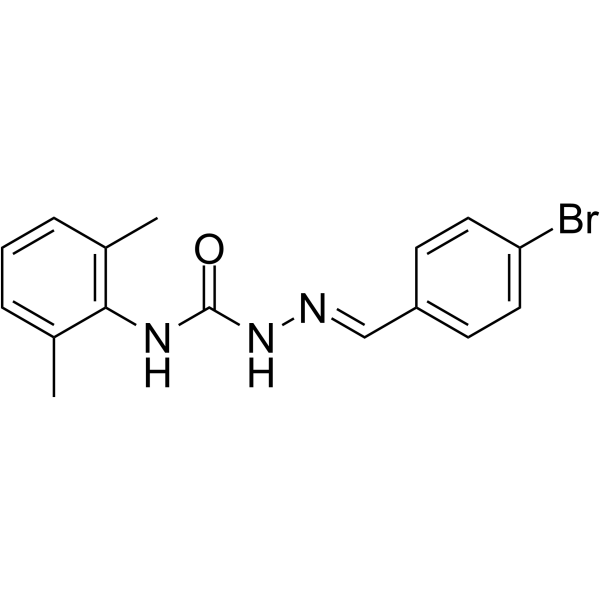
EGA is an inhibitor that selectively targets the endosomal trafficking pathways. EGA targets the proteins involved in the endosomal trafficking pathways through which multiple toxins and viruses enter cells. EGA exerts its activity by inhibiting the trafficking from early endosomes to late endosomes, blocking the entry of multiple acid-dependent bacterial toxins and viruses into mammalian cells and delaying the lysosomal targeting and degradation of EGFR .
loading...
    loading...
2
2 Cited Publications
Cat. No.: HY-141598B
CAS No.: 2238831-60-0
Synonyms: DS-1062; Dato-DXd
Datopotamab deruxtecan (DS-1062) is a TROP2-targeted antibody-drug conjugate (ADC) with human TROP2 Kd of 0.74 nmol/L. Datopotamab deruxtecan consists of the antibody Datopotamab (HY-P99843) and the toxic molecule-linker conjugate Deruxtecan (HY-13631E). Datopotamab deruxtecan binds TROP2, triggers internalization and lysosomal trafficking and releases DXd topoisomerase I inhibitor payload. Datopotamab deruxtecan disrupts DNA function, induces DNA damage, apoptosis, and bystander killing of tumor microenvironment cells. Datopotamab deruxtecan can be used in research related to triple-negative breast cancer, gastric cancer, and non-small cell lung cancer .
loading...
    loading...
1
1 Cited Publications
Cat. No.: HY-148673
CAS No.: 2455427-91-3
Purity:  99.97%
Synonyms: AZD0780; PCSK9-IN-12
Target:  

PCSK9

Laroprovstat (AZD0780) is an orall active PCSK9 inhibitor. PCSK9-IN-12 has bind affinity for PCSK9 with a Kd value of <200 nM. Laroprovstat binds to a pocket in the PCSK9 C-terminal domain and does not affect the PCSK9-LDL receptor (LDLR) interaction. Laroprovstat inhibits lysosomal trafficking of PSCK9-LDLR complexes and prevents PCSK9-induced LDLR degradation. Laroprovstat can be used for the research of hypercholesterolemia .
loading...
    loading...
Cat. No.: HY-182959
Research Areas:  

Cancer

Hsp70TAC PD-1 Degrader-2 is a PD-L1 Hsp70TAC (Hsp70-targeting Chimeras) degrader with Kd values of 0.36 μM. Hsp70TAC PD-1 Degrader-2 forms a ternary complex with Hsp70 and PD-L1 to drive PD-L1 degradation. Hsp70TAC PD-1 Degrader-2 induces degradation of mature membrane-bound PD-L1 in an Hsp70-dependent manner and via caveolin-mediated endocytosis and lysosomal trafficking. Hsp70TAC PD-1 Degrader-2 accumulates preferentially in tumor cells with elevated Hsp70 expression for tumor-selective PD-L1 degradation. Hsp70TAC PD-1 Degrader-2 can be used for the research of cancer, such as breast invasive carcinoma, glioblastoma multiforme, diffuse large b-cell lymphoma . (Pink: PD-1/PD-L1 ligand (HY-19745A); Blue: Hsp70 ligand (HY-182979); Black: linker (HY-182982)).
loading...
    loading...
Cat. No.: HY-184300
Target:  

PD-1/PD-L1

Research Areas:  

Inflammation/Immunology Cancer

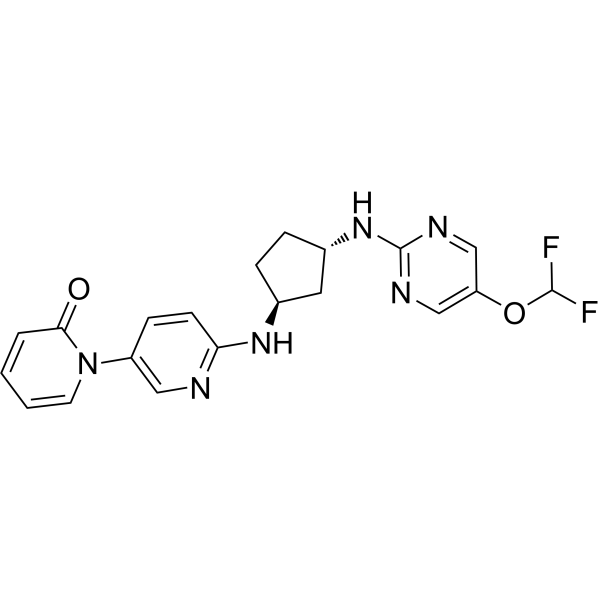
PDL1 degrader-4 is a PD-L1 degrader that induces PD-L1 degradation via the LAMP2-mediated lysosomal pathway, with a Kd value of 5.58 μM. PDL1 degrader-4 induces anti-tumor immunity through PD-L1 degradation. PDL1 degrader-4 is applicable to research related to non-small cell lung cancer .
loading...
    loading...

