8 Results for "

m-Carboxynitrobenzene-d4

" in MedChemExpress (MCE) Product Catalog:
Products (8)

8 Results for "m-Carboxynitrobenzene-d4" in MCE Product Catalog:

Cat. No.: HY-114118S
Semaglutide-d8 is the deuterium labeled Semaglutide (HY-114118). Semaglutide is a long-acting, selective, competitive GLP-1R agonist that can penetrate the blood-brain barrier. After activating GLP-1R, Semaglutide promotes insulin secretion, inhibits gastric emptying and appetite, and at the same time enhances autophagy, inhibits oxidative stress and apoptosis. Semaglutide also regulates mitochondrial function and lipid metabolism (such as reducing de novo lipogenesis in the liver). Semaglutide has activities such as lowering blood sugar, reducing weight, neuroprotection (such as improving motor function in Parkinson's disease models, reducing α-synuclein aggregation) and improving hepatic steatosis. Semaglutide can be used for the study of neurodegenerative diseases and liver diseases such as type 2 diabetes, obesity, Parkinson's disease, metabolic associated fatty liver disease (MASLD), and cancer [4] .
loading...
    loading...
Cat. No.: HY-114118S1
Semaglutide-d8 tetraTFA is the deuterium labeled Semaglutide (HY-114118). Semaglutide is a long-acting, selective, competitive GLP-1R agonist that can penetrate the blood-brain barrier. After activating GLP-1R, Semaglutide promotes insulin secretion, inhibits gastric emptying and appetite, and at the same time enhances autophagy, inhibits oxidative stress and apoptosis. Semaglutide also regulates mitochondrial function and lipid metabolism (such as reducing de novo lipogenesis in the liver). Semaglutide has activities such as lowering blood sugar, reducing weight, neuroprotection (such as improving motor function in Parkinson's disease models, reducing α-synuclein aggregation) and improving hepatic steatosis. Semaglutide can be used for the study of neurodegenerative diseases and liver diseases such as type 2 diabetes, obesity, Parkinson's disease, metabolic associated fatty liver disease (MASLD), and cancer [4] .
loading...
    loading...
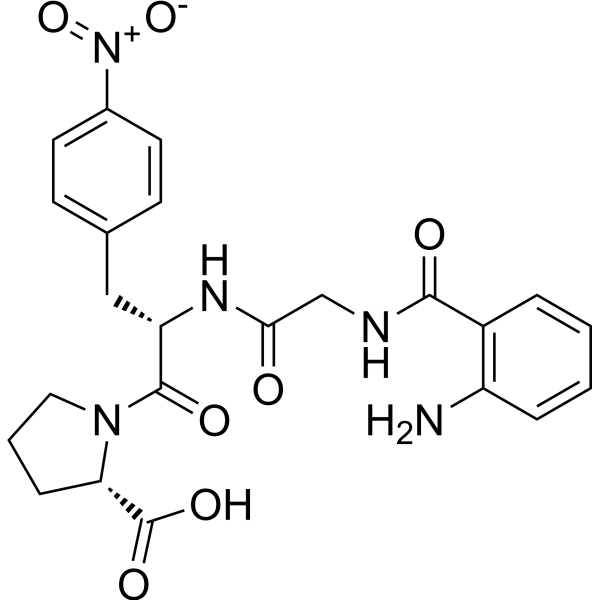
Cat. No.: HY-P4545
CAS No.: 67482-93-3
Target:  

Angiotensin Receptor

Research Areas:  

Others

Abz-Gly-p-nitro-Phe-Pro-OH is the fluorescent substrate angiotensin I converting enzyme (ACE-I) with 355 nm excitation and 405 nm emission wavelengths .
loading...
    loading...
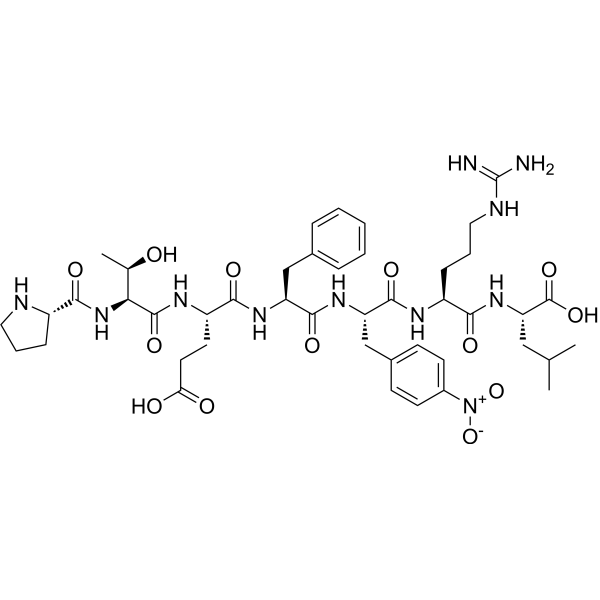
Cat. No.: HY-P4561
CAS No.: 90331-82-1
Target:  

Cathepsin

Research Areas:  

Others

H-Pro-Thr-Glu-Phe-p-nitro-Phe-Arg-Leu-OH is a water-soluble polypeptide that can serve as a substrate for cathepsin D, pepsin and pepsinogen. H-Pro-Thr-Glu-Phe-p-nitro-Phe-Arg-Leu-OH has potential applications in biochemical analysis .
loading...
    loading...
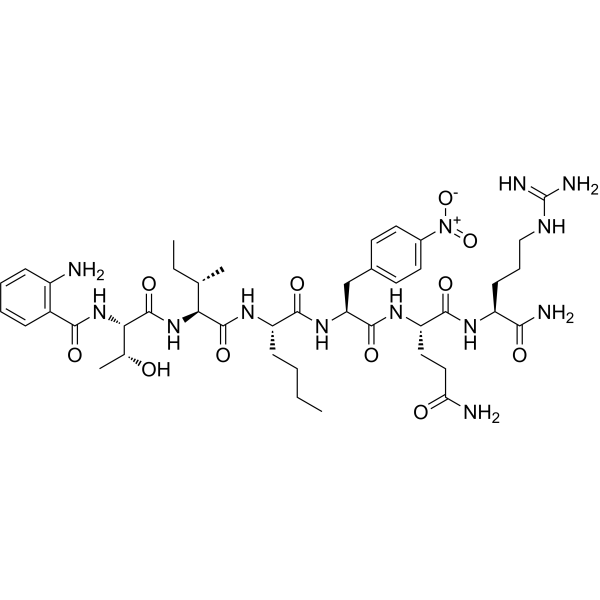
Cat. No.: HY-P4725
CAS No.: 133233-38-2
Target:  

Fluorescent Dye

Research Areas:  

Others

Abz-Thr-Ile-Nle-p-nitro-Phe-Gln-Arg-NH2 is a fluorogenic substrate, that can be used for the fluorescence screening assay .
loading...
    loading...
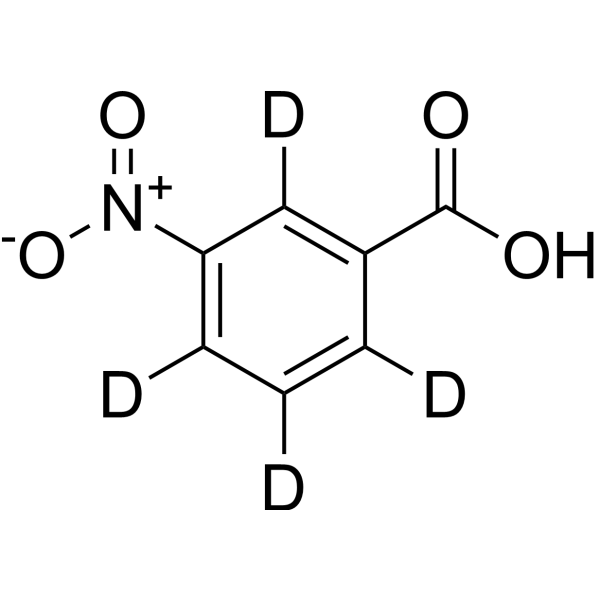
Cat. No.: HY-Y1313S
CAS No.: 78399-78-7
Synonyms: m-Carboxynitrobenzene-d4; m-Nitrobenzenecarboxylic acid-d4; m-Nitrobenzoic acid-d4
3-Nitrobenzoic acid-d4 (m-Carboxynitrobenzene-d4; m-Nitrobenzenecarboxylic acid-d4; m-Nitrobenzoic acid-d4) is the deuterium labeled 3-Nitrobenzoic acid (HY-Y1313). 3-Nitrobenzoic acid is an antioxidant and antibacterial agent that can kill bacteria and fungi. 3-Nitrobenzoic acid can be degraded or reduced by certain bacteria (such as Pseudomonas) and fungi (such as white rot fungi) into aldehydes and alcohols.
loading...
    loading...
Cat. No.: HY-P4556
CAS No.: 50572-79-7
Research Areas:  

Others

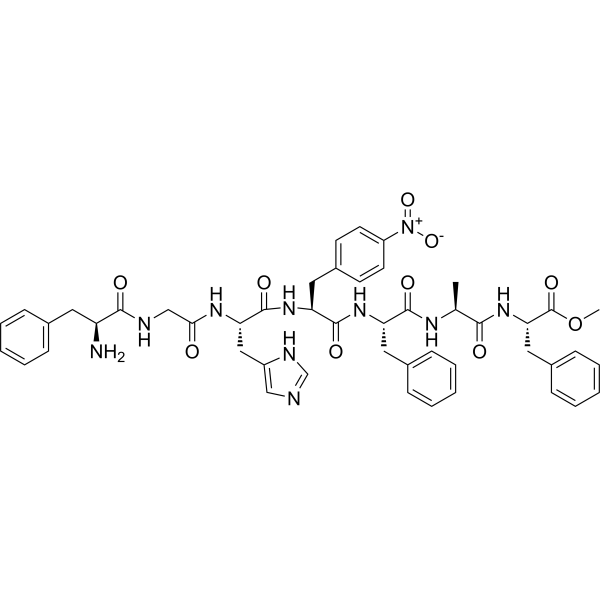
H-Phe-Gly-His-p-nitro-Phe-Phe-Ala-Phe-OMe is a polypeptide that can be hydrolyzed by Rennin (HY-P2810). H-Phe-Gly-His-p-nitro-Phe-Phe-Ala-Phe-OMe is commonly used as a biochemical reaction reagent .
loading...
    loading...
Cat. No.: HY-P10819
Research Areas:  

Cancer

S9-CMC1 TFA is a covalent peptide lysine-specific demethylase 1 (LSD1) inhibitor with an IC50 value of 2.53 μM. S9-CMC1 TFA specifically recognizes Cys360 in the enzyme-active region. S9-CMC1 TFA inhibits LSD1 activity, increasing H3K4me1 and H3K4me2 levels, leading to G1 cell cycle arrest and apoptosis and inhibiting cell proliferation. S9-CMC1 TFA significantly inhibits tumor growth in A549 xenograft animal models .
loading...
    loading...

