

8 Results for "

motoneurons

" in MedChemExpress (MCE) Product Catalog:
Products (8)

8 Results for "motoneurons" in MCE Product Catalog:

2
2 Cited Publications
Cat. No.: HY-P2727
CAS No.: 9024-13-9
Synonyms: ChABC
Research Areas:  

Neurological Disease

Chondroitinase ABC (ChABC) is an enzyme that degrades glycosaminoglycan side-chains of chondroitin sulfate (CS-GAG) from the chondroitin sulfate proteoglycan (CSPG) core protein. Chondroitinase ABC facilitates reinnervation by degrading CS-GAGs around motoneurons. Chondroitinase ABC has the potential for the research of spinal injury .
loading...
    loading...
1
1 Cited Publications
Cat. No.: HY-14604
CAS No.: 90494-79-4
Purity:  98.57%
Synonyms: SR57746A; SR57746 hydrochloride
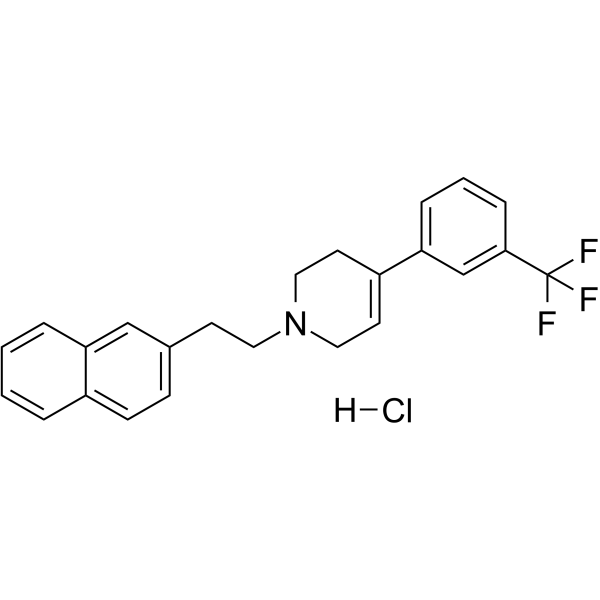
Xaliproden (SR57746) hydrochloride (SR57746A) is an orally active, highly selective 5-HT1A receptor agonist. Xaliproden hydrochloride activates pertussis toxin-sensitive G protein-coupled signaling cascades, as well as the PKC, ERK1/ERK2, Akt and p21 Ras/MEK-1 pathways. Xaliproden hydrochloride also downregulates the JNK/p66/c-Jun signaling pathway, induces phosphorylation of the shc adaptor protein, regulates extracellular dopamine and 5-HT levels, and induces [ 35S]GTPγS labeling in rat brain structures rich in 5-HT1A receptors. Xaliproden hydrochloride exerts neurotrophic, neuroprotective, renoprotective, anti-inflammatory, anti-apoptotic, anti-fibrotic and analgesic effects. Xaliproden hydrochloride also enhances NGF-induced neurite outgrowth, promotes motor neuron survival, attenuates renal tubular injury and inhibits chemotherapy-induced mechanical allodynia, without activating or altering NGF-induced TrkA receptor activation. Xaliproden hydrochloride can be used in the research of motor neuron disease, diabetic nephropathy, chemotherapy-induced peripheral neuropathy, amyotrophic lateral sclerosis, Alzheimer's disease, acute tonic nociceptive pain, inflammatory pain, depression and anxiety .
loading...
    loading...
Cat. No.: HY-B0229
CAS No.: 139264-17-8
Synonyms: BW-311C90; 311C90
Zolmitriptan (BW-311C90; 311C90) is a 5-HT1B/1D receptor partial agonist that can cross the blood-brain barrier, with Kis of 5.01 nM, 0.63 nM, and 63.09 nM for 5-HT1B, 5-HT1D, 5-HT1F receptor, respectively. Zolmitriptan can be used for the research of migraine .
loading...
    loading...
Cat. No.: HY-10412
CAS No.: 156177-65-0
Purity:  98.5%
Synonyms: KT7515
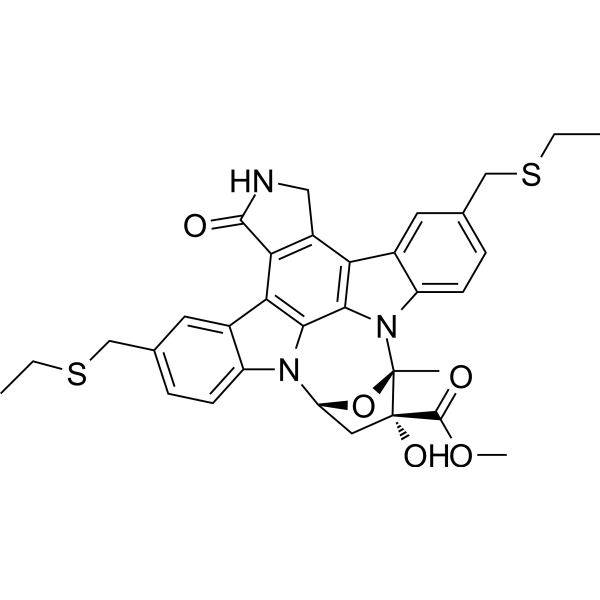
CEP-1347 is an inhibitor of the JNK/SAPK pathway with neuroprotective effects. CEP-1347 blocks JNK1 activation induced by members of the mixed lineage kinase (MLK) family (MLK3, MLK2, MLK1, dual leucine zipper kinase, and leucine zipper kinase). As an inhibitor of MDM4, CEP-1347 can more effectively inhibit the growth of glioma cells expressing wild-type p53 .
loading...
    loading...
Cat. No.: HY-P3585
CAS No.: 915091-83-7
Epobis, a dendrimeric peptide, is a recombinant form of erythropoietin. Epobis is a potent erythropoietin receptor agonist. Epobis promotes neuritogenesis in primary motoneurons. Epobis decrease TNF release and crosses the blood-brain barrier. Epobis has anti-inflammatory and memory enhancing properties .
loading...
    loading...
Cat. No.: HY-P3889
CAS No.: 51165-07-2
Target:  

Neurokinin Receptor

Research Areas:  

Neurological Disease

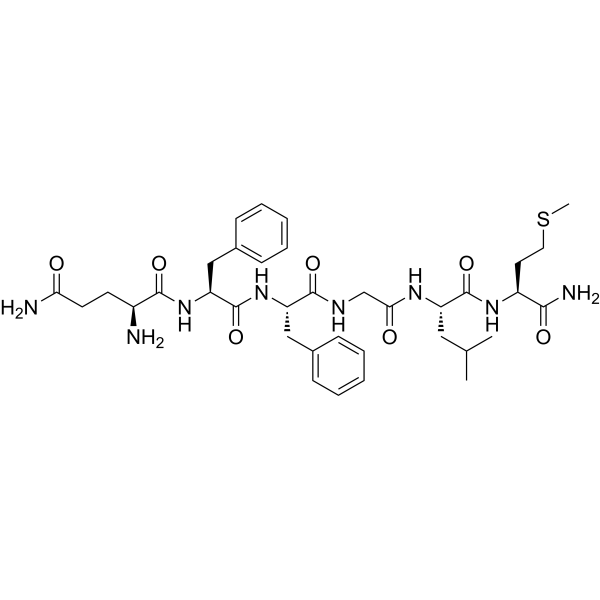
Substance P (6-11) is the C-terminal hexapeptideamide of Substance P (HY-P0201). Substance P (6-11) binds to NK-1 tachykinin receptor. Substance P (6-11) shows depolarization of motoneurons and a hypotensive effect .
loading...
    loading...
Cat. No.: HY-P1833
CAS No.: 117680-39-4
Target:  

Peptides

Research Areas:  

Neurological Disease

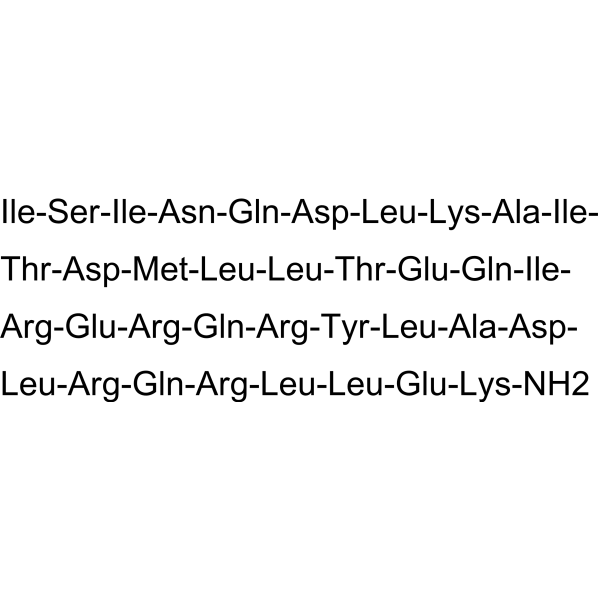
Egg Laying Hormone, aplysia is a neuropeptide synthesized by the bag cell neurons, which contains 36 amino acids and can stimulate egglaying and ovulation in Aplysia via electrical discharge triggering of neurons. Egg-laying hormone of Aplysia induces a voltage-dependent slow inward current carried by Na' in an identified motoneuron .
loading...
    loading...
Cat. No.: HY-P2135
CAS No.: 130092-56-7
Target:  

Peptides

Research Areas:  

Neurological Disease

Neuropeptide AF1 is a FMRFamide-like neuropeptide. Neuropeptide AF1 can be isolated from head extracts of the nematode Ascaris suum. Neuropeptide AF1 rapidly and reversibly abolishs slow membrane potential oscillations of identified ventral and dorsal inhibitory motoneurons and selectively reduces their input resistances. Neuropeptide AF1 inhibits locomotory movements in intact Ascaris .
loading...
    loading...

