9 Results for "

p-MEK

" in MedChemExpress (MCE) Product Catalog:
Products (9)

9 Results for "p-MEK" in MCE Product Catalog:

Cat. No.: HY-136420
CAS No.: 2413035-41-1
Purity:  99.90%
Target:  

PROTACs Raf Apoptosis

Research Areas:  

Cancer

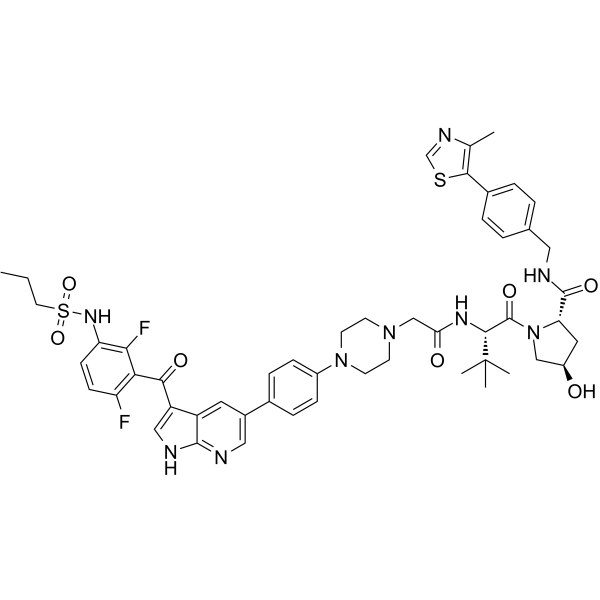
SJF-0628 is a RAF PROTAC degrader. SJF-0628 induces targeted degradation of BRAF in various cancer cell lines (colorectal cancer cell lines (Colo-205, LS-411N, HT-29, RKO) and triple-negative breast cancer cell line DU-4475). SJF-0628 decreases pMEK and pErk levels in DU-4475 cells. SJF-0628 has anti-tumor activity. SJF-0628 can be used for research of colorectal cancer and triple-negative breast cancer .
Cat. No.: HY-146127
CAS No.: 3069455-54-2
Target:  

MEK

Research Areas:  

Cancer

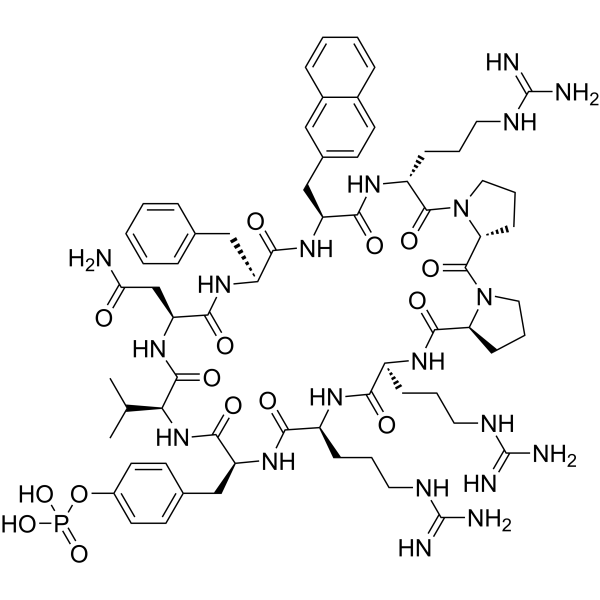
Grb2 SH2 domain inhibitor 1 is an inhibitor of the Grb2 SH2 domain with an IC50 of 0.40 μM. Grb2 SH2 domain inhibitor 1 is also a cell-permeable cyclic peptide that can enter the cytosol of mammalian cells. Grb2 SH2 domain inhibitor 1 downregulates the expression level of p-MEK. Grb2 SH2 domain inhibitor 1 can be used in the research of breast cancer .
Cat. No.: HY-146223
Purity:  99.52%
Target:  

Ras p38 MAPK PI3K Apoptosis

Research Areas:  

Cancer

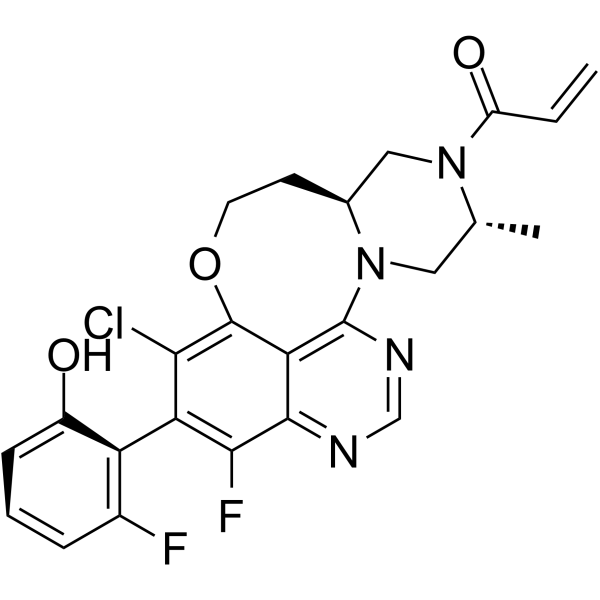
AZD4625 is an orally active, selective irreversible, covalent allosteric GTPase KRASG12C inhibitor with an IC50 of 3 nM. AZD4625 can inhibit the MAPK pathway (with decreased pCRAF, pMEK, and pERK) and the PI3K pathway (with decreased pAKT and pS6), and induce cell apoptosis. AZD4625 has no binding and inhibition of wild-type RAS or isoforms carrying non-KRASG12C mutations. AZD4625 can be used for the study of KRASG12C mutant non-small cell lung cancer .
Cat. No.: HY-179908
CAS No.: 3002056-26-7
Target:  

MEK

Research Areas:  

Cancer

MEK-IN-8 (Compound 30) is a MEK inhibitor (IC50: < 5 nM for pMEK in A549 cells). MEK-IN-8 can be used in tumor research .
Cat. No.: HY-179424
CAS No.: 3095636-64-6
PROTAC HIF-1α degrader-2 is a highly efficient and selective PROTAC degrader targeting HIF-1α. PROTAC HIF-1α degrader-2 promotes HIF-1α degradation via the ubiquitin-proteasome pathway by facilitating the formation of a HIF-1α/VHL ternary complex. PROTAC HIF-1α degrader-2 inhibits HeLa cell proliferation, migration, and colony formation, and induces apoptosis. PROTAC HIF-1α degrader-2 reduces p-MEK and p-AKT expression in the MAPK and PI3K/AKT pathways. PROTAC HIF-1α degrader-2 can be used for the study of cervical cancer .
Cat. No.: HY-146223A
Purity:  98.00%
Target:  

Ras PI3K p38 MAPK Apoptosis

Research Areas:  

Cancer

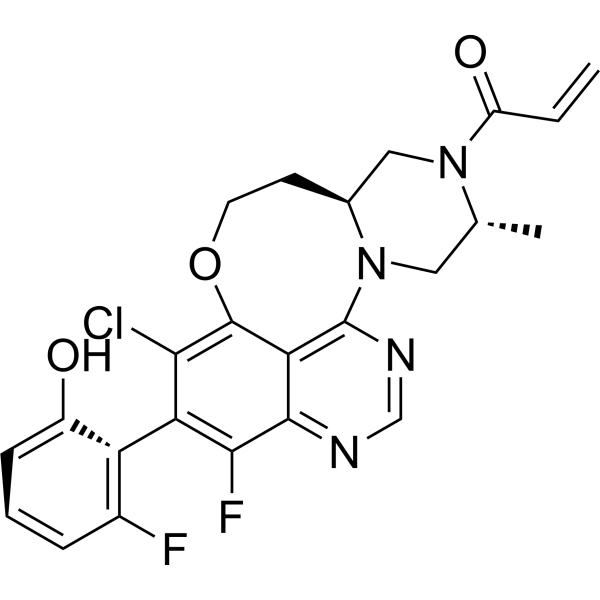
(3R,10R,14aS)-AZD4625 is the isomer of AZD4625 (HY-146223), and can be used as an experimental control. AZD4625 is an orally active, selective irreversible, covalent allosteric GTPase KRASG12C inhibitor with an IC50 of 3 nM. AZD4625 can inhibit the MAPK pathway (with decreased pCRAF, pMEK, and pERK) and the PI3K pathway (with decreased pAKT and pS6), and induce cell apoptosis. AZD4625 has no binding and inhibition of wild-type RAS or isoforms carrying non-KRASG12C mutations. AZD4625 can be used for the study of KRASG12C mutant non-small cell lung cancer .
Cat. No.: HY-161966
CAS No.: 3046428-94-5
Research Areas:  

Cancer

VEGFR-2-IN-52 (compound 14d) is a potent VEGFR-2 inhibitor with an IC50 value of 191.1 nM. VEGFR-2-IN-52 decreases the protein expression of p-VEGFR-2, MMP9, p-ERK1/2 and p-MEK1. VEGFR-2-IN-52 shows cytotoxicity. VEGFR-2-IN-52 induces apoptosis and cell cycle arrest at G0/G1 phase. VEGFR-2-IN-52 increases the levels of ROS .
Cat. No.: HY-143468
CAS No.: 2417022-06-9
Target:  

Apoptosis MEK

Research Areas:  

Cancer

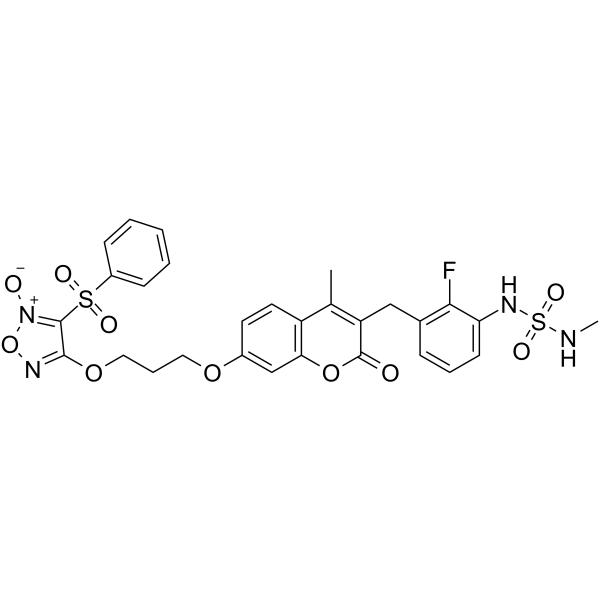
MEK-IN-5 is a potent MEK inhibitor and NO donor. MEK-IN-5 significantly reduces the levels of pMEK and pERK in a dose-dependent and time-dependent manner. MEK-IN-5 induces apoptosis in MDA-MB-231 cells .
Cat. No.: HY-182899
DPAP is a p-ERK1/2 inhibitor with an IC50 of 7.85 μM against p-ERK1/2. DPAP inhibits the expression of p-MEK1/2 and disrupts the Ras-ERK signaling pathway. DPAP inhibits the expression of COX-2 in nerve cells. DPAP damages DNA and mitochondria, induces Apoptosis via the mitochondrial pathway, and upregulates PD-L1. DPAP inhibits melanoma metastasis and angiogenesis, and inactivates spinal microglia and astrocytes. DPAP exhibits anti-melanoma activity and can be combined with anti-PD-1 monoclonal antibodies to modify anti-tumor effects. DPAP is applicable for the research of melanoma .

