



15 Results for "

starch hydrolysis

" in MedChemExpress (MCE) Product Catalog:
Products (15)

15 Results for "starch hydrolysis" in MCE Product Catalog:

2
2 Cited Publications
Cat. No.: HY-B2193
CAS No.: 9000-90-2
α-Amylase is a hydrolase enzyme that catalyses the hydrolysis of internal α-1, 4-glycosidic linkages in starch to yield products like glucose and maltose.
loading...
    loading...
Cat. No.: HY-W145519
CAS No.: 9005-27-0
Hydroxyethyl starch (MW170-230 kDa) is a type of hydroxyethyl starch with a molecular weight of 170-230 kDa. A medium-molecular-weight hydroxyethyl starch (HES 200/0.62) exhibits minimal intravascular hydrolysis. The rapidly degradable medium-molecular-weight Hydroxyethyl starch 200/0.5 causes almost no coagulation disorders and improves hemorheological parameters .
loading...
    loading...
Cat. No.: HY-W115731
CAS No.: 9004-53-9
Dextrins are a group of low molecular weight carbohydrates produced by the hydrolysis of starch. Dextrin is commonly used as a thickener, stabilizer or binder in a variety of foods including baked goods, beverages and confectionary. In addition, it is used in the production of adhesives, paper and textiles. Its unique chemical properties make it an important ingredient in a variety of industrial processes, especially in construction and packaging.
loading...
    loading...
Cat. No.: HY-B2192
CAS No.: 9000-92-4
Amylase is an enzyme produced by pancreas and salivary glands, catalyzing the hydrolysis of starch into sugars. Amylase are broadly classified into α, β, and γ subtypes .
loading...
    loading...
Cat. No.: HY-P2968
CAS No.: 9000-85-5
Target:  

Amylases

Research Areas:  

Others

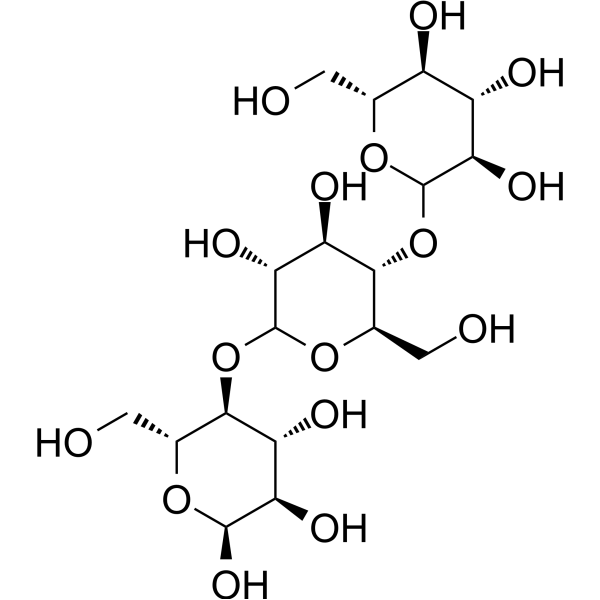
Bacterial α-Amylase catalyses the hydrolysis of internal α-1,4-glycosidic linkages in starch in low molecular weight products, such glucose, maltose and maltotriose units. Bacterial α-Amylase is often used in biochemical studies .
loading...
    loading...
Cat. No.: HY-N6675
CAS No.: 94238-00-3
Gardenia yellow is a competitive inhibitor of α-Amylase (HY-B2193) and α-glucosidase. Gardenia yellow can bind to the catalytic sites of α-Amylase and α-glucosidase, inhibit starch digestion, and significantly increase the contents of resistant starch and slowly digestible starch in starch-based systems. Gardenia yellow reduces the glycemic index and hydrolysis index. Gardenia yellow can be used in diabetes-related research .
loading...
    loading...
Cat. No.: HY-B2193A
CAS No.: 9000-90-2
Synonyms: 1,4-alpha-D-Glucan-glucanohydrolase, ptyalin
α-Amylase, Human Saliva (1,4-alpha-D-Glucan-glucanohydrolase) is a hydrolase enzyme that can be isolated from human saliva. α-Amylase, Human Saliva catalyses the hydrolysis of internal α-1, 4-glycosidic linkages in starch to yield products like glucose and maltose. α-Amylase, Human Saliva can be used in life science research .
loading...
    loading...
Cat. No.: HY-B2193C
CAS No.: 9000-90-2
Synonyms: 1,4-alpha-D-Glucan-glucanohydrolase, amy2, PPA, PA
Research Areas:  

Others

α-Amylase, Porcine Pancreatic (1,4-alpha-D-Glucan-glucanohydrolase) is a hydrolase enzyme that can be isolated from porcine pancreatic. α-Amylase, Porcine Pancreatic catalyses the hydrolysis of internal α-1, 4-glycosidic linkages in starch to yield products like glucose and maltose. α-Amylase, Porcine Pancreatic can be used in life science research .
loading...
    loading...
Cat. No.: HY-B2193B
CAS No.: 9000-90-2
Synonyms: Amylase, a-Amylase, 1,4-a-D-glucan glucanohydrolase, glycogenase
Research Areas:  

Others

α-Amylase, Human Pancreas (Amylase) is a hydrolase enzyme that can be isolated from human pancreas. α-Amylase, Human Pancreas catalyses the hydrolysis of internal α-1, 4-glycosidic linkages in starch to yield products like glucose and maltose. α-Amylase, Human Pancreas can be used in life science research .
loading...
    loading...
Cat. No.: HY-B2192A
CAS No.: 9000-92-4
Synonyms: Maltin
Research Areas:  

Others

Diastase, Aspergillus oryzae (Maltin) is a starch hydrolase derived from Aspergillus oryzae. Diastase, Aspergillus oryzae catalyzes starch hydrolysis through sequential stages, first producing dextrins, then glucose and maltose .
loading...
    loading...
Cat. No.: HY-N8326
CAS No.: 6471-60-9
Target:  

Others

Maltononaose is a linear oligosaccharide consisting of 9 glucose units linked by alpha-1, 4-glucoside bonds. Maltononaose is used as a substrate to study the subsites affinity of glucoamylase. Maltononaose can be used to determine the activity of amylase and to optimize the process of starch hydrolysis .
loading...
    loading...
Cat. No.: HY-E70118
CAS No.: 9032-15-9
Target:  

Glycosidase

Research Areas:  

Others

oligo-α-1,6-Glucosidase, Bacillus cereus ATCC7064 is a hydrolase that mainly hydrolyzes oligosaccharides with α-1,6-glycosidic bonds. oligo-α-1,6-Glucosidase, Bacillus cereus ATCC7064 can catalyzes the exo hydrolysis of α-1,6-glucoside bonds from the nonreducing ends of panose, palatinose, α-limit dextrins, and isomaltooligosaccharides. oligo-α-1,6-Glucosidase, Bacillus cereus ATCC7064 participates in the degradation pathway of starch and glycogen, assisting enzymes such as α-amylase to completely hydrolyzes amylopectin .
loading...
    loading...
Cat. No.: HY-W019938
CAS No.: 7785-84-4
Synonyms: Trisodium cyclo-triphosphate
Target:  

Others

Research Areas:  

Others

Sodium trimetaphosphate (Trisodium cyclo-triphosphate) is an orally active, multifunctional compound. Sodium trimetaphosphate serves as a buffer and chelating agent in cosmetics, a starch modifier in food, and can also act as a bone imaging agent. Sodium trimetaphosphate undergoes alkaline hydrolysis, with the rate-limiting first step producing sodium tripolyphosphate; the conversion rate is low when sodium carbonate or silicate is used. Sodium trimetaphosphate can be used in caries-related research .
loading...
    loading...
Cat. No.: HY-N18049
CAS No.: 20882-69-3
Decussatin is an α-Amylases inhibitor isolated from the Tibetan medicinal plant Swertia mussotii. By inhibiting the catalytic activity of α-Amylases, Decussatin reduces the hydrolysis of complex carbohydrates such as starch and the intestinal absorption of glucose, thereby lowering blood glucose levels in the body. Decussatin shows no significant in vitro antibacterial or antifungal activity. Decussatin can be used for the research of type 2 diabetes .
loading...
    loading...
Cat. No.: HY-P11904
LADW is a tetrapeptide derived from the hydrolysate of tuna skeletal muscle myosin, with dual inhibitory activities against angiotensin-converting enzyme 1 (ACE1) and α-glucosidase. The IC50 value of LADW against ACE1 is 28.02 μM, while its IC50 value against Saccharomyces cerevisiae α-glucosidase is 4.40 mM. LADW binds competitively to the active site of ACE1, stabilizes the enzyme conformation, and blocks substrate binding. LADW binds to α-glucosidase to inhibit carbohydrate hydrolysis and can also alter starch structure. LADW can be used in studies related to hypertension and diabetes .
loading...
    loading...
  • 1

