



TAS4464
Based on 10 publication(s) in Google Scholar
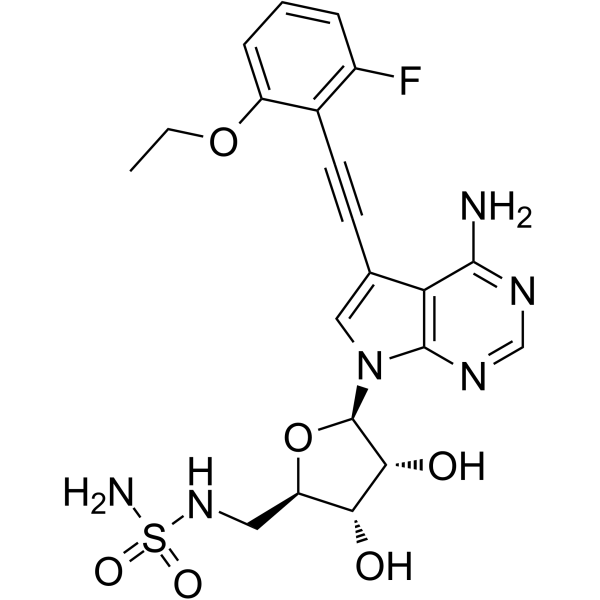
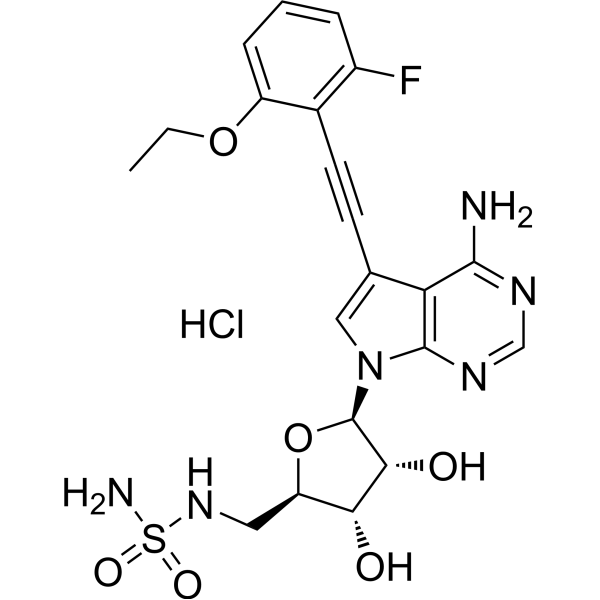
TAS4464 is a long-acting, highly selective covalent inhibitor targeting NEDD8-activating enzyme (NAE) (IC50=0.955 nM), and also inhibits CAII with an IC50 of 0.73 μM, which is less potent than MLN4924 (HY-70062). The IC50 values of TAS4464 against other E1 enzymes UAE and SAE are 449 nM and 1280 nM, respectively. TAS4464 targets NEDD8 in an ATP-dependent manner to inhibit NAE, blocks the neddylation pathway, causes accumulation of CRL ubiquitin ligase substrates (such as CDT1, p27, phosphorylated IκBα), and further induces tumor cell apoptosis. TAS4464 exhibits antiproliferative and cytotoxic effects, and has broad-spectrum antitumor activity against various hematologic and solid tumor cell lines as well as patient-derived tumor cells. TAS4464 has a wide selcetive window, without obvious toxicity. TAS4464 can be used in the research of hematologic malignancies (leukemia, lymphoma, multiple myeloma, etc.) and solid tumors (small cell lung cancer, colorectal cancer, sarcoma, endometrial cancer, ovarian cancer, etc.).
For research use only. We do not sell to patients.
- Purity: 98.69%
- CAS No.: 1848959-10-3
- Formula: C21H23FN6O6S
- Molecular Weight:506.51
-
Storage:Powder -20°C, 3 years , 4°C, 2 years ; In solvent -80°C, 2 years , -20°C, 1 year

To place orders, for customer services and technical support, please contact: MedChemExpress USA
Tel: 609-228-6898 E-mail: [email protected] [email protected]


-
 Biological Activity
-
Chemical Information
-
Solvent & Solubility
- Purity & Documentation
- References
-
 Help & FAQs


Publications Citing Use of MedChemExpress (MCE) TAS4464
More- Nat Commun. 2024 Jan 11;15(1):468. [Abstract]
- Cell Death Dis. 2025 Mar 31;16(1):228. [Abstract]
- Proc Natl Acad Sci U S A. 2022 Feb 8;119(6):e2111737119. [Abstract]
- Sci Data. 2024 Sep 19;11(1):1024. [Abstract]
- Biochim Biophys Acta Mol Basis Dis. 2026 Apr 15;1872(6):168261. [Abstract]
- Biochim Biophys Acta Mol Basis Dis. 2024 Jun 11;1870(7):167292. [Abstract]
- Sci Rep. 2025 May 30;15(1):18978. [Abstract]
- Viruses. 2021 Aug 14;13(8):1610. [Abstract]
- Seoul National University. 2025.
- Biomed Pharmacother. 2025 Oct 3:192:118622. [Abstract]


Biological Activity
IC50:0.955 nM (NAE)[1]
TAS4464 is a highly potent and selective recombinant NAE inhibitor, with over 470-fold and 1340-fold selectivity against recombinant UAE and SAE, respectively, and weak off-target inhibitory activity against CA2[1].
TAS4464 (1-10 μM; 24-48 h) induces apoptosis in leukemia, lymphoma, multiple myeloma and solid tumor cell lines, with the apoptosis rate increasing as the drug concentration rises[1].
TAS4464 (1 nM-1 μM, 4 h; 100 nM, 1-24 h) significantly increases the protein expression levels of CRL ubiquitin ligase substrates CDT1, p27, and phosphorylated IκBα in tumor cells, while reduces the level of cullin neddylation modification[1].
TAS4464 (0.1-10 μM; 24-48 h) significantly inhibits the migratory capacity of solid tumor cell lines such as colorectal cancer and sarcoma, with a concentration-dependent inhibitory effect[1].
MedChemExpress (MCE) has not independently confirmed the accuracy of these methods. They are for reference only.
TAS4464 (100 mg/kg; i.v.; administered on days 1, 4, 8 and 11, with one cycle every 21 days; 8 cycles total) hydrochloride significantly prolongs survival and reduces tumor burden in a systemic diffuse large B-cell lymphoma model of SCID mice xenografted with TMD8-Luc[1].
MedChemExpress (MCE) has not independently confirmed the accuracy of these methods. They are for reference only.
| NCT Number | Sponsor | Condition | Start Date |
Phase

|
|---|---|---|---|---|
| NCT01329991 | Plexxikon| | 2011-05 | PHASE1 |


Chemical Information
-
CAS No. 1848959-10-3
-
Appearance Solid
-
Molecular Weight 506.51
-
Formula C21H23FN6O6S
-
Color Off-white to light yellow
-
SMILES
NC1=NC=NC2=C1C(C#CC3=C(F)C=CC=C3OCC)=CN2[C@@H]4O[C@H](CNS(=O)(N)=O)[C@@H](O)[C@H]4O
-
Shipping
Room temperature in continental US; may vary elsewhere.
-
Storage
Powder -20°C 3 years 4°C 2 years In solvent -80°C 2 years -20°C 1 year


Publications (10)
-
Journal Impact Factor
-
Most Recent
-
Nat Commun
Diabetic sensory neuropathy and insulin resistance are induced by loss of UCHL1 in Drosophila. [Abstract]2024 Jan 11;15(1):468. PMID: 38212312 -
Cell Death Dis
NUB1 reduction promotes PCNA-mediated tumor growth by disturbing the PCNA polyubiquitination/NEDDylation in hepatocellular carcinoma cells. [Abstract]2025 Mar 31;16(1):228. PMID: 40164590 -
Proc Natl Acad Sci U S A
Cullin neddylation inhibitor attenuates hyperglycemia by enhancing hepatic insulin signaling through insulin receptor substrate stabilization. [Abstract]2022 Feb 8;119(6):e2111737119. PMID: 35115401 -
Sci Data
High-throughput drug screening identifies novel therapeutics for Low Grade Serous Ovarian Carcinoma. [Abstract]2024 Sep 19;11(1):1024. PMID: 39300112 -
Biochim Biophys Acta Mol Basis Dis
2026 Apr 15;1872(6):168261. PMID: 41990488 -
Biochim Biophys Acta Mol Basis Dis
Inhibition of neddylation disturbs zygotic genome activation through histone modification change and leads to early development arrest in mouse embryos. [Abstract]2024 Jun 11;1870(7):167292. PMID: 38871031 -
Sci Rep
Neddylation status determines the therapeutic sensitivity of tyrosine kinase inhibitors in chronic myeloid leukemia. [Abstract]2025 May 30;15(1):18978. PMID: 40447744 -
Viruses
Nedd8-Activating Enzyme Is a Druggable Host Dependency Factor of Human and Mouse Cytomegalovirus. [Abstract]2021 Aug 14;13(8):1610. PMID: 34452475 -
-
Biomed Pharmacother
TAS4464, a neddylation inhibitor, mitigates Staphylococcus aureus-induced periprosthetic joint infection by modulating immunosuppressive cell functions. [Abstract]2025 Oct 3:192:118622. PMID: 41045650


Solvent & Solubility
DMSO : 40 mg/mL (78.97 mM; Need ultrasonic; Hygroscopic DMSO has a significant impact on the solubility of product, please use newly opened DMSO)
Please refer to the solubility information to select the appropriate solvent. Once prepared, please aliquot and store the solution to prevent product inactivation from repeated freeze-thaw cycles.
Storage method and period of stock solution: -80°C, 2 years; -20°C, 1 year. When stored at -80°C, please use it within 2 years. When stored at -20°C, please use it within 1 year.
Please refer to the solubility information to select the appropriate solvent. Once prepared, please aliquot and store the solution to prevent product inactivation from repeated freeze-thaw cycles.
Storage method and period of stock solution: -80°C, 2 years; -20°C, 1 year. When stored at -80°C, please use it within 2 years. When stored at -20°C, please use it within 1 year.
Concentration (start) × Volume (start) = Concentration (final) × Volume (final)
Select the appropriate dissolution method based on your experimental animal and administration route.
- For the following dissolution methods, please ensure to first prepare a clear stock solution using an In Vitro approach and then sequentially add co-solvents:
- To ensure reliable experimental results, the clarified stock solution can be appropriately stored based on storage conditions. As for the working solution for In Vivo experiments, it is recommended to prepare freshly and use it on the same day.
- The percentages shown for the solvents indicate their volumetric ratio in the final prepared solution. If precipitation or phase separation occurs during preparation, heat and/or sonication can be used to aid dissolution.
Add each solvent one by one: 10% DMSO 40% PEG300 5% Tween-80 45% Saline
Solubility: ≥ 2 mg/mL (3.95 mM); Clear solution
This protocol yields a clear solution of ≥ 2 mg/mL (saturation unknown).
Taking 1 mL working solution as an example, add 100 μL DMSO stock solution (20.0 mg/mL) to 400 μL PEG300, and mix evenly; then add 50 μL Tween-80 and mix evenly; then add 450 μL Saline to adjust the volume to 1 mL.
Preparation of Saline: Dissolve 0.9 g sodium chloride in ddH₂O and dilute to 100 mL to obtain a clear Saline solution.
Add each solvent one by one: 10% DMSO 90% (20% SBE-β-CD in Saline)
Solubility: ≥ 2 mg/mL (3.95 mM); Clear solution
This protocol yields a clear solution of ≥ 2 mg/mL (saturation unknown).
Taking 1 mL working solution as an example, add 100 μL DMSO stock solution (20.0 mg/mL) to 900 μL 20% SBE-β-CD in Saline, and mix evenly.
Preparation of 20% SBE-β-CD in Saline (4°C, storage for one week): 2 g SBE-β-CD powder is dissolved in 10 mL Saline, completely dissolve until clear.
Please enter the basic information of animal experiments:
-
-
-
-
Recommended: Prepare an additional quantity of animals to account for potential losses during experiments.
Please enter your animal formula composition:
-
%DMSO +
Recommended: Keep the proportion of DMSO in working solution below 2% if your animal is weak.
-
%+
-
+%Tween-80 + +
-
%Saline +
The co-solvents required include: DMSO, . All of co-solvents are available by MedChemExpress (MCE). , Tween 80. All of co-solvents are available by MedChemExpress (MCE).
Working solution concentration: 0.22 mg/mL
Method for preparing stock solution: mg drug dissolved in μL DMSO. Stock solution concentration: mg/mL.
1. Take μL DMSO stock solution;
2. Add μL .
μL , mix evenly;
3. Then add μL Tween 80, mix evenly;
4. Then add μL
Please ensure that the stock solution in the first step is dissolved to a clear state, and add co-solvents in sequence. You can use ultrasonic heating (ultrasonic cleaner, recommended frequency 20-40 kHz), vortexing, etc. to assist dissolution.


Purity & Documentation
-
Data Sheet (283 KB)
-
SDS (393 KB)
- English - EN (393 KB)
- Français - FR (393 KB)
- Deutsch - DE (393 KB)
- Norwegian - NO (393 KB)
- Español - ES (393 KB)
- Swedish - SV (393 KB)
- Italian - IT (393 KB)
- Korean - KR (393 KB)
- Portuguese - PT (393 KB)
-
Handling Instructions (2659 KB)
References


Complete Stock Solution Preparation Table
Please refer to the solubility information to select the appropriate solvent. Once prepared, please aliquot and store the solution to prevent product inactivation from repeated freeze-thaw cycles.
Storage method and period of stock solution: -80°C, 2 years; -20°C, 1 year. When stored at -80°C, please use it within 2 years. When stored at -20°C, please use it within 1 year.
| Optional Solvent | Concentration Solvent Mass | 1 mg | 5 mg | 10 mg | 25 mg |
|---|---|---|---|---|---|
| DMSO | 1 mM | 1.9743 mL | 9.8715 mL | 19.7429 mL | 49.3574 mL |
| 5 mM | 0.3949 mL | 1.9743 mL | 3.9486 mL | 9.8715 mL | |
| 10 mM | 0.1974 mL | 0.9871 mL | 1.9743 mL | 4.9357 mL | |
| 15 mM | 0.1316 mL | 0.6581 mL | 1.3162 mL | 3.2905 mL | |
| 20 mM | 0.0987 mL | 0.4936 mL | 0.9871 mL | 2.4679 mL | |
| 25 mM | 0.0790 mL | 0.3949 mL | 0.7897 mL | 1.9743 mL | |
| 30 mM | 0.0658 mL | 0.3290 mL | 0.6581 mL | 1.6452 mL | |
| 40 mM | 0.0494 mL | 0.2468 mL | 0.4936 mL | 1.2339 mL | |
| 50 mM | 0.0395 mL | 0.1974 mL | 0.3949 mL | 0.9871 mL | |
| 60 mM | 0.0329 mL | 0.1645 mL | 0.3290 mL | 0.8226 mL |


TAS4464 Related Classifications
HY-128586 Related Classifications
 Powered by Bioz