



CA VB
CA VB (CA5B) is a mitochondrial carbonic anhydrase isoform that catalyzes CO2 hydration to support bicarbonate-dependent metabolism[1][2]. Mechanistically, CA VB contributes to Krebs cycle anaplerosis by supporting mitochondrial oxaloacetate synthesis in pancreatic β cells[3]. In mouse islets and Min6 β cells, thiazides inhibited glucose- and sulfonylurea-stimulated insulin secretion through CA5B inhibition[3]. CA5B knockout mice resisted thiazide-induced glucose intolerance, which identifies CA VB as the functional thiazide-sensitive isoform in this β-cell model[3]. Compared with CA VA, CA VB shows broader tissue distribution, whereas CA VA is most highly expressed in liver and has a predominant role in ammonia detoxification[2]. This isoform distinction matters because CA5A sequencing identified disease-causing variants in early-onset metabolic crisis, while the same cohort found none in CA5B[4]. CA VB also differs pharmacologically from CA VA, because human CA VB shows greater sensitivity to anion inhibitors and a distinct bicarbonate inhibition profile[5]. For experimental applications, CA VA/VB inhibitors reduced paclitaxel-induced neuropathic pain and improved mitochondrial dysfunction in mice[6]. In cerebrovascular models, CA VB inhibition or deletion reduced amyloid- and tau-linked endothelial dysfunction, BBB disruption, and inflammatory activation[7].
References:
- [1]. Supuran CT. Carbonic anhydrase inhibitors and their potential in a range of therapeutic areas. Expert Opin Ther Pat. 2018 Oct;28(10):709-712. doi: 10.1080/13543776.2018.1523897. Epub 2018 Sep 19. PMID: 30217119. et al. Carbonic anhydrase inhibitors and their potential in a range of therapeutic areas. Expert Opin Ther Pat. 2018 Oct;28(10):709-712. [Content Brief]
- [2]. Aspatwar A, et al. Mitochondrial carbonic anhydrase VA and VB: properties and roles in health and disease. J Physiol. 2023 Jan;601(2):257-274. [Content Brief]
- [3]. Kucharczyk P, et al. Thiazides Attenuate Insulin Secretion Through Inhibition of Mitochondrial Carbonic Anhydrase 5b in β -Islet Cells in Mice. J Am Soc Nephrol. 2023 Jul 1;34(7):1179-1190. [Content Brief]
- [4]. Diez-Fernandez C, et al. Defective hepatic bicarbonate production due to carbonic anhydrase VA deficiency leads to early-onset life-threatening metabolic crisis. Genet Med. 2016 Oct;18(10):991-1000. [Content Brief]
- [5]. Nishimori I, et al. Carbonic anhydrase inhibitors: the inhibition profiles of the human mitochondrial isoforms VA and VB with anions are very different. Bioorg Med Chem. 2007 Nov 1;15(21):6742-7. [Content Brief]
- [6]. Micheli L, et al. Inhibitors of Mitochondrial Human Carbonic Anhydrases VA and VB as a Therapeutic Strategy against Paclitaxel-Induced Neuropathic Pain in Mice. Int J Mol Sci. 2022 Jun 2;23(11):6229. [Content Brief]
- [7]. Rabezanahary H, et al. Live virus neutralizing antibodies against pre and post Omicron strains in food and retail workers in Québec, Canada. Heliyon. 2024 May 21;10(10):e31026. [Content Brief]
All Product Categories
-
CA VB Related Products (2)
Related Products (2)

-
Elsulfavirine
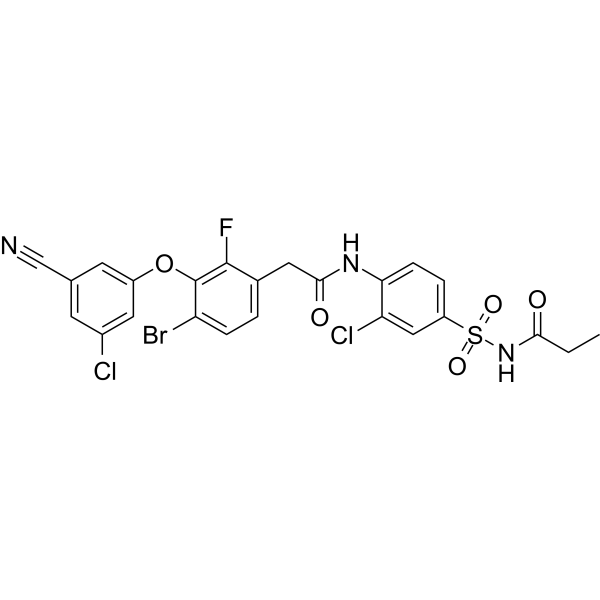 0 ImagesSynonyms: R-1206Elsulfavirine (R-1206) is an orally active human carbonic anhydrase (carbonic anhydrase, CA) inhibitor and an allosteric inhibitor of HIV-1 non-nucleoside reverse transcriptase (NNRT). Elsulfavirine also targets and blocks the interaction between adenylosuccinate lyase (ADSL) and insulin-induced gene proteins INSIG1/2, blocks SREBP-1-mediated de novo lipid synthesis, and inhibits the proliferation of liver cancer cells. The combination of Elsulfavirine and Lenvatinib (HY-10981) produces a synergistic anti-tumor effect. Elsulfavirine is converted into the active metabolite VM1500A in vivo, blocks the DNA polymerase activity of reverse transcriptase, and inhibits HIV-1 replication. Elsulfavirine exhibits a Ki of 1960 nM-52400 nM against human carbonic anhydrase isoforms including I, VII, VI, VA, VB, IX, XIII, XIV. Elsulfavirine is used in studies related to HIV-1 infection and liver cancer.
-
Elsulfavirine sodium
 0 ImagesCat. No.: HY-109056ACAS No.: 867365-40-0Synonyms: R-1206 sodiumElsulfavirine sodium (R-1206) is an orally active human carbonic anhydrase (carbonic anhydrase, CA) inhibitor and an allosteric inhibitor of HIV-1 non-nucleoside reverse transcriptase (NNRT). Elsulfavirine sodium also targets and blocks the interaction between adenylosuccinate lyase (ADSL) and insulin-induced gene proteins INSIG1/2, blocks SREBP-1-mediated de novo lipid synthesis, and inhibits the proliferation of liver cancer cells. The combination of Elsulfavirine sodium and Lenvatinib (HY-10981) produces a synergistic anti-tumor effect. Elsulfavirine sodium is converted into the active metabolite VM1500A in vivo, blocks the DNA polymerase activity of reverse transcriptase, and inhibits HIV-1 replication. Elsulfavirine sodium exhibits a Ki of 1960 nM-52400 nM against human carbonic anhydrase isoforms including I, VII, VI, VA, VB, IX, XIII, XIV. Elsulfavirine sodium is used in studies related to HIV-1 infection and liver cancer.



