



α-Lactose hydrate

Based on 1 Customer Validation
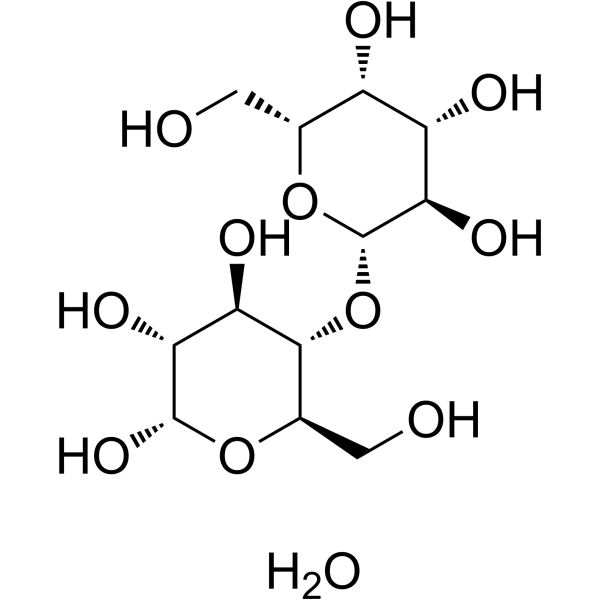
α-Lactose hydrate (α-D-Lactose (hydrate)) is the primary carbohydrate in the milk of most mammals. α-Lactose hydrate consists of glucose and galactose and exists in two isomeric forms, α and β. α-Lactose hydrate has numerous applications in the food and pharmaceutical industries, such as serving as a bulking or agglomerating agent, and a diluent for pigments, flavors or enzymes.
For research use only. We do not sell to patients.
- Purity : 98.0%
- CAS No.: 5989-81-1
- Formula: C12H24O12
- Molecular Weight:360.31
-
Storage:Powder -20°C, 3 years , 4°C, 2 years ; In solvent -80°C, 6 months , -20°C, 1 month

To place orders, for customer services and technical support, please contact: MedChemExpress USA
Tel: 609-228-6898 E-mail: [email protected] [email protected]


-
 Biological Activity
-
Chemical Information
-
Solvent & Solubility
- Purity & Documentation
- References
-
 Help & FAQs


-
HY-N2024A
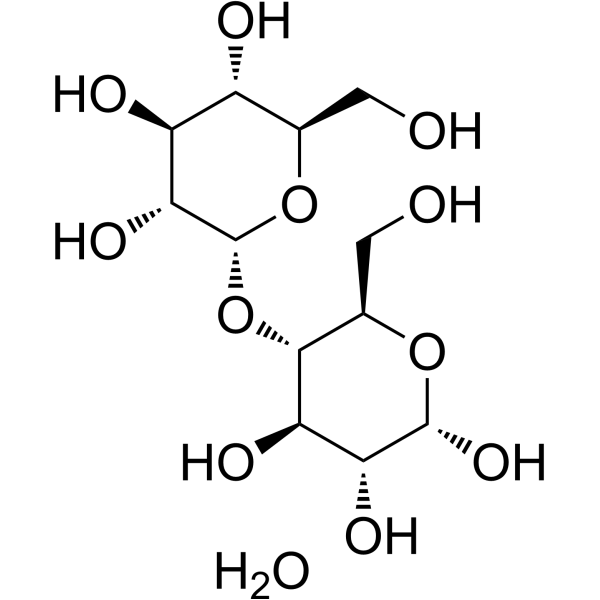
Maltose monohydrateDegradative Product of Starch -
HY-B0400
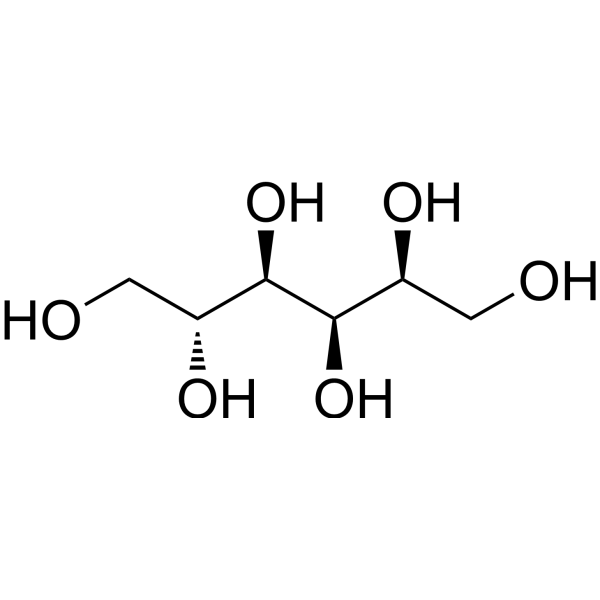
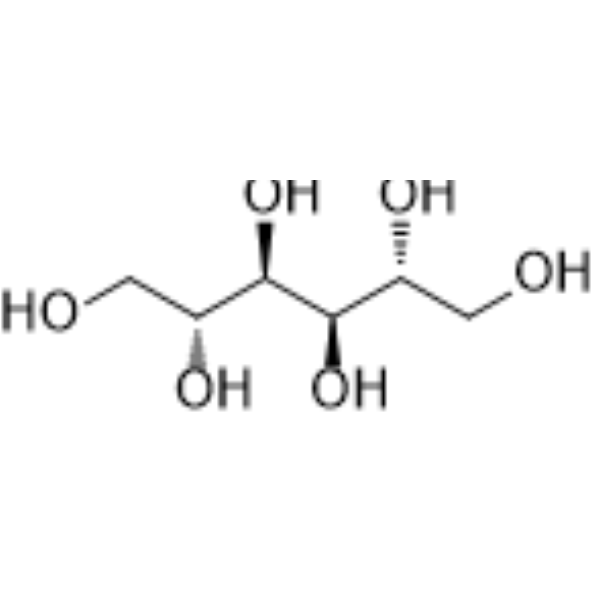
D-SorbitolSugar Alcohol -

HY-W087904R
α-Lactose hydrate (Standard)Suger -
HY-B0400B
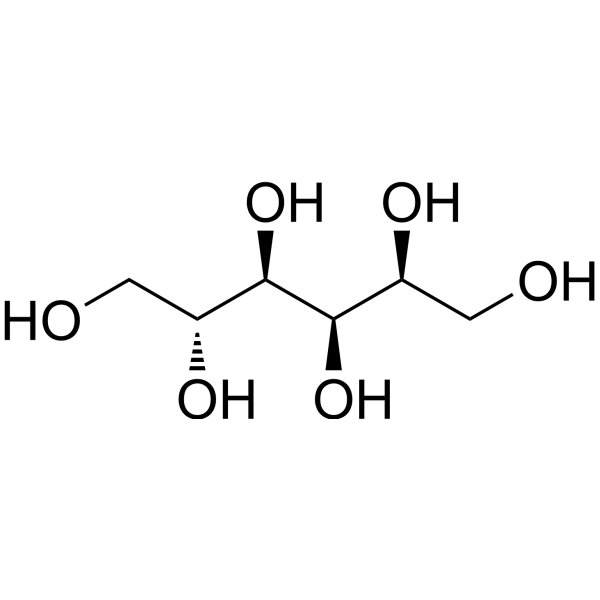
D-Sorbitol, for cell cultureSix-Carbon Sugar Alcohol -

HY-B0400R
D-Sorbitol (Standard)Sugar Alcohol -

HY-N2024AR
Maltose monohydrate (Standard)Standard of Maltose monohydrate -
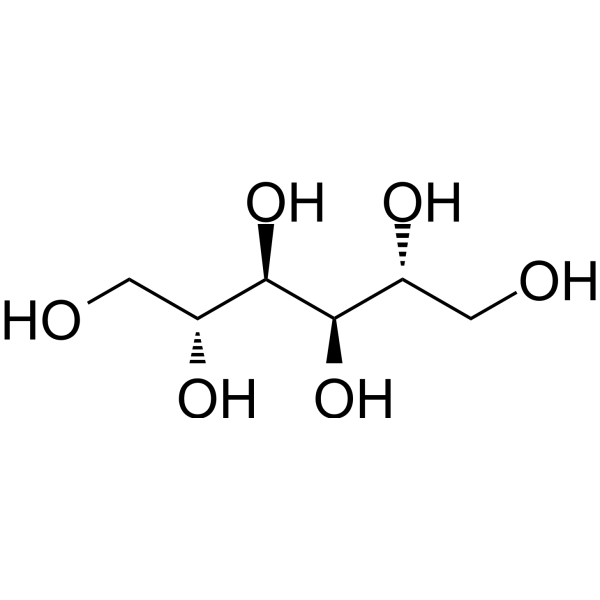
HY-N0378
D-MannitolResistant Sugar/Osmotic Diuretics -
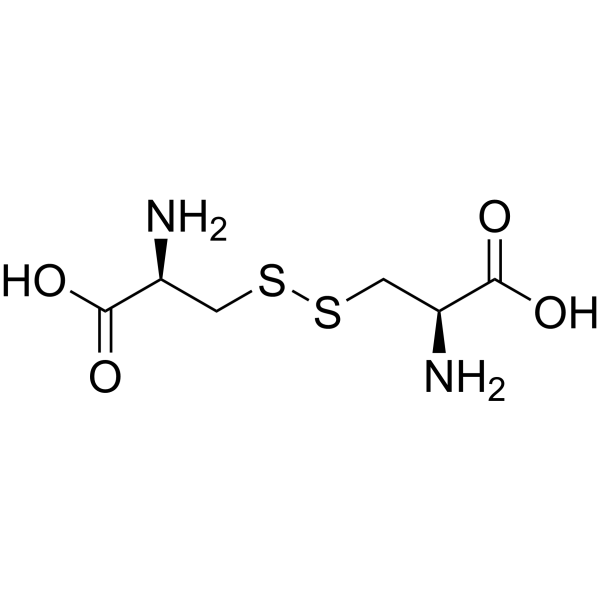
HY-N0394
L-CystineNrf2 Activator/ROS Inhibitor -
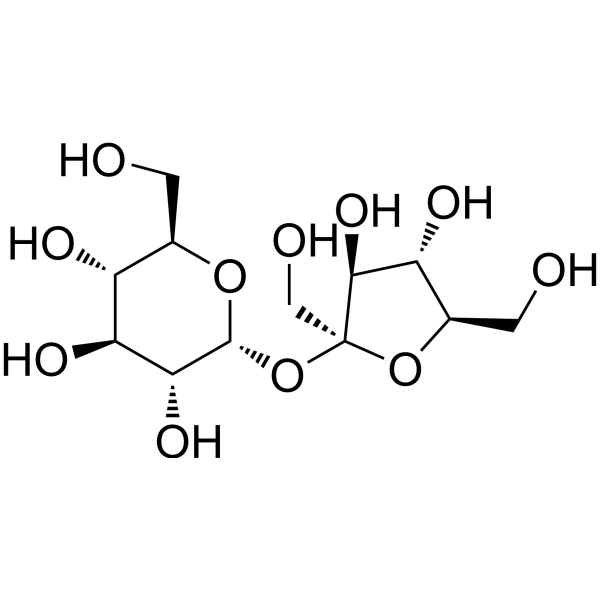
HY-B1779
SucroseDisaccharide -

HY-N0394R
L-Cystine (Standard)Endogenous Metabolite; Nrf2 Activator; ROS Inhibitor -
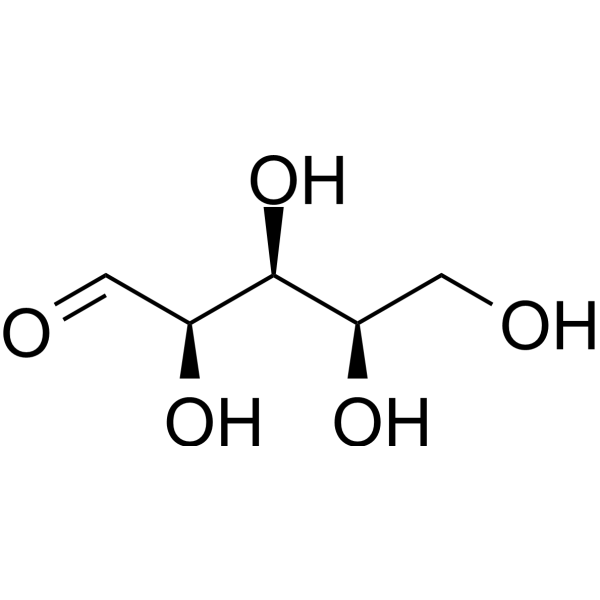
HY-N0537
XyloseEndogenous Metabolite -
HY-N0378R
D-Mannitol (Standard)Resistant Sugar/Osmotic Diuretics
All Endogenous Metabolite Isoforms
More

Biological Activity
Description
IC50 & Target
|
Human Endogenous Metabolite |
In Vitro
α-Lactose hydrate crystal lattice energy is -25.05 kcal mol-1, dominated by van der Waals interactions, with its top five intrinsic intermolecular synthons collectively accounting for 68% of total lattice stability[1].
α-Lactose hydrate crystal faces exhibit varying attachment energies and surface energies, with the {020} face having the lowest attachment energy (-8.01 kcal mol−1) and highest synthon saturation (68.00%), corresponding to the slowest growth and dominant presence in experimental tomahawk crystals[1].
α-Lactose hydrate has (010) crystal surface to which β-lactose binds more strongly (average total binding energy -15.83 kcal mol-1) than to the (0-10) surface (average total binding energy -12.79 kcal mol-1), leading to asymmetric inhibition of crystal growth and the characteristic tomahawk morphology[1].
α-Lactose hydrate (47.7% (w/w); heated to 70 °C for 30 min, then cooled to 25 °C) crystallized from aqueous solution forms crystals with a polar tomahawk morphology dominated by {020} and {001} faces[1].
α-Lactose hydrate (1.5 g; column conditioned at 30 °C for 2 h) has measured total surface energies ranging from 67.2 to 81.7 mJ m−2 at surface coverages of 1% to 20%, with values decreasing as surface coverage increases[1].
α-Lactose hydrate crystals exhibit morphology-dependent surface energies, with elongated tabular crystals having the lowest total surface energy (79.2 mJ m−2), followed by triangular (85.3 mJ m−2) and tomahawk (88.5 mJ m−2) crystals[1].
MedChemExpress (MCE) has not independently confirmed the accuracy of these methods. They are for reference only.


Chemical Information
-
CAS No. 5989-81-1
-
Appearance Solid
-
Molecular Weight 360.31
-
Formula C12H24O12
-
Color White to off-white
-
SMILES
OC[C@@H](O[C@@H]([C@@H]([C@H]1O)O)O)[C@H]1O[C@@H]2O[C@@H]([C@@H]([C@@H]([C@H]2O)O)O)CO.O
-
Synonyms
α-D-Lactose hydrate
-
Structure Classification
-
Initial Source
milk of humans and domestic animals
-
Shipping
Room temperature in continental US; may vary elsewhere.
-
Storage
Powder -20°C 3 years 4°C 2 years In solvent -80°C 6 months -20°C 1 month


Solvent & Solubility
In Vitro:
DMSO : 100 mg/mL (277.54 mM; Need ultrasonic; Hygroscopic DMSO has a significant impact on the solubility of product, please use newly opened DMSO)
Please refer to the solubility information to select the appropriate solvent. Once prepared, please aliquot and store the solution to prevent product inactivation from repeated freeze-thaw cycles.
Storage method and period of stock solution: -80°C, 6 months; -20°C, 1 month. When stored at -80°C, please use it within 6 months. When stored at -20°C, please use it within 1 month.
Please refer to the solubility information to select the appropriate solvent. Once prepared, please aliquot and store the solution to prevent product inactivation from repeated freeze-thaw cycles.
Storage method and period of stock solution: -80°C, 6 months; -20°C, 1 month. When stored at -80°C, please use it within 6 months. When stored at -20°C, please use it within 1 month.
Concentration (start) × Volume (start) = Concentration (final) × Volume (final)
In Vivo:
Select the appropriate dissolution method based on your experimental animal and administration route.
- For the following dissolution methods, please ensure to first prepare a clear stock solution using an In Vitro approach and then sequentially add co-solvents:
- To ensure reliable experimental results, the clarified stock solution can be appropriately stored based on storage conditions. As for the working solution for In Vivo experiments, it is recommended to prepare freshly and use it on the same day.
- The percentages shown for the solvents indicate their volumetric ratio in the final prepared solution. If precipitation or phase separation occurs during preparation, heat and/or sonication can be used to aid dissolution.
Add each solvent one by one: 10% DMSO 40% PEG300 5% Tween-80 45% Saline
Solubility: ≥ 2.5 mg/mL (6.94 mM); Clear solution
This protocol yields a clear solution of ≥ 2.5 mg/mL (saturation unknown).
Taking 1 mL working solution as an example, add 100 μL DMSO stock solution (25.0 mg/mL) to 400 μL PEG300, and mix evenly; then add 50 μL Tween-80 and mix evenly; then add 450 μL Saline to adjust the volume to 1 mL.
Preparation of Saline: Dissolve 0.9 g sodium chloride in ddH₂O and dilute to 100 mL to obtain a clear Saline solution.
Add each solvent one by one: 10% DMSO 90% (20% SBE-β-CD in Saline)
Solubility: ≥ 2.5 mg/mL (6.94 mM); Clear solution
This protocol yields a clear solution of ≥ 2.5 mg/mL (saturation unknown).
Taking 1 mL working solution as an example, add 100 μL DMSO stock solution (25.0 mg/mL) to 900 μL 20% SBE-β-CD in Saline, and mix evenly.
Preparation of 20% SBE-β-CD in Saline (4°C, storage for one week): 2 g SBE-β-CD powder is dissolved in 10 mL Saline, completely dissolve until clear.
In Vivo Dissolution Calculator
Please enter the basic information of animal experiments:
-
-
-
-
Recommended: Prepare an additional quantity of animals to account for potential losses during experiments.
Please enter your animal formula composition:
-
%DMSO +
Recommended: Keep the proportion of DMSO in working solution below 2% if your animal is weak.
-
%+
-
+%Tween-80 + +
-
%Saline +
The co-solvents required include: DMSO, . All of co-solvents are available by MedChemExpress (MCE). , Tween 80. All of co-solvents are available by MedChemExpress (MCE).
Working solution concentration: 0.22 mg/mL
Method for preparing stock solution: mg drug dissolved in μL DMSO. Stock solution concentration: mg/mL.
1. Take μL DMSO stock solution;
2. Add μL .
μL , mix evenly;
3. Then add μL Tween 80, mix evenly;
4. Then add μL
Please ensure that the stock solution in the first step is dissolved to a clear state, and add co-solvents in sequence. You can use ultrasonic heating (ultrasonic cleaner, recommended frequency 20-40 kHz), vortexing, etc. to assist dissolution.


Purity & Documentation
-
Data Sheet (280 KB)
-
SDS (254 KB)
- English - EN (254 KB)
- Français - FR (254 KB)
- Deutsch - DE (254 KB)
- Norwegian - NO (254 KB)
- Español - ES (254 KB)
- Swedish - SV (254 KB)
- Italian - IT (254 KB)
- Korean - KR (254 KB)
- Portuguese - PT (254 KB)
-
Handling Instructions (2659 KB)
References


Complete Stock Solution Preparation Table
Please refer to the solubility information to select the appropriate solvent. Once prepared, please aliquot and store the solution to prevent product inactivation from repeated freeze-thaw cycles.
Storage method and period of stock solution: -80°C, 6 months; -20°C, 1 month. When stored at -80°C, please use it within 6 months. When stored at -20°C, please use it within 1 month.
| Optional Solvent | Concentration Solvent Mass | 1 mg | 5 mg | 10 mg | 25 mg |
|---|---|---|---|---|---|
| DMSO | 1 mM | 2.7754 mL | 13.8769 mL | 27.7539 mL | 69.3847 mL |
| 5 mM | 0.5551 mL | 2.7754 mL | 5.5508 mL | 13.8769 mL | |
| 10 mM | 0.2775 mL | 1.3877 mL | 2.7754 mL | 6.9385 mL | |
| 15 mM | 0.1850 mL | 0.9251 mL | 1.8503 mL | 4.6256 mL | |
| 20 mM | 0.1388 mL | 0.6938 mL | 1.3877 mL | 3.4692 mL | |
| 25 mM | 0.1110 mL | 0.5551 mL | 1.1102 mL | 2.7754 mL | |
| 30 mM | 0.0925 mL | 0.4626 mL | 0.9251 mL | 2.3128 mL | |
| 40 mM | 0.0694 mL | 0.3469 mL | 0.6938 mL | 1.7346 mL | |
| 50 mM | 0.0555 mL | 0.2775 mL | 0.5551 mL | 1.3877 mL | |
| 60 mM | 0.0463 mL | 0.2313 mL | 0.4626 mL | 1.1564 mL | |
| 80 mM | 0.0347 mL | 0.1735 mL | 0.3469 mL | 0.8673 mL | |
| 100 mM | 0.0278 mL | 0.1388 mL | 0.2775 mL | 0.6938 mL |


α-Lactose hydrate Related Classifications
HY-W087904 Related Classifications
 Powered by Bioz
Keywords
- α-Lactose
- 5989-81-1
- α-D-Lactose
- Endogenous Metabolite
- Biochemical Assay Reagents
- van der Waals interactions
- elongated tabular crystals
- disaccharide excipient
- crystal lattice energy
- crystal surface energies
- intermolecular synthons
- aqueous solution
- pharmaceutical carrier
- drug molecules
- tomahawk crystals
- Inhibitor
- inhibitor
- inhibit