



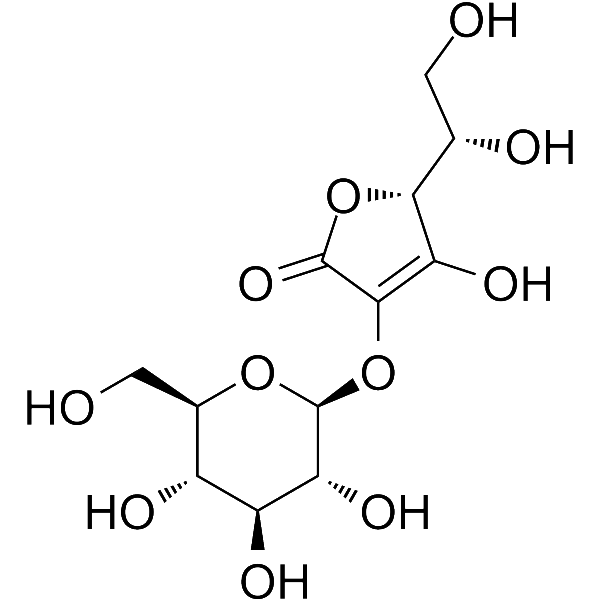
2-O-β-D-Glucopyranosyl-L-ascorbic acid
Based on 1 publication(s) in Google Scholar
2-O-β-D-Glucopyranosyl-L-ascorbic acid (AA-2βG) is an orally active vitamin C derivative. 2-O-β-D-Glucopyranosyl-L-ascorbic acid exhibits multiple activities including antioxidant, anti-tumor and immunomodulatory effects. 2-O-β-D-Glucopyranosyl-L-ascorbic acid mediates tumor cell apoptosis, induces cell cycle arrest, scavenges free radicals and eliminates oxidative stress. 2-O-β-D-Glucopyranosyl-L-ascorbic acid can be used in studies related to cancer, inflammation and immunity.
For research use only. We do not sell to patients.
- Purity : 95.0%
- CAS No.: 562043-82-7
- Formula: C12H18O11
- Molecular Weight:338.26
-
Storage:
4°C, protect from light
* In solvent : -80°C, 6 months; -20°C, 1 month (protect from light)

To place orders, for customer services and technical support, please contact: MedChemExpress USA
Tel: 609-228-6898 E-mail: [email protected] [email protected]


-
 Biological Activity
-
Chemical Information
-
Solvent & Solubility
- Purity & Documentation
- References
-
 Help & FAQs


Publications Citing Use of MedChemExpress (MCE) 2-O-β-D-Glucopyranosyl-L-ascorbic acid
More

Biological Activity
Description
In Vitro
2-O-β-D-Glucopyranosyl-L-ascorbic acid (1.0-5.0 mM; 24-72 h) selectively induces cytotoxicity and antiproliferative effects in a time- and dose-dependent manner in Hela, HS-746T and Colo-320 cancer cells[1].
2-O-β-D-Glucopyranosyl-L-ascorbic acid (3.0 mM; 24-72 h) induces dose- and time-dependent apoptotic morphological changes in Hela cells, including chromatin condensation, membrane blebbing, and apoptotic body formation[1].
2-O-β-D-Glucopyranosyl-L-ascorbic acid (0.001-1.0 mM; 24-48 h) induces time- and dose-dependent G0/G1 cell cycle arrest in Hela cells[1].
2-O-β-D-Glucopyranosyl-L-ascorbic acid (5.0 mM; 24 h) downregulates the protein expression levels of vinculin, mitofilin, heat shock protein 60, α-tubulin, heterogeneous nuclear ribonucleoprotein H1, GAPDH, and c-Jun/AP-1, while it upregulates the protein expression level of p53[1].
2-O-β-D-Glucopyranosyl-L-ascorbic acid (3.1-12.5 μM; 1 h) significantly inhibits hydrogen peroxide-induced production of ROS and superoxide anions, and restores mitochondrial transmembrane potential in mouse macrophage RAW264.7 cells[2].
2-O-β-D-Glucopyranosyl-L-ascorbic acid (3.1-12.5 μM; 4 h) restores intracellular GSH levels, reduces GSSG levels, and increases the GSH/GSSG ratio in hydrogen peroxide-treated mouse RAW264.7 macrophages[2].
2-O-β-D-Glucopyranosyl-L-ascorbic acid (3.1-12.5 μM; 4 h) restores the activities of superoxide dismutase and catalase in hydrogen peroxide-treated murine macrophage RAW264.7 cells[2].
2-O-β-D-Glucopyranosyl-L-ascorbic acid (3.1-12.5 μM; 4 h) significantly reduces the release of LDH and TNF-α in hydrogen peroxide-induced mouse macrophage RAW264.7 cells[2].
2-O-β-D-Glucopyranosyl-L-ascorbic acid (12.5 μM; 4 h pretreatment) downregulates Keap-1 expression and upregulates the expressions of Nrf2 and HO-1 in hydrogen peroxide-treated mouse macrophage RAW264.7 cells[2].
2-O-β-D-Glucopyranosyl-L-ascorbic acid (12.5 μM; 4 h) promotes the nuclear translocation of Nrf2 in hydrogen peroxide-treated mouse macrophage RAW264.7 cells[2].
MedChemExpress (MCE) has not independently confirmed the accuracy of these methods. They are for reference only.
-
Cell Line:human cervix adenocarcinoma Hela cells, human gastric carcinoma HS-746T cells, human colorectal adenocarcinoma Colo-320 cells, human liver cancer Bel-7402 cells, human primary vascular endothelial VEC cells
-
Concentration:1.0 mM, 2.0 mM, 3.0 mM, 4.0 mM, 5.0 mM
-
Incubation Time:24 h, 48 h, 72 h
-
Result:Induced cytotoxicity and antiproliferative effects in a cell type-, time-, and dose-dependent manner.
Caused 90% cell death in Hela cells treated with 5.0 mM for 72 h.
Reduced cell viability significantly in HS-746T and Colo-320 cells, with greater effects at higher concentrations and longer incubation times.
Showed moderate inhibition or slight promotion of cell viability in Bel-7402 cells and VEC cells.
-
Cell Line:human cervix adenocarcinoma Hela cells
-
Concentration:0.001 mM, 0.01 mM, 0.1 mM, 1.0 mM
-
Incubation Time:24 h, 36 h, 48 h
-
Result:Increased G0/G1 phase cell fraction and decreased S phase cell fraction in a time- and dose-dependent manner, indicating G0/G1 phase cell cycle arrest.
Resulted in 58.58% G0/G1 and 31.22% S phase cells with 0.001 mM treatment for 48 h.
Caused 60.95% G0/G1 and 26.72% S phase cells with 0.01 mM treatment for 48 h.
Induced 72.02% G0/G1 and 22.85% S phase cells with 0.1 mM treatment for 48 h.
Led to 85.16% G0/G1 and 11.16% S phase cells with 1.0 mM treatment for 48 h.
Raised G0/G1 fraction to 74.30% at 24 h, 80.69% at 36 h, and 85.16% at 48 h, while decreasing S phase fraction to 21.0% at 24 h, 14.27% at 36 h, and 11.16% at 48 h with 1.0 mM treatment.
-
Cell Line:hydrogen peroxide (H2O2)-treated murine macrophage RAW264.7 cells
-
Concentration:12.5 μM
-
Incubation Time:4 h (pretreatment prior to 6 h H2O2 stimulation)
-
Result:Downregulated H2O2-induced Keap-1 expression, and significantly reversed H2O2-suppressed Nrf2 and HO-1 expression levels, with statistically significant effects (p < 0.01) observed for all three proteins relative to H2O2-only treatment.
-
Cell Line:hydrogen peroxide (H2O2)-treated murine macrophage RAW264.7 cells
-
Concentration:12.5 μM
-
Incubation Time:4 h (pretreatment prior to 6 h H2O2 stimulation)
-
Result:Induced nuclear translocation of Nrf2 following H2O2 stimulation, with increased Nrf2 fluorescence observed in the nuclear compartment relative to H2O2-only treatment.
In Vivo
MedChemExpress (MCE) has not independently confirmed the accuracy of these methods. They are for reference only.
-
Animal Model:BALB/c treated Cyclophosphamide (HY-17420) (5-week-old, 16 ± 1.0 g)[3]
-
Dosage:100 mg/kg BW/day
-
Administration:intragastric gavage; daily; 32 consecutive days
-
Result:Significantly reversed cyclophosphamide-induced body weight loss, colon length reduction, and decreases in thymus and spleen indexes.
Significantly reversed cyclophosphamide-induced increases in neutrophil and monocyte percentages and decrease in lymphocyte percentage, with no significant effect on eosinophil percentage.
Significantly reversed cyclophosphamide-induced down-regulation of TNF-α, up-regulation of TGF-β1, and decrease in IgA levels; no significant effect on IL-10 levels.
Significantly reversed cyclophosphamide-induced decreases in hepatic GSH, CAT, and SOD levels and increase in ALT level; no significant effect on hepatic MDA level).
Prevented cyclophosphamide-induced histopathological damage to jejunum, colon, and liver tissue, maintaining intact villi structure and preventing liver focal solidification necrosis and vacuolar degeneration.
Significantly reversed cyclophosphamide-induced reductions in cecal i-butyric and i-valeric acid concentrations.
Reversed cyclophosphamide-induced increases in Epsilonbacteraeota and Proteobacteria relative abundances and decreases in Patescibacteria and Tenericutes relative abundances in colonic microbiota; reversed cyclophosphamide-induced changes in relative abundances of 13 bacterial families; significantly altered 61 colonic microbial functional modules compared to the cyclophosphamide-only group, including enriching amino acid metabolism/synthesis pathways and depleting disease-related pathways.
Significantly increased Bacteroidetes relative abundance, decreased Firmicutes relative abundance, and reversed cyclophosphamide-induced increase in Proteobacteria relative abundance in small-intestinal microbiota; significantly increased Muribaculaceae relative abundance and decreased Desulfovibrionaceae and Paenibacillaceae relative abundances compared to the cyclophosphamide-only group; significantly altered 119 small-intestinal microbial functional modules compared to the cyclophosphamide-only group, including enriching DNA replication/transcription/translation pathways, amino acid biosynthesis, and energy metabolism pathways, and depleting disease-related pathways.


Chemical Information
-
CAS No. 562043-82-7
-
Appearance Solid
-
Molecular Weight 338.26
-
Formula C12H18O11
-
Color White to light yellow
-
SMILES
OC([C@H](O1)[C@H](CO)O)=C(O[C@H]2[C@@H]([C@H]([C@@H]([C@@H](CO)O2)O)O)O)C1=O
-
Synonyms
AA-2βG
-
Structure Classification
-
Initial Source
-
Shipping
Room temperature in continental US; may vary elsewhere.
-
Storage
4°C, protect from light
* In solvent : -80°C, 6 months; -20°C, 1 month (protect from light)


Publications (1)
-
Journal Impact Factor
-
Most Recent
-
Food Chem
Discovery of novel ascorbic acid derivatives and other metabolites in fruit of Rosa roxburghii Tratt through untargeted metabolomics and feature-based molecular networking. [Abstract]2023 Mar 30;405(Pt A):134807. PMID: 36370576


Solvent & Solubility
In Vitro:
H2O : ≥ 250 mg/mL (739.08 mM)
* "≥" means soluble, but saturation unknown.
Please refer to the solubility information to select the appropriate solvent. Once prepared, please aliquot and store the solution to prevent product inactivation from repeated freeze-thaw cycles.
Storage method and period of stock solution: -80°C, 6 months; -20°C, 1 month (protect from light). When stored at -80°C, please use it within 6 months. When stored at -20°C, please use it within 1 month.
* Note: If you choose water as the stock solution, please dilute it to the working solution, then filter and sterilize it with a 0.22 μm filter before use.
Please refer to the solubility information to select the appropriate solvent. Once prepared, please aliquot and store the solution to prevent product inactivation from repeated freeze-thaw cycles.
Storage method and period of stock solution: -80°C, 6 months; -20°C, 1 month (protect from light). When stored at -80°C, please use it within 6 months. When stored at -20°C, please use it within 1 month.
* Note: If you choose water as the stock solution, please dilute it to the working solution, then filter and sterilize it with a 0.22 μm filter before use.
Concentration (start) × Volume (start) = Concentration (final) × Volume (final)
In Vivo:
For the following dissolution methods, please prepare the working solution directly:
It is recommended to prepare fresh solutions and use them promptly within a short period of time.
The percentages shown for the solvents indicate their volumetric ratio in the final prepared solution. If precipitation or phase separation occurs during preparation, heat and/or sonication can be used to aid dissolution.
Add each solvent one by one: PBS
Solubility: 100 mg/mL (295.63 mM); Clear solution; Need ultrasonic


Purity & Documentation
-
Data Sheet (292 KB)
-
SDS (394 KB)
- English - EN (394 KB)
- Français - FR (394 KB)
- Deutsch - DE (394 KB)
- Norwegian - NO (394 KB)
- Español - ES (394 KB)
- Swedish - SV (394 KB)
- Italian - IT (394 KB)
- Korean - KR (394 KB)
- Portuguese - PT (394 KB)
-
Handling Instructions (2659 KB)
References
[1]. Zhang Z, et al. Selective suppression of cervical cancer Hela cells by 2-O-β-D-glucopyranosyl-L-ascorbic acid isolated from the fruit of Lycium barbarum L. Cell Biol Toxicol. 2011;27(2):107-121. [Content Brief]
[2]. Wang SF, et al. 2-O-β-d-glucopyranosyl-l-ascorbic acid, a novel vitamin C derivative from Lycium barbarum, prevents oxidative stress. Redox Biol. 2019;24:101173. [Content Brief]
[3]. Huang K, et al. Ascorbic Acid Derivative 2-O-β-d-Glucopyranosyl-l-Ascorbic Acid from the Fruit of Lycium barbarum Modulates Microbiota in the Small Intestine and Colon and Exerts an Immunomodulatory Effect on Cyclophosphamide-Treated BALB/c Mice. J Agric Food Chem. 2020 Oct 7;68(40):11128-11143. [Content Brief]


Complete Stock Solution Preparation Table
Please refer to the solubility information to select the appropriate solvent. Once prepared, please aliquot and store the solution to prevent product inactivation from repeated freeze-thaw cycles.
Storage method and period of stock solution: -80°C, 6 months; -20°C, 1 month (protect from light). When stored at -80°C, please use it within 6 months. When stored at -20°C, please use it within 1 month.
| Optional Solvent | Concentration Solvent Mass | 1 mg | 5 mg | 10 mg | 25 mg |
|---|---|---|---|---|---|
| H2O | 1 mM | 2.9563 mL | 14.7815 mL | 29.5631 mL | 73.9076 mL |
| 5 mM | 0.5913 mL | 2.9563 mL | 5.9126 mL | 14.7815 mL | |
| 10 mM | 0.2956 mL | 1.4782 mL | 2.9563 mL | 7.3908 mL | |
| 15 mM | 0.1971 mL | 0.9854 mL | 1.9709 mL | 4.9272 mL | |
| 20 mM | 0.1478 mL | 0.7391 mL | 1.4782 mL | 3.6954 mL | |
| 25 mM | 0.1183 mL | 0.5913 mL | 1.1825 mL | 2.9563 mL | |
| 30 mM | 0.0985 mL | 0.4927 mL | 0.9854 mL | 2.4636 mL | |
| 40 mM | 0.0739 mL | 0.3695 mL | 0.7391 mL | 1.8477 mL | |
| 50 mM | 0.0591 mL | 0.2956 mL | 0.5913 mL | 1.4782 mL | |
| 60 mM | 0.0493 mL | 0.2464 mL | 0.4927 mL | 1.2318 mL | |
| 80 mM | 0.0370 mL | 0.1848 mL | 0.3695 mL | 0.9238 mL | |
| 100 mM | 0.0296 mL | 0.1478 mL | 0.2956 mL | 0.7391 mL |
* Note: If you choose water as the stock solution, please dilute it to the working solution, then filter and sterilize it with a 0.22 μm filter before use.


2-O-β-D-Glucopyranosyl-L-ascorbic acid Related Classifications
HY-N6958 Related Classifications
 Powered by Bioz