



Fosfructose
Based on 2 publication(s) in Google Scholar
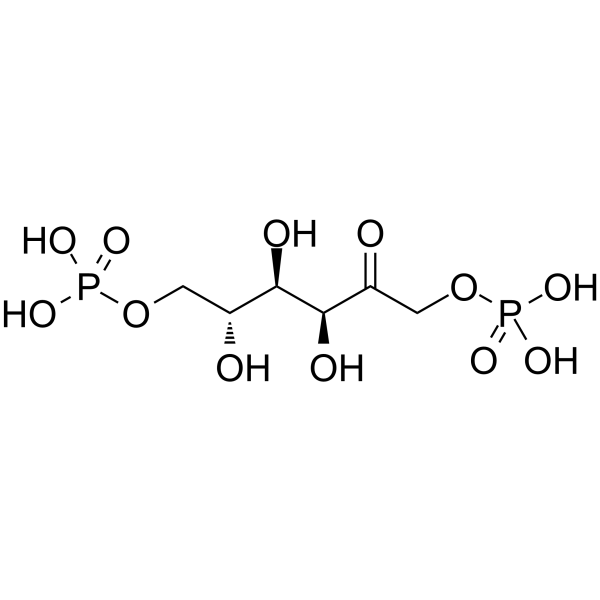
Fosfructose is an orally active cyclooxygenase-2 inhibitor and Toll-like receptor 4 modulator. Fosfructose reduces the expression of cyclooxygenase-2, thereby decreasing prostaglandin production. By inhibiting the Toll-like receptor 4 signaling pathway, Fosfructose downregulates LPS-induced adhesion molecule expression. Fosfructose is applicable to research related to ischemic stroke, epilepsy, sepsis, myocardial injury, osteoporosis, and ultraviolet B-induced skin damage.
Nur für Forschungszwecke. Wir verkaufen nicht an Patienten.
- Reinheit : 98.0%
- CAS. Nr.: 488-69-7
- Formel: C6H14O12P2
- Molecular Weight:340.12
-
Speicherung:
-20°C, sealed storage, away from moisture and light
* In solvent : -80°C, 6 months; -20°C, 1 month (sealed storage, away from moisture and light)

To place orders, for customer services and technical support, please contact: MedChemExpress USA
Tel: 609-228-6898 E-mail: [email protected] [email protected]


-
 Biologische Aktivität
-
Chemical Information
-
Lösungsmittel & Löslichkeit
- Protokoll
- Reinheit & Dokumentation
- Verweise
-
 Help & FAQs


Publications Citing Use of MedChemExpress (MCE) Fosfructose
More

Biologische Aktivität
Beschreibung
IC50 & Target
|
Human Endogenous Metabolite |
In Vitro
Fosfructose (0.5-2%) concentration-dependently inhibits protein oxidation in cell-free human serum albumin assays[1].
Fosfructose (5-10 mM) concentration-dependently increases metabolism in hypoxic rat cardiomyocytes and increases membrane fluidity in lipid vesicles[1].
Fosfructose (3.5 mM) inhibits cyanide- and iodoacetate-induced intracellular calcium increases in cultured astrocytes and adult rat brain slices[1].
Fosfructose (1-20 mM; 24 h post-irradiation for 10 mM) dose-dependently reduces UVB-induced intracellular oxidation in HaCaT cells, and 10 mM (24 h post-irradiation) inhibits COX-2 expression, prostaglandin production, and increases GSH levels[1].
Fosfructose (10-20 mM; 24 h post-treatment) concentration-dependently protects mouse cortical neurons from NMDA-induced excitotoxicity by reducing ROS production and neuronal death[1].
Fosfructose (10 mM; 20 min reperfusion) improves ATP + ADP preservation and ATP recovery in isolated rat liver mitochondria following ischemia-reperfusion injury[1].
Fosfructose (5 mM) reduces K+ permeability, preserves Na+/K+ ATPase activity, and inhibits TNF-α-induced apoptosis in GalN-treated isolated rat hepatocytes[1].
MedChemExpress (MCE) has not independently confirmed the accuracy of these methods. They are for reference only.
In Vivo
Fosfructose (0.5 g/kg; i.p.; single dose) reduces sepsis-induced inflammatory markers and achieves 50% 7-day survival in Wistar rats[1].
Fosfructose (2 g/kg; i.p.; single dose; at sepsis induction) inhibits sepsis-induced platelet aggregation and coagulation abnormalities in Wistar rats[1].
Fosfructose (500 mg/kg; i.p.; single pre-insult dose) drastically improves long-term survival in mice with Candida albicans-induced candidemia[1].
Fosfructose (i.p.) reverses cisplatin-induced acute renal failure in Wistar rats[1].
Fosfructose (i.p.) reduces doxorubicin-induced cardiac histological damage in Wistar rats[1].
Fosfructose (2 g/kg; i.p.; single dose) reverses hypothermia-induced oxidative stress and metabolic acidosis in Wistar rats[1].
Fosfructose (1.0 g/kg; i.p.; single pre-kindling dose) delays seizure acquisition in a rat rapid hippocampal kindling model by modulating BDNF/TrkB signaling and cation-chloride cotransporter expression[1].
Fosfructose (0.5-1 g/kg; i.p.; single pre-insult dose) exerts a dose-dependent anticonvulsant effect in rats with chemically induced acute seizures, increasing seizure latency and reducing seizure duration and severity[1].
Fosfructose (0.5-1 g/kg; i.p.; single pre-convulsion dose) protects hippocampal mitochondrial function and synaptic structure in immature rats with repeated febrile convulsions[1].
Fosfructose (350 mg/kg; i.v.; twice daily; 7 days), combined with an immunosuppressant, quadruples heterotropic heart transplant survival in Mus musculus (mice) by inhibiting T-lymphocyte proliferation and IL-2 production[1].
Fosfructose (9 mM; topical; once daily for 3 days pre-irradiation; immediately post-irradiation) preserves skin antioxidant capacity and reduces UVB-induced oxidative stress in hairless mice[1].
MedChemExpress (MCE) has not independently confirmed the accuracy of these methods. They are for reference only.
-
Animal Model:Wistar (galactosamine-induced hepatitis)[1]
-
Dosage:2 g/kg
-
Administration:i.p.; single post-insult dose
-
Result:Reversed galactosamine-induced liver damage.
Improved hepatic carbohydrate metabolism.
Reduced indexes of apoptosis and necrosis in liver tissue.
-
Animal Model:Wistar (intraperitoneal LPS-containing capsule-induced sepsis)[1]
-
Dosage:0.5 g/kg
-
Administration:i.p.; single dose
-
Result:Reduced leukocytosis and tissue edema at 6 hours post-sepsis induction.
Achieved 50% survival of treated animals beyond 7 days of sepsis.
-
Animal Model:Wistar (direct cecal puncture-induced sepsis)[1]
-
Dosage:2 g/kg
-
Administration:i.p.; single dose; at sepsis induction
-
Result:Inhibited platelet aggregation and other coagulation abnormalities at 12 hours post-sepsis induction.
-
Animal Model:Mice (intratracheal instillation of Candida albicans-induced candidemia)[1]
-
Dosage:500 mg/kg
-
Administration:i.p.; single pre-insult dose
-
Result:Drastically improved survival beyond 15 days post-candidemia induction.
-
Animal Model:Wistar (hypothermia-induced oxidative stress)[1]
-
Dosage:2 g/kg
-
Administration:i.p.; single dose
-
Result:Reversed hypothermia-induced increases in ROS production.
Reversed hypothermia-induced reduction in antioxidant enzyme activities.
Reversed hypothermia-induced blood metabolic acidosis.
-
Animal Model:Wistar (rapid hippocampal kindling-induced seizure susceptibility)[1]
-
Dosage:1.0 g/kg
-
Administration:i.p.; single pre-kindling dose
-
Result:Significantly delayed kindling acquisition.
Delayed the upregulation of BDNF and TrkB mRNAs in the hippocampus.
Prevented kindling-induced KCC2 downregulation.
Decreased NKCC1 expression to reduce intracellular chloride accumulation.
-
Animal Model:Wistar (kainic acid, pilocarpine, or pentylenetetrazol injection-induced acute seizures)[1]
-
Dosage:0.5 g/kg, 1 g/kg
-
Administration:i.p.; single pre-insult dose
-
Result:Produced a dose-dependent anticonvulsant effect.
Reduced seizure duration and severity.
Significantly increased seizure latency.
-
Animal Model:immature rats (hot water immersion-induced repeated febrile convulsions)[1]
-
Dosage:0.5 g/kg, 1 g/kg
-
Administration:i.p.; single pre-convulsion dose
-
Result:Protected hippocampal mitochondrial structure and function.
Protected against synaptic damage.
Did not prevent neuronal degeneration.
-
Animal Model:Mice (heterotropic heart transplant rejection)[1]
-
Dosage:350 mg/kg
-
Administration:i.v.; twice daily; 7 days
-
Result:Improved heart transplant survival four-fold compared to non-treated animals, with a greater effect than the immunosuppressant alone.
Reduced induced T-lymphocyte proliferation.
Prevented increases in IL-2 production.
-
Animal Model:Hairless mice (4 days of 100 mJ/cm2 UVB irradiation-induced skin damage)[1]
-
Dosage:9 mM
-
Administration:topical; once daily for 3 days pre-irradiation; immediately post-irradiation
-
Result:Penetrated the skin.
Preserved cellular antioxidant capacity (GSH content and catalase activity).
Reduced oxidative stress markers (protein carbonyls) in both dermis and epidermis.
Clinical Trial
| NCT Number | Sponsor | Condition | Start Date |
Phase

|
|---|---|---|---|---|
| NCT01329991 | Plexxikon| | 2011-05 | PHASE1 |


Chemical Information
-
CAS. Nr. 488-69-7
-
Appearance Oil
-
Molecular Weight 340.12
-
Formel C6H14O12P2
-
Color White to off-white
-
SMILES
O=P(O)(O)OCC([C@@H](O)[C@H](O)[C@H](O)COP(O)(O)=O)=O
-
Synonyms
Diphosphofructose; Esafosfan; FDP
-
Structure Classification
-
Initial Source
-
Versand
Room temperature in continental US; may vary elsewhere.
-
Speicherung
-20°C, sealed storage, away from moisture and light
* In solvent : -80°C, 6 months; -20°C, 1 month (sealed storage, away from moisture and light)


Publications (2)
-
Journal Impact Factor
-
Most Recent
-
Adv Sci (Weinh)
Metabolic Imbalance Triggers Adaptive Remodeling to Accelerate Diploidization in Murine Haploid Embryonic Stem Cells. [Abstract]2026 Apr 22:e22570. PMID: 42018132 -


Lösungsmittel & Löslichkeit
In Vitro:
DMSO : 25 mg/mL (73.50 mM; Need ultrasonic; Hygroscopic DMSO has a significant impact on the solubility of product, please use newly opened DMSO)
Please refer to the solubility information to select the appropriate solvent. Once prepared, please aliquot and store the solution to prevent product inactivation from repeated freeze-thaw cycles.
Storage method and period of stock solution: -80°C, 6 months; -20°C, 1 month (sealed storage, away from moisture and light). When stored at -80°C, please use it within 6 months. When stored at -20°C, please use it within 1 month.
Please refer to the solubility information to select the appropriate solvent. Once prepared, please aliquot and store the solution to prevent product inactivation from repeated freeze-thaw cycles.
Storage method and period of stock solution: -80°C, 6 months; -20°C, 1 month (sealed storage, away from moisture and light). When stored at -80°C, please use it within 6 months. When stored at -20°C, please use it within 1 month.
Konzentration (Stammlösung) × Volumen (Stammlösung) = Konzentration (Ziellösung) × Volumen (Ziellösung)


Reinheit & Dokumentation
-
Data Sheet (284 KB)
-
SDS (396 KB)
- English - EN (396 KB)
- Français - FR (396 KB)
- Deutsch - DE (396 KB)
- Norwegian - NO (396 KB)
- Español - ES (396 KB)
- Swedish - SV (396 KB)
- Italian - IT (396 KB)
- Korean - KR (396 KB)
- Portuguese - PT (396 KB)
-
Handling Instructions (2659 KB)
Verweise


Complete Stock Solution Preparation Table
Please refer to the solubility information to select the appropriate solvent. Once prepared, please aliquot and store the solution to prevent product inactivation from repeated freeze-thaw cycles.
Storage method and period of stock solution: -80°C, 6 months; -20°C, 1 month (sealed storage, away from moisture and light). When stored at -80°C, please use it within 6 months. When stored at -20°C, please use it within 1 month.
| Optional Solvent | Concentration Solvent Mass | 1 mg | 5 mg | 10 mg | 25 mg |
|---|---|---|---|---|---|
| DMSO | 1 mM | 2.9401 mL | 14.7007 mL | 29.4014 mL | 73.5035 mL |
| 5 mM | 0.5880 mL | 2.9401 mL | 5.8803 mL | 14.7007 mL | |
| 10 mM | 0.2940 mL | 1.4701 mL | 2.9401 mL | 7.3503 mL | |
| 15 mM | 0.1960 mL | 0.9800 mL | 1.9601 mL | 4.9002 mL | |
| 20 mM | 0.1470 mL | 0.7350 mL | 1.4701 mL | 3.6752 mL | |
| 25 mM | 0.1176 mL | 0.5880 mL | 1.1761 mL | 2.9401 mL | |
| 30 mM | 0.0980 mL | 0.4900 mL | 0.9800 mL | 2.4501 mL | |
| 40 mM | 0.0735 mL | 0.3675 mL | 0.7350 mL | 1.8376 mL | |
| 50 mM | 0.0588 mL | 0.2940 mL | 0.5880 mL | 1.4701 mL | |
| 60 mM | 0.0490 mL | 0.2450 mL | 0.4900 mL | 1.2251 mL |


Fosfructose Related Classifications
HY-106950 Related Classifications
 Powered by Bioz