



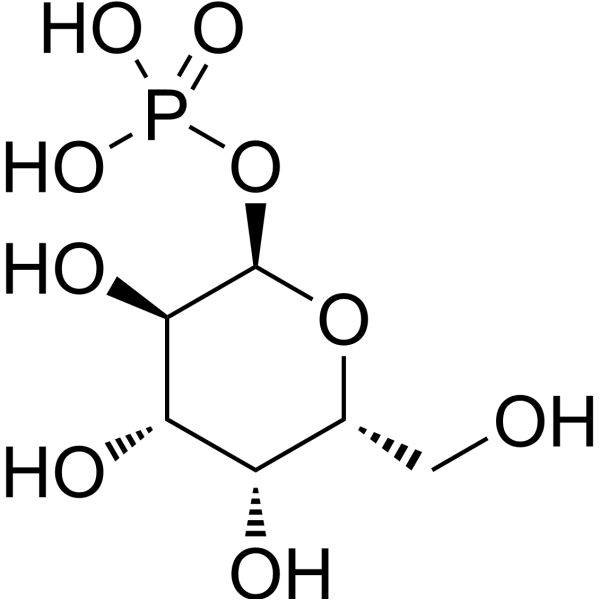
Galactose 1-phosphate
Galactose 1-phosphate acts as a competitive substrate inhibitor of galactose-1-phosphate uridylyltransferase (GALT). Galactose 1-phosphate is a competitive inhibitor of Phosphoglucomutase, yet the rate at which this enzyme converts Galactose 1-phosphate to Galactose-6-phosphate is 400 times slower than the rate of converting Glucose-1-phosphate. Galactose 1-phosphate can be used in studies related to Saccharomyces cerevisiae infection and type I galactosemia.
연구목적의 판매만을 진행합니다. 환자를 대상으로 한 판매는 하지 않습니다.
- CAS No.: 2255-14-3
- 화학식: C6H13O9P
- 분자량:260.14
-
보관:
Please store the product under the recommended conditions in the Certificate of Analysis.

To place orders, for customer services and technical support, please contact: MedChemExpress USA
Tel: 609-228-6898 E-mail: [email protected] [email protected]


-
 Biological Activity
-
Chemical Information
- Protocol
- 순도&문서
- References
-
 Help & FAQs


All Endogenous Metabolite Isoforms
More

Biological Activity
제품 설명
IC50 & Target
|
Human Endogenous Metabolite |
In Vitro
Galactose 1-phosphate acts as a competitive substrate inhibitor of Escherichia coli galactose-1-phosphate uridylyltransferase (GALT), which can displace UMP from the covalently bound UMP-GALT intermediate to form UDP-galactose[1].
Galactose 1-phosphate acts as a competitive inhibitor of Phosphoglucomutase, yet the reaction rate at which this enzyme converts Galactose 1-phosphate to galactose-6-phosphate is 400 times slower than that of glucose-1-phosphate conversion[2].
MedChemExpress (MCE) has not independently confirmed the accuracy of these methods. They are for reference only.


Chemical Information
-
CAS No. 2255-14-3
-
분자량 260.14
-
화학식 C6H13O9P
-
SMILES
O=P(O)(O)O[C@H]1O[C@@H]([C@H](O)[C@H](O)[C@H]1O)CO
-
Structure Classification
-
Initial Source
-
선적
Room temperature in continental US; may vary elsewhere.
-
보관
Please store the product under the recommended conditions in the Certificate of Analysis.


순도&문서
References
[1]. McCorvie TJ, et al. The structural and molecular biology of type I galactosemia: Enzymology of galactose 1-phosphate uridylyltransferase. IUBMB Life. 2011;63(9):694-700. [Content Brief]
[2]. de Jongh WA, et al. The roles of galactitol, galactose-1-phosphate, and phosphoglucomutase in galactose-induced toxicity in Saccharomyces cerevisiae. Biotechnol Bioeng. 2008;101(2):317-326. [Content Brief]

Calculators
Concentration (start) × Volume (start) = Concentration (final) × Volume (final)


Galactose 1-phosphate Related Classifications
HY-113143 Related Classifications
 Powered by Bioz