



Pulchinenoside A

Based on 1 Customer Validation
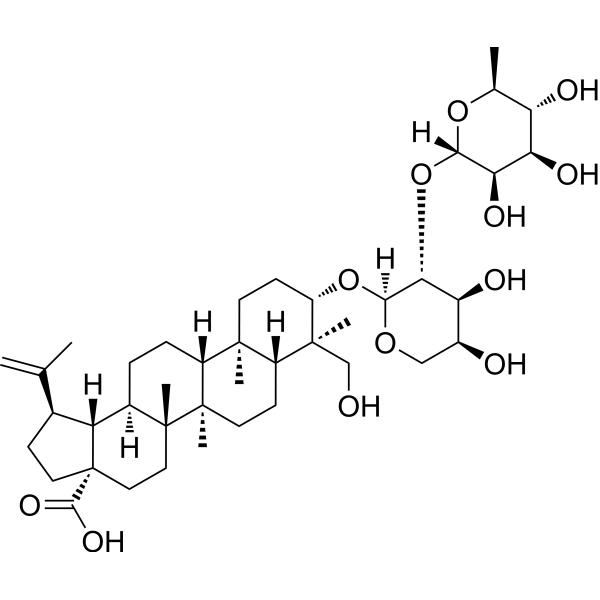
Pulchinenoside A (Anemoside A3) is an orally active triterpenoid glycoside found in the root of Pulsatilla chinensis. Pulchinenoside A has amti-inflammation, antitumor, antidepressant, immunoregulatory and neuroprotective efrects. Pulchinenoside A activates NF-κB/MAPK signaling pathway. Pulchinenoside A can induce relaxing effect in rat renal arteries. Pulchinenoside A can be used for the researches of experimental autoimmune encephalomyelitis, breast cancer, depression and renovascular hypertension.
Para uso exclusivo en investigación. No vendemos a pacientes.
- Pureza : 98.81%
- No. CAS: 129724-84-1
- Fòrmula: C41H66O12
- Peso molecular:750.96
-
Almacenamiento:Powder -20°C, 3 years , 4°C, 2 years ; In solvent -80°C, 2 years , -20°C, 1 year

To place orders, for customer services and technical support, please contact: MedChemExpress USA
Tel: 609-228-6898 E-mail: [email protected] [email protected]


-
 Actividad biológica
-
Chemical Information
-
Solvente y solubilidad
- Protocolo
- Pureza y Documentación
- Referencias
-
 Help & FAQs




Actividad biológica
Descripciòn
IC50 & Target
|
NMDA Receptor |
Cellular Effect
|
Cell Line

|
Type | Value | Description | References |
|---|---|---|---|---|
| THP-1 | IC50 |
>=80 μM
Compound: AA3
|
Cytotoxicity against human THP-1 cells assessed as inhibition of cell viability incubated for 24 hrs by CCK8 assay
Cytotoxicity against human THP-1 cells assessed as inhibition of cell viability incubated for 24 hrs by CCK8 assay
|
[PMID: 38687956] |
In Vitro
Pulchinenoside A (30 min) dose-dependently inhibits PGE2-EP4 signaling in human THP-1 acute monocytic leukemia cells with IC50 values of 22.4 μM (for PGE2-induced cAMP) and 22.9 μM (for PGE1-OH-induced cAMP), without reducing cell viability[1].
Pulchinenoside A exhibits stable binding affinity with purified TLR4 protein, with a docking score of −9.6287[3].
Pulchinenoside A (1.5625-200 μg/mL; 24 h) is non-cytotoxic to THP-1-derived M0 macrophages at concentrations up to 200 μg/mL, maintaining over 80% cell viability[3].
Pulchinenoside A (50-100 μg/mL; 24 h) induces M1 polarization of THP-1-derived M0 macrophages, significantly increasing mRNA expression of TNF-α, IL-12, IL-6, and IL-1β at concentrations of 50 and 100 μg/mL[3].
Pulchinenoside A (50-100 μg/mL; 24 h) promotes M1 polarization of THP-1-derived M0 macrophages, significantly increasing the proportion of CD86+ cells at concentrations of 50 and 100 μg/mL[3].
Pulchinenoside A (50-100 μg/mL; 24 h) activates the TLR4/NF-κB/MAPK signaling pathway in THP-1-derived M0 macrophages, significantly increasing expression of key pathway proteins at concentrations of 50 and 100 μg/mL[3].
Pulchinenoside A (25-100 μg/mL; 24 h) significantly inhibits MCF-7 breast cancer cell viability in a THP-1 macrophage-MCF-7 co-culture system[3].
Pulchinenoside A (50-100 μg/mL; 24 h) increases IL-12 secretion by macrophages and down-regulates VEGF mRNA expression in MCF-7 breast cancer cells in a co-culture system[3].
Pulchinenoside A (50-100 μg/mL; 24 h) activates the TLR4/NF-κB/MAPK signaling pathway in TAMs generated in a THP-1 macrophage-MCF-7 co-culture system, significantly increasing expression of key pathway proteins at concentrations of 50 and 100 μg/mL[3].
Pulchinenoside A (0.1-10 μg/mL; 25 min) protects PC12 cells from apoptosis induced by sodium cyanide and glucose deprivation[4].
Pulchinenoside A (3-100 μM) induces relaxing effect in rat renal arteries[5].
MedChemExpress (MCE) has not independently confirmed the accuracy of these methods. They are for reference only.
-
Cell Line:THP-1-derived M0 macrophages
-
Concentration:1.5625, 3.125, 12.5, 20, 25, 50, 100, 200 μg/mL
-
Incubation Time:24 h
-
Result:Showed minimal cytotoxicity toward M0 macrophages, with cell viability remaining above 80% across all tested concentrations.
-
Cell Line:THP-1-derived M0 macrophages
-
Concentration:50, 100 μg/mL
-
Incubation Time:24 h
-
Result:Significantly increased relative mRNA expression of TNF-α, IL-12, IL-6, and IL-1β.
-
Cell Line:THP-1-derived M0 macrophages
-
Concentration:50, 100 μg/mL
-
Incubation Time:24 h
-
Result:Significantly increased the percentage of CD86+ cells.
-
Cell Line:THP-1-derived M0 macrophages; MCF-7 breast cancer cells in THP-1 macrophage-MCF-7 co-culture system
-
Concentration:50, 100 μg/mL
-
Incubation Time:24 h
-
Result:Increased relative protein expression of TLR4, MyD88, TRAF6, IκBα, NF-κB, and P38.
-
Cell Line:MCF-7 breast cancer cells in THP-1 macrophage-MCF-7 co-culture system
-
Concentration:25, 50, 100 μg/mL
-
Incubation Time:24 h
-
Result:Significantly inhibited MCF-7 cell viability.
-
Cell Line:rat adrenal pheochromocytoma PC12 cells
-
Concentration:0.1 μg/mL, 1 μg/mL, 10 μg/mL
-
Incubation Time:25 min (pre-incubation); 24 h (maintenance)
-
Result:Protected PC12 cells from apoptosis induced by sodium cyanide and glucose deprivation.
Reduced the sub-G1 apoptotic peak in NaCN/glucose-deprived PC12 cells at 10 μg/mL.
In Vivo
Pulchinenoside A (30-300 mg/kg; i.p.; single dose) produces antidepressant-like effects in stress-naive mice via reduced immobility in forced swim and tail suspension tests, with no impact on locomotor activity[2].
Pulchinenoside A (100 mg/kg; i.p.; daily; 5 days) reverses chronic mild stress-induced depression-like behaviors in mice, including reduced anhedonia and feeding latency, with faster onset efficacy than the classical antidepressant clomipramine[2].
Pulchinenoside A (100 mg/kg; i.p.; daily; 5 days) exerts antidepressant-like effects in CSDS-susceptible mice via a mechanism dependent on activation of GluA2-lacking AMPARs in the hippocampal stratum lacunosum-moleculare[2].
Pulchinenoside A (5-20 mg/kg; i.p.; daily; 13 days) induces M1 macrophage polarization via a TLR4-dependent pathway, significantly reducing breast tumor growth and angiogenesis in BALB/c mice[3].
MedChemExpress (MCE) has not independently confirmed the accuracy of these methods. They are for reference only.
-
Animal Model:C57BL/6 (female, 10-week-old, experimental autoimmune encephalomyelitis induced via immunization with 100 μg MOG35-55 peptide in complete Freund’s adjuvant containing 2 mg/mL heat-killed Mycobacterium tuberculosis, followed by intraperitoneal injection of 400 ng pertussis toxin on day 0 and day 1 post-immunization)[1]
-
Dosage:100 mg/kg
-
Administration:p.o.; daily; from day 0 or 8 to day 20
-
Result:Increased the mean time to reach a clinical score of 1 (tail paralysis) to 15.6 days.
Reduced day 20 weight loss to 9.5%.
Lowered the incidence of severe EAE (score ≥3.5) to 7.6%.
Significantly reduced spinal cord vacuolization, inflammatory cell infiltration, and demyelination.
Reduced levels of IFN-γ, IL-4, and IL-17 in lymphocytes following ex vivo MOG35-55 re-stimulation.
Significantly reduced clinical disease scores over the course of the experiment when administered starting day 8.
-
Animal Model:C57BL/6J mice with depression (male, 8-10 weeks old)[2]
-
Dosage:30 mg/kg; 100 mg/kg; 300 mg/kg
-
Administration:i.p.; single dose
-
Result:Reduced mouse immobility time compared to vehicle controls in the forced swim test.
Reduced mouse immobility time compared to vehicle controls in the tail suspension test at 100 mg/kg and 300 mg/kg doses.
Had no effect on mouse locomotor activity in the open field test.
-
Animal Model:BALB/c (six-week-old female; orthotopic breast cancer model via 106 4T1-Luc cell injection)[3]
-
Dosage:5 mg/kg; 10 mg/kg; 20 mg/kg
-
Administration:i.p.; daily; 13 days
-
Result:Significantly reduced tumor volume, tumor wet weight, and bioluminescence intensity compared to the model group.
Significantly increased the proportion of CD86+, TLR4+, and CD86+/TLR4+ double-positive cells in tumor tissues compared to the model group.
Significantly upregulated tumor IL-12 mRNA expression compared to the model group.
Significantly downregulated tumor VEGF IHC scores compared to the model group.


Chemical Information
-
No. CAS 129724-84-1
-
Appearance Solid
-
Peso molecular 750.96
-
Fòrmula C41H66O12
-
Color White to off-white
-
SMILES
C[C@H]1[C@H](O)[C@@H](O)[C@@H](O)[C@]([H])(O[C@@H]2[C@@H](O)[C@@H](O)CO[C@@]2([H])O[C@@H]3[C@](CO)(C)[C@]4([H])CC[C@@]5(C)[C@]6(C)CC[C@@]7(C(O)=O)CC[C@@H](C(C)=C)[C@]7([H])[C@@]6([H])CC[C@]5([H])[C@@]4(C)CC3)O1
-
Synonyms
Anemoside A3
-
Structure Classification
-
Initial Source
-
Envío
Room temperature in continental US; may vary elsewhere.
-
Almacenamiento
Powder -20°C 3 years 4°C 2 years In solvent -80°C 2 years -20°C 1 year


Solvente y solubilidad
In Vitro:
DMSO : 50 mg/mL (66.58 mM; Need ultrasonic; Hygroscopic DMSO has a significant impact on the solubility of product, please use newly opened DMSO)
Please refer to the solubility information to select the appropriate solvent. Once prepared, please aliquot and store the solution to prevent product inactivation from repeated freeze-thaw cycles.
Storage method and period of stock solution: -80°C, 2 years; -20°C, 1 year. When stored at -80°C, please use it within 2 years. When stored at -20°C, please use it within 1 year.
Please refer to the solubility information to select the appropriate solvent. Once prepared, please aliquot and store the solution to prevent product inactivation from repeated freeze-thaw cycles.
Storage method and period of stock solution: -80°C, 2 years; -20°C, 1 year. When stored at -80°C, please use it within 2 years. When stored at -20°C, please use it within 1 year.
Concentration (start) × Volume (start) = Concentration (final) × Volume (final)
In Vivo:
Select the appropriate dissolution method based on your experimental animal and administration route.
- For the following dissolution methods, please ensure to first prepare a clear stock solution using an In Vitro approach and then sequentially add co-solvents:
- To ensure reliable experimental results, the clarified stock solution can be appropriately stored based on storage conditions. As for the working solution for In Vivo experiments, it is recommended to prepare freshly and use it on the same day.
- The percentages shown for the solvents indicate their volumetric ratio in the final prepared solution. If precipitation or phase separation occurs during preparation, heat and/or sonication can be used to aid dissolution.
Add each solvent one by one: 10% DMSO 40% PEG300 5% Tween-80 45% Saline
Solubility: ≥ 2.5 mg/mL (3.33 mM); Clear solution
This protocol yields a clear solution of ≥ 2.5 mg/mL (saturation unknown).
Taking 1 mL working solution as an example, add 100 μL DMSO stock solution (25.0 mg/mL) to 400 μL PEG300, and mix evenly; then add 50 μL Tween-80 and mix evenly; then add 450 μL Saline to adjust the volume to 1 mL.
Preparation of Saline: Dissolve 0.9 g sodium chloride in ddH₂O and dilute to 100 mL to obtain a clear Saline solution.
Add each solvent one by one: 10% DMSO 90% (20% SBE-β-CD in Saline)
Solubility: ≥ 2.5 mg/mL (3.33 mM); Clear solution
This protocol yields a clear solution of ≥ 2.5 mg/mL (saturation unknown).
Taking 1 mL working solution as an example, add 100 μL DMSO stock solution (25.0 mg/mL) to 900 μL 20% SBE-β-CD in Saline, and mix evenly.
Preparation of 20% SBE-β-CD in Saline (4°C, storage for one week): 2 g SBE-β-CD powder is dissolved in 10 mL Saline, completely dissolve until clear.
In Vivo Dissolution Calculator
Please enter the basic information of animal experiments:
-
-
-
-
Recommended: Prepare an additional quantity of animals to account for potential losses during experiments.
Please enter your animal formula composition:
-
%DMSO +
Recommended: Keep the proportion of DMSO in working solution below 2% if your animal is weak.
-
%+
-
+%Tween-80 + +
-
%Saline +
The co-solvents required include: DMSO, . All of co-solvents are available by MedChemExpress (MCE). , Tween 80. All of co-solvents are available by MedChemExpress (MCE).
Working solution concentration: 0.22 mg/mL
Method for preparing stock solution: mg drug dissolved in μL DMSO. Stock solution concentration: mg/mL.
1. Take μL DMSO stock solution;
2. Add μL .
μL , mix evenly;
3. Then add μL Tween 80, mix evenly;
4. Then add μL
Please ensure that the stock solution in the first step is dissolved to a clear state, and add co-solvents in sequence. You can use ultrasonic heating (ultrasonic cleaner, recommended frequency 20-40 kHz), vortexing, etc. to assist dissolution.


Pureza y Documentación
-
Ficha de datos (293 KB)
-
SDS (252 KB)
- English - EN (252 KB)
- Français - FR (252 KB)
- Deutsch - DE (252 KB)
- Norwegian - NO (252 KB)
- Español - ES (252 KB)
- Swedish - SV (252 KB)
- Italian - IT (252 KB)
- Korean - KR (252 KB)
- Portuguese - PT (252 KB)
-
Instrucciones de manejo (2659 KB)
Referencias
[1]. Ip FCF, et al. Anemoside A3 ameliorates experimental autoimmune encephalomyelitis by modulating T helper 17 cell response. PLoS One. 2017;12(7):e0182069. Published 2017 Jul 31. [Content Brief]
[2]. Wang CM, et al. Anemoside A3 rapidly reverses depression-like behaviors and weakening of excitatory synaptic transmission in mouse models of depression. J Psychopharmacol. 2019;33(1):37-50. [Content Brief]
[3]. Yin L, et al. Anemoside A3 activates TLR4-dependent M1-phenotype macrophage polarization to represses breast tumor growth and angiogenesis. Toxicol Appl Pharmacol. 2021;432:115755. [Content Brief]
[4]. Gao XD, et al. Pulsatilloside A and anemoside A3 protect PC12 cells from apoptosis induced by sodium cyanide and glucose deprivation. Planta Med. 2003;69(2):171-174. [Content Brief]
[5]. Zhang DM, et al. Anemoside A3-induced relaxation in rat renal arteries: role of endothelium and Ca2+ channel inhibition. Planta Med. 2010;76(16):1814-1819. [Content Brief]


Complete Stock Solution Preparation Table
Please refer to the solubility information to select the appropriate solvent. Once prepared, please aliquot and store the solution to prevent product inactivation from repeated freeze-thaw cycles.
Storage method and period of stock solution: -80°C, 2 years; -20°C, 1 year. When stored at -80°C, please use it within 2 years. When stored at -20°C, please use it within 1 year.
| Optional Solvent | Concentration Solvent Mass | 1 mg | 5 mg | 10 mg | 25 mg |
|---|---|---|---|---|---|
| DMSO | 1 mM | 1.3316 mL | 6.6581 mL | 13.3163 mL | 33.2907 mL |
| 5 mM | 0.2663 mL | 1.3316 mL | 2.6633 mL | 6.6581 mL | |
| 10 mM | 0.1332 mL | 0.6658 mL | 1.3316 mL | 3.3291 mL | |
| 15 mM | 0.0888 mL | 0.4439 mL | 0.8878 mL | 2.2194 mL | |
| 20 mM | 0.0666 mL | 0.3329 mL | 0.6658 mL | 1.6645 mL | |
| 25 mM | 0.0533 mL | 0.2663 mL | 0.5327 mL | 1.3316 mL | |
| 30 mM | 0.0444 mL | 0.2219 mL | 0.4439 mL | 1.1097 mL | |
| 40 mM | 0.0333 mL | 0.1665 mL | 0.3329 mL | 0.8323 mL | |
| 50 mM | 0.0266 mL | 0.1332 mL | 0.2663 mL | 0.6658 mL | |
| 60 mM | 0.0222 mL | 0.1110 mL | 0.2219 mL | 0.5548 mL |


Pulchinenoside A Related Classifications
HY-N0204 Related Classifications
 Powered by Bioz