



Drug Intermediate
Drug Iintermediate
Drug intermediates are used as raw materials for the production of bulk drugs, or they can refer to a material produced during synthesis of an API that must undergo further molecular change or processing before it becomes an API. Drug intermediates are hygienically formulated using high grade raw materials and they are used in the pharmaceutical and cosmetic industry[1][2].
References:
- [1]. Ma HC, et al. Homochiral Covalent Organic Framework for Catalytic Asymmetric Synthesis of a Drug Intermediate. J Am Chem Soc. 2020 Jul 22;142(29):12574-12578. [Content Brief]
- [2]. Ramachary D B, et al. Development of pharmaceutical drugs, drug intermediates and ingredients by using direct organo‐click reactions[J]. 2008.
All Product Categories
-
Drug Intermediate Related Products (4709)
Related Products (4709)

-
1-(3-Methyl-1-phenyl-1H-pyrazol-5-yl)piperazine acetate
 0 Images1-(3-Methyl-1-phenyl-1H-pyrazol-5-yl)piperazine acetate is a drug intermediate for synthesis of various active compounds.
-
2-Chloro-1-(5-methoxy-1H-indol-3-yl)-ethanone
 0 Images2-Chloro-1-(5-methoxy-1H-indol-3-yl)-ethanone is a drug intermediate for synthesis of various active compounds.
-
2-(4-Hydroxy-3-oxobutyl)isoindoline-1,3-dione
 0 Images2-(4-Hydroxy-3-oxobutyl)isoindoline-1,3-dione is a drug intermediate for synthesis of various active compounds.
-
3-Benzyl-6-bromo-1H-quinolin-2-one
 0 Images3-Benzyl-6-bromo-1H-quinolin-2-one is a drug intermediate for synthesis of various active compounds.
-
2,5-Dimethylpyrrole
 0 ImagesCat. No.: HY-W010627CAS No.: 625-84-32,5-Dimethylpyrrole is an aromatic heterocyclic compound. 2,5-Dimethylpyrrole as an important intermediate, and can be used in the synthesis of other active compounds.
-
α-Pyrone
 0 ImagesCat. No.: HY-W013018CAS No.: 504-31-42-Pyrone is a drug intermediate, and its derivatives possess cytotoxicity.
-
tert-Butyl (1S)-3-oxo-2-azabicyclo[2.2.1]heptane-2-carboxylate
![tert-Butyl (1S)-3-oxo-2-azabicyclo[2.2.1]heptane-2-carboxylate](https://file.medchemexpress.com/product_pic/hy-42551.gif "Click to View tert-Butyl (1S)-3-oxo-2-azabicyclo[2.2.1]heptane-2-carboxylate Product Detail") 0 ImagesCat. No.: HY-42551CAS No.: 204913-00-8tert-Butyl (1S)-3-oxo-2-azabicyclo[2.2.1]heptane-2-carboxylate is a drug intermediate for synthesis of various active compounds.
0 ImagesCat. No.: HY-42551CAS No.: 204913-00-8tert-Butyl (1S)-3-oxo-2-azabicyclo[2.2.1]heptane-2-carboxylate is a drug intermediate for synthesis of various active compounds.
-
(R)-Octahydro-pyrido[1,2-A]pyrazine
![(R)-Octahydro-pyrido[1,2-A]pyrazine](https://file.medchemexpress.com/product_pic/hy-w044751.gif "Click to View (R)-Octahydro-pyrido[1,2-A]pyrazine Product Detail") 0 Images(R)-Octahydro-pyrido[1,2-A]pyrazine is a drug intermediate for synthesis of various active compounds.
0 Images(R)-Octahydro-pyrido[1,2-A]pyrazine is a drug intermediate for synthesis of various active compounds.
-
Fmoc-Aph(Hor)-OH
 0 ImagesCat. No.: HY-W097232CAS No.: 1253282-31-3Fmoc-Aph(Hor)-OH is a peptide intermediate and can be used in peptide synthesis.
-
6,7,8,9,10,11-Hexahydrocyclooct[b]Indole
![6,7,8,9,10,11-Hexahydrocyclooct[b]Indole](https://file.medchemexpress.com/product_pic/hy-44847.gif "Click to View 6,7,8,9,10,11-Hexahydrocyclooct[b]Indole Product Detail") 0 Images6,7,8,9,10,11-Hexahydrocyclooct[b]Indole is a drug intermediate for synthesis of various active compounds.
0 Images6,7,8,9,10,11-Hexahydrocyclooct[b]Indole is a drug intermediate for synthesis of various active compounds.

-
2-(2-Pyrimidinyl)benzoic acid
 0 ImagesCat. No.: HY-WAA0133CAS No.: 400892-62-82-(2-Pyrimidinyl)benzoic acid is a drug intermediate for synthesis of various active compounds.
-
rel-2-(tert-Butoxycarbonyl)octahydrocyclopenta[c]pyrrole-3a-carboxylic acid
![rel-2-(tert-Butoxycarbonyl)octahydrocyclopenta[c]pyrrole-3a-carboxylic acid](https://file.medchemexpress.com/product_pic/hy-w045799.gif "Click to View rel-2-(tert-Butoxycarbonyl)octahydrocyclopenta[c]pyrrole-3a-carboxylic acid Product Detail") 0 ImagesCat. No.: HY-W045799CAS No.: 1445951-33-6rel-2-(tert-Butoxycarbonyl)octahydrocyclopenta[c]pyrrole-3a-carboxylic acid is a drug intermediate for synthesis of various active compounds.
0 ImagesCat. No.: HY-W045799CAS No.: 1445951-33-6rel-2-(tert-Butoxycarbonyl)octahydrocyclopenta[c]pyrrole-3a-carboxylic acid is a drug intermediate for synthesis of various active compounds.
-
N-[5-(Methoxycarbonyloxy)-2,4-di(tert-butyl)phenyl]-4-oxo-1H-quinoline-3-carboxamide
![N-[5-(Methoxycarbonyloxy)-2,4-di(tert-butyl)phenyl]-4-oxo-1H-quinoline-3-carboxamide](https://file.medchemexpress.com/product_pic/hy-i0148.gif "Click to View N-[5-(Methoxycarbonyloxy)-2,4-di(tert-butyl)phenyl]-4-oxo-1H-quinoline-3-carboxamide Product Detail") 0 ImagesSynonyms: Ivacaftor MethylcarbonateN-[5-(Methoxycarbonyloxy)-2,4-di(tert-butyl)phenyl]-4-oxo-1H-quinoline-3-carboxamide (Ivacaftor Methylcarbonate) is a drug intermediate for synthesis of various active compounds.
0 ImagesSynonyms: Ivacaftor MethylcarbonateN-[5-(Methoxycarbonyloxy)-2,4-di(tert-butyl)phenyl]-4-oxo-1H-quinoline-3-carboxamide (Ivacaftor Methylcarbonate) is a drug intermediate for synthesis of various active compounds.
-
Chloropyrazine
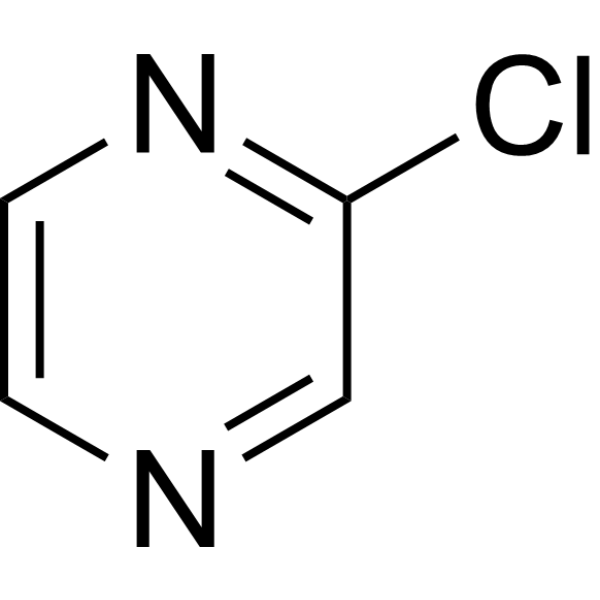 0 ImagesSynonyms: Pyrazin-2-yl chlorideChloropyrazine (Pyrazin-2-yl chloride) is a pyrazine compound that can be used for the synthesis of active compounds. Chloropyrazine can also serve as an electrolyte additive for research on lithium-sulfur batteries.
-
Ethyl 3-(4-chlorophenyl)propanoate
 0 ImagesEthyl 3-(4-chlorophenyl)propanoate (Ethyl p-chlorohydrocinnamate) is a drug intermediate for synthesis of various active compounds.
-
2-Aminomethylpyrimidine hydrochloride
 0 ImagesSynonyms: Pyrimidin-2-ylmethanamine hydrochloride2-Aminomethylpyrimidine (Pyrimidin-2-ylmethanamine) hydrochloride is a synthetic intermediate useful for pharmaceutical synthesis.
-
Ibuprofen impurity 6
 0 ImagesCat. No.: HY-W087193CAS No.: 3585-49-7Synonyms: p-Butylhydratropic AcidIbuprofen impurity 6 (p-Butylhydratropic Acid) is an impurity of Ibuprofen.
-
1-Bromo-3,5-dimethyladamantane
 0 Images1-Bromo-3,5-dimethyladamantane is an intermediate for Memantine (HY-B0591). Memantine is an orally active, noncompetitive N-methyl-D-aspartate receptor (NMDAR) antagonist. Memantine can be used for the research of moderate-to-severe Alzheimer's disease (AD).
-
Oxcarbazepine impurity 2
 0 ImagesCat. No.: HY-W103288CAS No.: 21737-58-6Oxcarbazepine impurity 2 is an impurity of Oxcarbazepine.



