



GRK6
GRK6 is a serine/threonine G protein-coupled receptor kinase that phosphorylates activated GPCRs, promotes β-arrestin recruitment, and limits receptor signaling[1]. Mechanistically, GRK6 regulates immune-cell chemotaxis through receptor desensitization and trafficking, especially in CXCR2, CXCR4, and LTB4/BLT1 signaling models[2][3][4]. In inflammatory models, GRK6 deficiency increases acute inflammation, enhances LTB4-induced neutrophil chemotaxis, and impairs G-CSF-induced neutrophil mobilization through enhanced CXCR4-mediated chemotaxis[3][4]. GRK6 also supports apoptotic cell clearance by cooperating with GIT1 to activate Rac1, linking this kinase to autoimmune disease mechanisms in mice[5]. Compared with related isoforms, GRK6 differs from GRK2 because CXCR1 predominantly couples to GRK2, whereas CXCR2 interacts with GRK6 to regulate sensitization, trafficking, and neutrophil function[2]. Compared with GRK5, GRK6 shows shared receptor-regulatory activity in some systems, but combinatorial knockout studies demonstrate cell-type-specific and GPCR-type-specific functions across neutrophils, T cells, B cells, and dendritic cells[6]. For experimental applications, GRK6 knockout, siRNA depletion, and overexpression models provide practical tools to study GPCR desensitization, β-arrestin signaling, immune migration, inflammation, and receptor-specific isoform selectivity[2][6][7].
References:
- [1]. Krupnick JG, et al. The role of receptor kinases and arrestins in G protein-coupled receptor regulation. Annu Rev Pharmacol Toxicol. 1998;38:289-319. [Content Brief]
- [2]. Fiorenza S, et al. A combination of local inflammation and central memory T cells potentiates immunotherapy in the skin. J Immunol. 2012 Dec 15;189(12):5622-31. [Content Brief]
- [3]. Kavelaars A, et al. Increased acute inflammation, leukotriene B4-induced chemotaxis, and signaling in mice deficient for G protein-coupled receptor kinase 6. J Immunol. 2003 Dec 1;171(11):6128-34. [Content Brief]
- [4]. Vroon A, et al. GRK6 deficiency is associated with enhanced CXCR4-mediated neutrophil chemotaxis in vitro and impaired responsiveness to G-CSF in vivo. J Leukoc Biol. 2004 Apr;75(4):698-704. [Content Brief]
- [5]. Nakaya M, et al. GRK6 deficiency in mice causes autoimmune disease due to impaired apoptotic cell clearance. Nat Commun. 2013;4:1532. [Content Brief]
- [6]. Glaser KM, et al. Combinatorial depletions of G-protein coupled receptor kinases in immune cells identify pleiotropic and cell type-specific functions. Front Immunol. 2022 Nov 14;13:1039803. [Content Brief]
- [7]. Burns RN, et al. Mechanisms of homologous and heterologous phosphorylation of FFA receptor 4 (GPR120): GRK6 and PKC mediate phosphorylation of Thr³⁴⁷, Ser³⁵⁰, and Ser³⁵⁷ in the C-terminal tail. Biochem Pharmacol. 2014 Feb 15;87(4):650-9. [Content Brief]
All Product Categories
-
GRK6 Related Products (2)
Related Products (2)

-
GRK6/Aurora A-IN-1
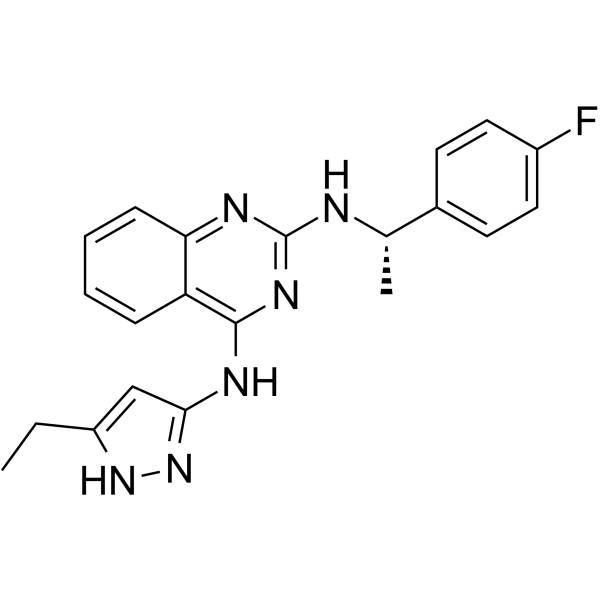 0 ImagesGRK6/Aurora A-IN-1 is a dual inhibitor of G protein-coupled receptor kinase 6 (GRK6)/Aurora A, with IC50 values of 120 nM and 11 nM, respectively. GRK6 is a key kinase required for the survival of multiple myeloma (MM) cells. GRK6-IN-2 has the potential for research on multiple myeloma.
-
GRK5-IN-5
 0 ImagesCat. No.: HY-180583CAS No.: 3061801-11-1GRK5-IN-5 (Compound 4a) is a selective G protein-coupled receptor (GPCR) kinase 5 (GRK5) inhibitor with an IC50 of 0.03 μM. GRK5-IN-5 shows IC50 values of 2.2 and 0.036 μM for GRK2 and GRK6. GRK5-IN-5 has potent anti-myocardial hypertrophy activity and also inhibits the proliferation of non-myocardial cells. GRK5-IN-5 can inhibit the abnormal upregulation of hypertrophy marker genes Nppa and Nppb, thus blocking pathological myocardial remodeling. GRK5-IN-5 can be used for the research of cardiac hypertrophy.



