



Acyl Carrier Protein (ACP) (65-74)

Based on 1 Customer Validation
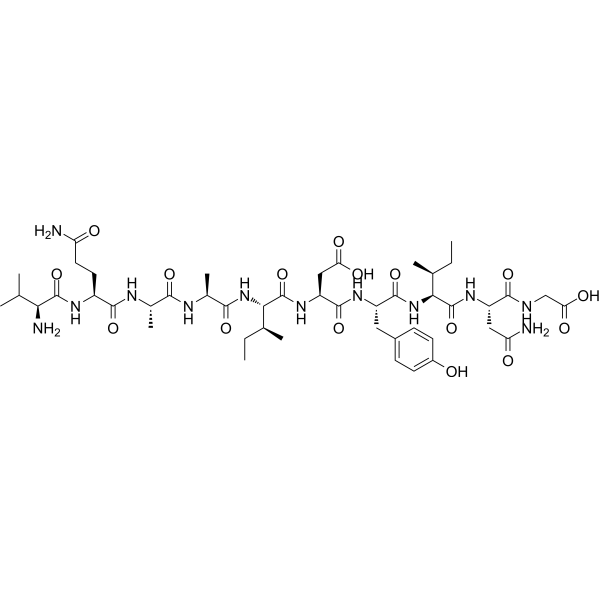
Acyl Carrier Protein (ACP) (65-74) is a key coenzyme fragment of fatty acid synthase (FAS) and participates in fatty acid synthesis as an acyl carrier. Acyl Carrier Protein (ACP) (65-74) mediates condensation, reduction and other cyclic reactions in fatty acid synthesis by covalently binding to acyl chains to form acyl-ACP intermediates, promoting acyl chain extension. Acyl Carrier Protein (ACP) (65-74) can regulate the synthesis ratio of saturated and unsaturated fatty acids. Acyl Carrier Protein (ACP) (65-74) can be used to study the mechanism of bacterial fatty acid synthesis and is a potential target for antibiotics (such as inhibiting the FAS system of pathogens).
For research use only. We do not sell to patients.
- Purity : 98.02%
- CAS No.: 66851-75-0
- Formula: C47H74N12O16
- Molecular Weight:1063.16
-
Storage:
Sealed storage, away from moisture and light, under nitrogen.
Powder -80°C, 2 years , -20°C, 1 year* In solvent : -80°C, 6 months; -20°C, 1 month (sealed storage, away from moisture and light, under nitrogen)

To place orders, for customer services and technical support, please contact: MedChemExpress USA
Tel: 609-228-6898 E-mail: [email protected] [email protected]


-
 Biological Activity
-
Chemical Information
-
Solvent & Solubility
- Purity & Documentation
- References
-
 Help & FAQs




Biological Activity
Description
In Vitro
1. Enzyme activity assay:
Acyl Carrier Protein (ACP) (65-74) (10 μM; 30 min) significantly enhances the catalytic efficiency of β-ketoacyl-ACP reductase (FabG) in in vitro enzymatic reactions, increasing the rate of NADPH-dependent reduction reactions by 3 times[1].
2. Protein interaction assay:
Acyl Carrier Protein (ACP) (65-74) (5 μM; 2 h) specifically binds to β-ketoacyl-ACP synthase III (FabH) in surface plasmon resonance (SPR) experiments with a dissociation constant K of 2.3 μM. The two may interact through a conserved acidic helical region[2].
MedChemExpress (MCE) has not independently confirmed the accuracy of these methods. They are for reference only.


Chemical Information
-
CAS No. 66851-75-0
-
Appearance Solid
-
Molecular Weight 1063.16
-
Formula C47H74N12O16
-
Color White to off-white
-
Sequence
Val-Gln-Ala-Ala-Ile-Asp-Tyr-Ile-Asn-Gly
-
Sequence Shortening
VQAAIDYING
-
Shipping
Room temperature in continental US; may vary elsewhere.
-
Storage
Sealed storage, away from moisture and light, under nitrogen
Powder -80°C 2 years -20°C 1 year * In solvent : -80°C, 6 months; -20°C, 1 month (sealed storage, away from moisture and light, under nitrogen)


Solvent & Solubility
In Vitro:
DMSO : ≥ 1.6 mg/mL (1.50 mM; Hygroscopic DMSO has a significant impact on the solubility of product, please use newly opened DMSO)
* "≥" means soluble, but saturation unknown.
Please refer to the solubility information to select the appropriate solvent. Once prepared, please aliquot and store the solution to prevent product inactivation from repeated freeze-thaw cycles.
Storage method and period of stock solution: -80°C, 6 months; -20°C, 1 month (sealed storage, away from moisture and light, under nitrogen). When stored at -80°C, please use it within 6 months. When stored at -20°C, please use it within 1 month.
Please refer to the solubility information to select the appropriate solvent. Once prepared, please aliquot and store the solution to prevent product inactivation from repeated freeze-thaw cycles.
Storage method and period of stock solution: -80°C, 6 months; -20°C, 1 month (sealed storage, away from moisture and light, under nitrogen). When stored at -80°C, please use it within 6 months. When stored at -20°C, please use it within 1 month.
Concentration (start) × Volume (start) = Concentration (final) × Volume (final)


Purity & Documentation
-
Data Sheet (273 KB)
-
SDS (252 KB)
- English - EN (252 KB)
- Français - FR (252 KB)
- Deutsch - DE (252 KB)
- Norwegian - NO (252 KB)
- Español - ES (252 KB)
- Swedish - SV (252 KB)
- Italian - IT (252 KB)
- Korean - KR (252 KB)
- Portuguese - PT (252 KB)
-
Handling Instructions (2659 KB)
References
[1]. Peng X, et al. An Acyl Carrier Protein Gene Affects Fatty Acid Synthesis and Growth of Hermetia illucens. Insects. 2023 Mar 21;14(3):300. [Content Brief]
[2]. Seo DW, et al. An endogenous proteinacious inhibitor in porcine liver for S-adenosyl-L-methionine dependent methylation reactions: identification as oligosaccharide-linked acyl carrier protein. Int J Biochem Cell Biol. 2000 Apr;32(4):455-64. [Content Brief]
[3]. Chan DI, et al. Current understanding of fatty acid biosynthesis and the acyl carrier protein. Biochem J. 2010 Aug 15;430(1):1-19. [Content Brief]


Complete Stock Solution Preparation Table
Please refer to the solubility information to select the appropriate solvent. Once prepared, please aliquot and store the solution to prevent product inactivation from repeated freeze-thaw cycles.
Storage method and period of stock solution: -80°C, 6 months; -20°C, 1 month (sealed storage, away from moisture and light, under nitrogen). When stored at -80°C, please use it within 6 months. When stored at -20°C, please use it within 1 month.
| Optional Solvent | Concentration Solvent Mass | 1 mg | 5 mg | 10 mg | 25 mg |
|---|---|---|---|---|---|
| DMSO | 1 mM | 0.9406 mL | 4.7030 mL | 9.4059 mL | 23.5148 mL |


Acyl Carrier Protein (ACP) (65-74) Related Classifications
HY-P1743 Related Classifications
 Powered by Bioz