



ALKBH5 Antibody (YA3429)
(Synonyms: ABH5,AlkB,OFOXD,OFOXD1,RNA demethylase ALKBH5 antibody)
Based on 1 Customer Validation
ALKBH5 Antibody (YA3429) is a Rabbit-derived and non-conjugated IgG monoclonal antibody, targeting to ALKBH5.
-
Host:
Rabbit
-
Isotype:
IgG
-
Application:
WB, IHC-P
-
Reactivity :
Human, Mouse, Rat
-
Formulation:
Supplied in PBS (pH7.4), 0.1% BSA, 40% Glycerol. Preservative: 0.05% Sodium Azide.
-
Conjugation:
Non-conjugated


To place orders, for customer services and technical support, please contact: MedChemExpress USA
Tel: 609-228-6898 E-mail: [email protected] [email protected]





Applications
| Application |
WB

WB: Western Blot
|
IHC-P
IHC-P: Immunohistochemistry-Paraffin
|
|---|---|---|
| Dilution Ratio | 1:1000 | 1:1000-1:2000 |


Product Details
ALKBH5 Antibody (YA3429) is a Rabbit-derived and non-conjugated IgG monoclonal antibody, targeting to ALKBH5.
-
Host Rabbit

-
Clonality Monoclonal, Recombinant

-
Species ReactivityHuman, Mouse, Rat
-
Observed Molecular WeightObserved band size: 44 kDa
Note: Due to possible protein modifications or aggregation, the molecular weight should be confirmed by actual measurement, and the predicted value is for reference only.

-
Calculated Molecular Weight Predicted band size: 44 kDa

Entrez Gene: 54890 Human ; 268420 Mouse ; 303193 Rat
SwissProt: Q6P6C2 Human ; Q3TSG4 Mouse ; D3ZKD3 Rat
OMIM: 613303 Human
Recombinant protein within human ALKBH5 aa 51-350 / 394.
Endogenous
affinity purified
Non-conjugated
Unmodified
IgG


Product Properties
-
Appearance
Liquid
-
Formulation
Supplied in PBS (pH7.4), 0.1% BSA, 40% Glycerol. Preservative: 0.05% Sodium Azide.
-
Concentration
Batch-dependent, Please check the COA for the concentration of each lot. Check Lot Concentration
-
Storage & Stability
Stored at -20°C for 1 year. Avoid repeated freeze / thaw cycles.
-
Shipping
Shipping with blue ice.


Verification Images
-
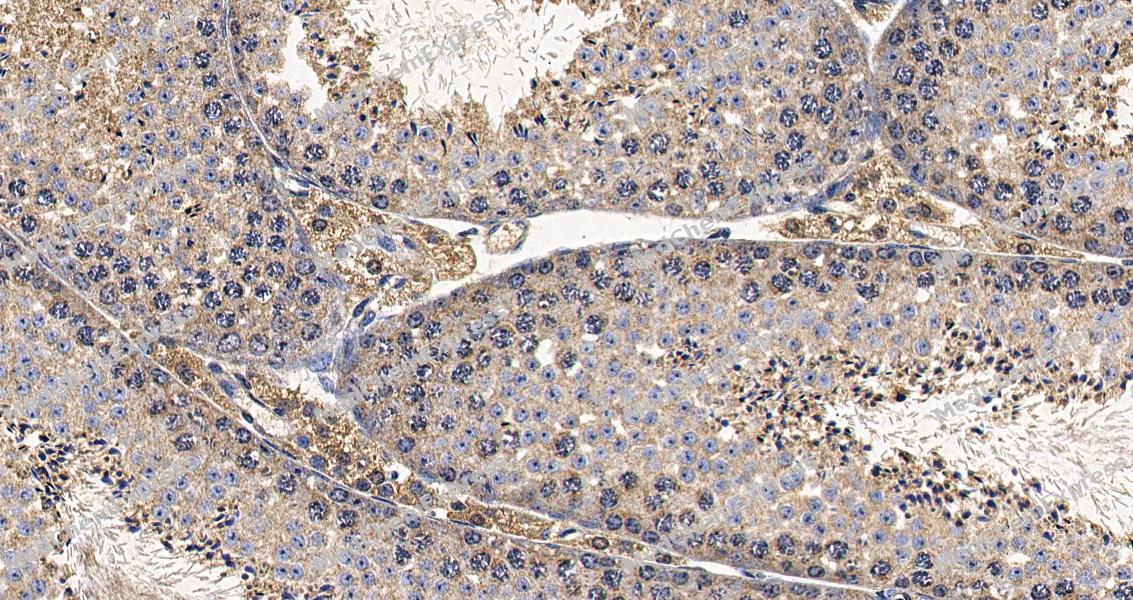 Immunohistochemical analysis of paraffin-embedded mouse testis tissue using ALKBH5 Antibody. The section was pre-treated using heat mediated antigen retrieval with sodium citrate buffer (pH 6.0) for 8 minutes. The tissues were blocked in QuickBlock for 20 minutes at room temperature, washed with ddH2O and PBS, and then probed with the primary antibody at 1/100 dilution in 4℃ overnight. The detection was performed using an HRP conjugated compact polymer system. DAB was used as the chromogen. Tissues were counterstained with hematoxylin and mounted with DPX.
 -
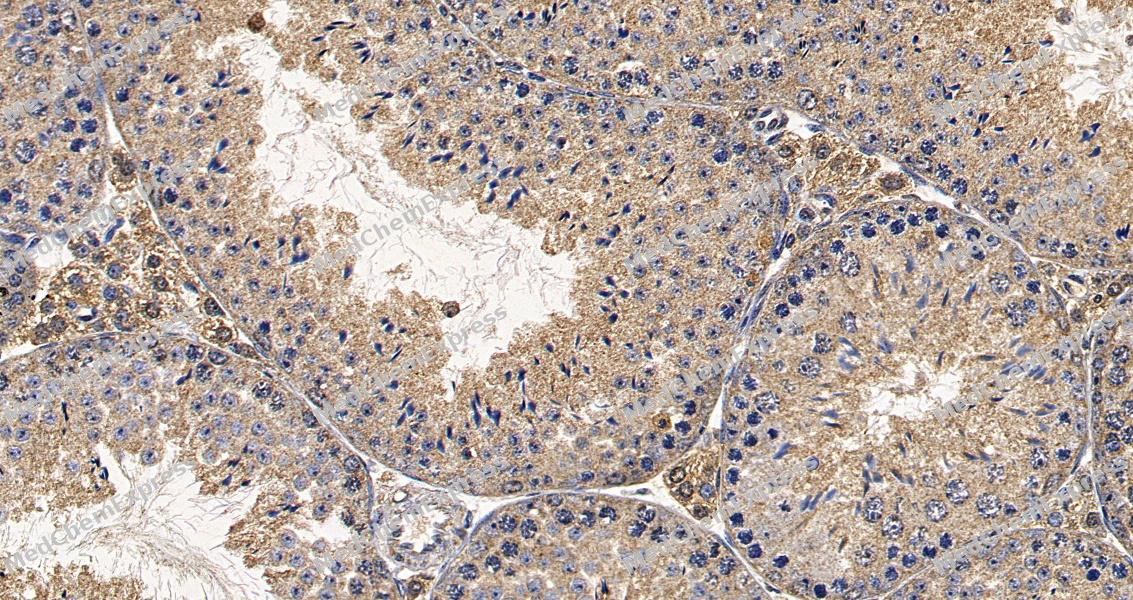 Immunohistochemical analysis of paraffin-embedded mouse testis tissue using ALKBH5 Antibody. The section was pre-treated using heat mediated antigen retrieval with sodium citrate buffer (pH 6.0) for 8 minutes. The tissues were blocked in QuickBlock for 20 minutes at room temperature, washed with ddH2O and PBS, and then probed with the primary antibody at 1/100 dilution in 4℃ overnight. The detection was performed using an HRP conjugated compact polymer system. DAB was used as the chromogen. Tissues were counterstained with hematoxylin and mounted with DPX.


Background
-
Function
ALKBH5 is a Dioxygenase that specifically demethylates N(6)-methyladenosine (m6A) RNA, the most prevalent internal modification of messenger RNA (mRNA) in higher eukaryotes. Demethylates RNA by oxidative demethylation, which requires molecular oxygen, alpha-ketoglutarate and iron. Demethylation of m6A mRNA affects mRNA processing, translation and export. Can also demethylate N(6)-methyladenosine in single-stranded DNA (in vitro). Required for the late meiotic and haploid phases of spermatogenesis by mediating m6A demethylation in spermatocytes and round spermatids: m6A demethylation of target transcripts is required for correct splicing and the production of longer 3'-UTR mRNAs in male germ cells. Involved in paraspeckle assembly, a nuclear membraneless organelle, by undergoing liquid-liquid phase separation. Paraspeckle assembly is coupled with m6A demethylation of RNAs, such as NEAT1 non-coding RNA. Also acts as a negative regulator of T-cell development: inhibits gamma-delta T-cell proliferation via demethylation of JAG1 and NOTCH2 transcripts. Inhibits regulatory T-cell (Treg) recruitment by mediating demethylation and destabilization of CCL28 mRNAs[1][2][3][4][5][6][7][8][9][10].
-
Subcellular Localization
Nucleus speckle
-
Expression
Tissue_specificity:Widely expressed, with highest expression in lung, followed by testis, pancreas, spleen and ovary
Induction:By hypoxia, directly activated by HIF1A. Expression is regulated by PRMT7
Positive sample: HEK-293 cell lysate, Jurkat cell lysate, HeLa cell lysate, HepG2 cell lysate, MCF7 cell lysate, F9 cell lysate, PC-12 cell lysate, rat testis tissue lysate, -
Isoforms & Post-Translational Modification
Q6P6C2 has 3 isomers: Q6P6C2-2: 44256 Da (predicted); Q6P6C2-1: 52255 Da (predicted); Q6P6C2-3: 43049 Da (predicted).
Phosphorylated at Ser-87 and Ser-325 in response to reactive oxygen species (ROS), promoting sumoylation and inactivation;Acetylated by KAT8 at Lys-235, promoting interaction with PSPC1, thereby facilitating recognition of N(6)-methyladenosine (m6A) mRNA by ALKBH5 (PubMed:37369679). Deacetylated at Lys-235 by HDAC7 (PubMed:37369679);Sumoylated at Lys-86 and Lys-321 by PIAS4 following phosphorylation at Ser-87 and Ser-325 in response to reactive oxygen species (ROS), inhibiting the RNA demethylase activity (PubMed:34048572, PubMed:37257451). Desumoylated by SENP1; relieving RNA demethylase inhibition, leading to N(6)-methyladenosine-containing mRNAs demethylation (PubMed:34048572, PubMed:37257451);Ubiquitinated at Lys-57 via 'Lys-48'-linked polyubiquitin chain, leading to its degradation by the proteasome (PubMed:37454738). Deubiquitinated at Lys-57 by USP9X, promoting its stabilizazion (PubMed:37454738) -
Subunit
Monomer (PubMed:24778178). Interacts with RBM33; promoting desumoylation by SENP1 and recruitment to N(6)-methyladenosine-containing mRNAs (PubMed:37257451). Interacts (when acetylated by KAT8) with PSPC1; interaction facilitates recognition of N(6)-methyladenosine (m6A) mRNA (PubMed:37369679)
-
SwissProt ID
-
Synonyms
ABH5,AlkB,OFOXD,OFOXD1,RNA demethylase ALKBH5 antibody


Documentation
-
Data Sheet (259 KB)
-
SDS (251 KB)
- English - EN (251 KB)
- Français - FR (251 KB)
- Deutsch - DE (251 KB)
- Norwegian - NO (251 KB)
- Español - ES (251 KB)
- Swedish - SV (251 KB)
- Italian - IT (251 KB)
- Korean - KR (251 KB)
- Portuguese - PT (251 KB)
-
User Guide for Antibodies (1077 KB)

 Powered by Bioz
