



CARM1 Antibody (YA812)
(Synonyms: PRMT4; CARM1)
Based on 1 Customer Validation
CARM1 Antibody (YA812) is a Mouse-derived and non-conjugated IgG1 monoclonal antibody, targeting to CARM1.
-
Host:
Mouse
-
Isotype:
IgG
-
Application:
WB, IP
-
Reactivity :
Human, Mouse
-
Formulation:
Supplied in 1*PBS (pH 7.3), 50% glycerol and 0.5% BSA. Preservative: 0.02% sodium azide.
-
Conjugation:
Non-conjugated


To place orders, for customer services and technical support, please contact: MedChemExpress USA
Tel: 609-228-6898 E-mail: [email protected] [email protected]





Applications
| Application |
WB

WB: Western Blot
|
IP
IP: Immunoprecipitation
|
|---|---|---|
| Dilution Ratio | 1:500-1:1000 | 1:20 |


Product Details
CARM1 Antibody (YA812) is a Mouse-derived and non-conjugated IgG1 monoclonal antibody, targeting to CARM1.
-
Host Mouse

-
Clonality Monoclonal

-
Species ReactivityHuman, Mouse
-
Observed Molecular WeightObserved band size: 63 kDa
Note: Due to possible protein modifications or aggregation, the molecular weight should be confirmed by actual measurement, and the predicted value is for reference only.

-
Calculated Molecular Weight Predicted band size: 66 kDa

Entrez Gene: 10498 Human ; 59035 Mouse ;
SwissProt: Q86X55 Human ; Q9WVG6 Mouse ;
OMIM: 603934 Human
Synthetic peptide corresponding to Human PRMT4/CARM1.The exact sequence is proprietary to MCE.
Endogenous
affinity purified
Non-conjugated
Unmodified
IgG


Product Properties
-
Appearance
Solution
-
Formulation
Supplied in 1*PBS (pH 7.3), 50% glycerol and 0.5% BSA. Preservative: 0.02% sodium azide.
-
Storage & Stability
Stored at -20°C for 1 year. Avoid repeated freeze / thaw cycles.
-
Shipping
Shipping with blue ice.


Verification Images
-
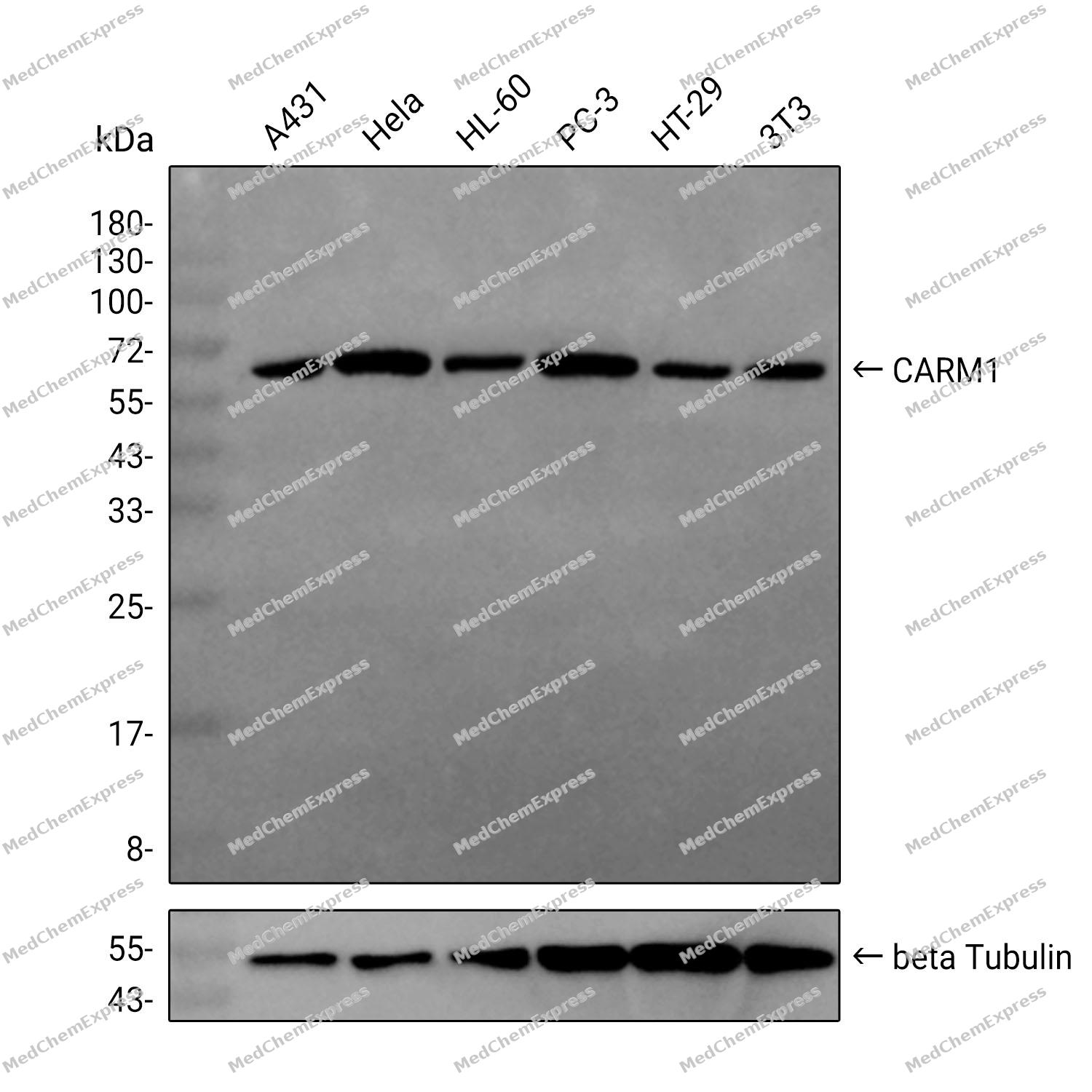 Western blot analysis was performed on extracts from A431 (lane 1, 15 μg), Hela (lane 2, 15 μg), HL-60 (lane 3, 15 μg), PC-3 (lane 4, 15 μg), HT-29 (lane 5, 15 μg), and 3T3 (lane 6, 15 μg) using CARM1 Mouse mAb.Proteins were transferred to a PVDF membrane and blocked with 5% non-fat milk in TBST at 4°C overnight.The primary antibody (1:1000 dilution) and the loading control antibody (beta-Tubulin, HY-P80955, 1:5000 dilution) was incubated in 5% non-fat milk in TBST for 1 hour at 37°C.Goat Anti-Mouse IgG-HRP Secondary Antibody (1:20000 dilution) was then applied for 40 minutes at 37°C.


Background
-
Function
CARM1 methylates (mono- and asymmetric dimethylation) the guanidino nitrogens of arginyl residues in several proteins involved in DNA packaging, transcription regulation, pre-mRNA splicing, and mRNA stability. Recruited to promoters upon gene activation together with histone acetyltransferases from EP300/P300 and p160 families, methylates histone H3 at 'Arg-17' (H3R17me), forming mainly asymmetric dimethylarginine (H3R17me2a), leading to activation of transcription via chromatin remodeling. During nuclear hormone receptor activation and TCF7L2/TCF4 activation, acts synergically with EP300/P300 and either one of the p160 histone acetyltransferases NCOA1/SRC1, NCOA2/GRIP1 and NCOA3/ACTR or CTNNB1/beta-catenin to activate transcription. During myogenic transcriptional activation, acts together with NCOA3/ACTR as a coactivator for MEF2C. During monocyte inflammatory stimulation, acts together with EP300/P300 as a coactivator for NF-kappa-B. Acts as a coactivator for PPARG, promotes adipocyte differentiation and the accumulation of brown fat tissue. Plays a role in the regulation of pre-mRNA alternative splicing by methylation of splicing factors. Also seems to be involved in p53/TP53 transcriptional activation. Methylates EP300/P300, both at 'Arg-2142', which may loosen its interaction with NCOA2/GRIP1, and at 'Arg-580' and 'Arg-604' in the KIX domain, which impairs its interaction with CREB and inhibits CREB-dependent transcriptional activation. Also methylates arginine residues in RNA-binding proteins PABPC1, ELAVL1 and ELAV4, which may affect their mRNA-stabilizing properties and the half-life of their target mRNAs. Acts as a transcriptional coactivator of ACACA/acetyl-CoA carboxylase by enriching H3R17 methylation at its promoter, thereby positively regulating fatty acid synthesis. Independently of its methyltransferase activity, involved in replication fork progression: promotes PARP1 recruitment to replication forks, leading to poly-ADP-ribosylation of chromatin at replication forks and reduced fork speed[1][2][3][4][5].
-
Subcellular Localization
Nucleus; Cytoplasm; Chromosome
-
Expression
Tissue_specificity:Overexpressed in prostate adenocarcinoma and high-grade prostate intraepithelial neoplasia. -
Isoforms & Post-Translational Modification
Q86X55 has 3 isomers: Q86X55-3: 65854 Da (predicted); Q86X55-1: 63460 Da (predicted); Q86X55-2: 41885 Da (predicted).
Auto-methylated on Arg-550. Methylation enhances transcription coactivator activity. Methylation is required for its role in the regulation of pre-mRNA alternative splicing (By similarity);Phosphorylation at Ser-216 is strongly increased during mitosis, and decreases rapidly to a very low, basal level after entry into the G1 phase of the cell cycle (PubMed:19843527). Phosphorylation at Ser-216 may promote location in the cytosol. Phosphorylation at Ser-216 interferes with S-adenosyl-L-methionine binding and strongly reduces methyltransferase activity (By similarity);Ubiquitinated by E3 ubiquitin-protein ligase complex containing FBXO9 at Lys-227; leading to proteasomal degradation -
Subunit
Homodimer (By similarity). Interacts with NR1H4 (PubMed:15471871). Interacts with SNRPC (By similarity). Interacts with the C-terminus of NCOA2/GRIP1, NCO3/ACTR and NCOA1/SRC1 (By similarity). Part of a complex consisting of CARM1, EP300/P300 and NCOA2/GRIP1 (By similarity). Interacts with FLII, TP53, myogenic factor MEF2, EP300/P300, TRIM24, CREBBP and CTNNB1 (By similarity). Interacts with RELA (PubMed:16497732). Identified in a complex containing CARM1, TRIM24 and NCOA2/GRIP1 (By similarity). Interacts with NCOA3/SRC3 (By similarity). Interacts with SKP2 (By similarity). Interacts (via PH domain-like fold) with C9orf72 (By similarity). Interacts with PARP1; promoting PARP1 recruimtent to replication forks (PubMed:33412112)
-
SwissProt ID
-
Synonyms
PRMT4; CARM1
-
Research Field
Cell Biology


Documentation
References
[1]. Li H, et al. Lipopolysaccharide-induced methylation of HuR, an mRNA-stabilizing protein, by CARM1. Coactivator-associated arginine methyltransferase. J Biol Chem. 2002 Nov 22;277(47):44623-30. [Content Brief]
[2]. Miao F, et al. Coactivator-associated arginine methyltransferase-1 enhances nuclear factor-kappaB-mediated gene transcription through methylation of histone H3 at arginine 17. Mol Endocrinol. 2006 Jul;20(7):1562-73. [Content Brief]
[3]. Lakowski TM, et al. Kinetic analysis of human protein arginine N-methyltransferase 2: formation of monomethyl- and asymmetric dimethyl-arginine residues on histone H4. Biochem J. 2009 Jun 26;421(2):253-61. [Content Brief]
[4]. Lee YH, et al. Regulation of coactivator complex assembly and function by protein arginine methylation and demethylimination. Proc Natl Acad Sci U S A. 2005 Mar 8;102(10):3611-6. [Content Brief]
[5]. Genois MM, et al. CARM1 regulates replication fork speed and stress response by stimulating PARP1. Mol Cell. 2021 Feb 18;81(4):784-800.e8. [Content Brief]

 Powered by Bioz
