



CSNK2A1 Antibody (YA2833)
(Synonyms: CSNK2A1; CK2A1; Casein kinase II subunit alpha; CK II alpha)
Based on 1 Customer Validation
CSNK2A1 Antibody (YA2833) is a Rabbit-derived and non-conjugated IgG monoclonal antibody, targeting to CSNK2A1.
-
Host:
Rabbit
-
Isotype:
IgG
-
Application:
WB
-
Reactivity :
Human, Mouse, Rat
-
Formulation:
Supplied in 50mM Tris-Glycine(pH 7.4), 0.15M NaCl, 40% Glycerol, 0.01% Sodium azide and 0.05% BSA
-
Conjugation:
Non-conjugated


To place orders, for customer services and technical support, please contact: MedChemExpress USA
Tel: 609-228-6898 E-mail: [email protected] [email protected]





Applications
| Application |
WB

WB: Western Blot
|
|---|---|
| Dilution Ratio | 1:500-1:1000 |


Product Details
CSNK2A1 Antibody (YA2833) is a Rabbit-derived and non-conjugated IgG monoclonal antibody, targeting to CSNK2A1.
-
Host Rabbit

-
Clonality Recombinant, Monoclonal

-
Species ReactivityHuman, Mouse, Rat
-
Observed Molecular WeightObserved band size: 45 kDa
Note: Due to possible protein modifications or aggregation, the molecular weight should be confirmed by actual measurement, and the predicted value is for reference only.

-
Calculated Molecular Weight Predicted band size: 45 kDa

Entrez Gene: 1457 Human ; 12995 Mouse ; 116549 Rat
SwissProt: P68400 Human ; Q60737 Mouse ; P19139 Rat
OMIM: 617062 Human
A synthetic peptide of human CSNK2A1
Endogenous
Affinity Purified
Non-conjugated
Unmodified
IgG


Product Properties
-
Appearance
Liquid
-
Formulation
Supplied in 50mM Tris-Glycine(pH 7.4), 0.15M NaCl, 40% Glycerol, 0.01% Sodium azide and 0.05% BSA
-
Concentration
Batch-dependent, Please check the COA for the concentration of each lot. Check Lot Concentration
-
Storage & Stability
Stored at -20°C for 1 year. Avoid repeated freeze / thaw cycles.
-
Shipping
Shipping with blue ice.


Verification Images
-
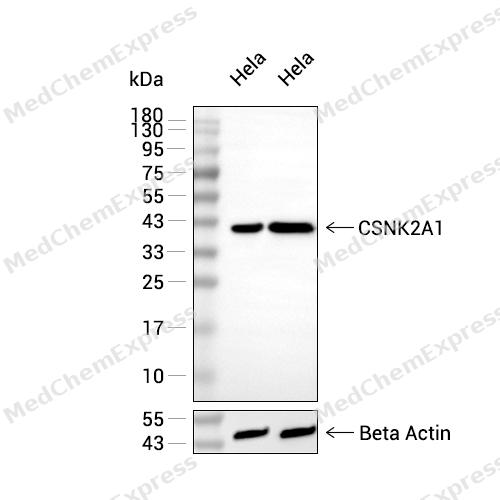 Western blot analysis of extracts from Hela (lane 2(20μg), Hela (lane 3(40μg), using CSNK2A1 Antibody. Proteins were transferred to a PVDF membrane and blocked with 5% BSA in TBST for 2 hour at room temperature. The primary antibody and Loading control antibody (Beta Actin, HY-P80438, 1/3000) was used in 5% BSA in TBST at 4°C overnight. Goat Anti-Mouse/Rabbit IgG-HRP Secondary Antibody (HY-P8004/HY-P8001, 1/10,000) was used for 1 hour at room temperature.


Background
-
Function
CSNK2A1 is a Catalytic subunit of a constitutively active serine/threonine-protein kinase complex that phosphorylates a large number of substrates containing acidic residues C-terminal to the phosphorylated serine or threonine. Regulates numerous cellular processes, such as cell cycle progression, apoptosis and transcription, as well as viral infection. May act as a regulatory node which integrates and coordinates numerous signals leading to an appropriate cellular response. During mitosis, functions as a component of the p53/TP53-dependent spindle assembly checkpoint (SAC) that maintains cyclin-B-CDK1 activity and G2 arrest in response to spindle damage. Also required for p53/TP53-mediated apoptosis, phosphorylating 'Ser-392' of p53/TP53 following UV irradiation. Phosphorylates a number of DNA repair proteins in response to DNA damage, such as MDC1, MRE11, RAD9A, RAD51 and HTATSF1, promoting their recruitment to DNA damage sites. Can also negatively regulate apoptosis. Phosphorylates the caspases CASP9 and CASP2 and the apoptotic regulator NOL3. Phosphorylation protects CASP9 from cleavage and activation by CASP8, and inhibits the dimerization of CASP2 and activation of CASP8. Phosphorylates YY1, protecting YY1 from cleavage by CASP7 during apoptosis. Regulates transcription by direct phosphorylation of RNA polymerases I, II, III and IV. Also phosphorylates and regulates numerous transcription factors including NF-kappa-B, STAT1, CREB1, IRF1, IRF2, ATF1, ATF4, SRF, MAX, JUN, FOS, MYC and MYB. Phosphorylates Hsp90 and its co-chaperones FKBP4 and CDC37, which is essential for chaperone function. Mediates sequential phosphorylation of FNIP1, promoting its gradual interaction with Hsp90, leading to activate both kinase and non-kinase client proteins of Hsp90. Regulates Wnt signaling by phosphorylating CTNNB1 and the transcription factor LEF1. Acts as an ectokinase that phosphorylates several extracellular proteins. During viral infection, phosphorylates various proteins involved in the viral life cycles of EBV, HSV, HBV, HCV, HIV, CMV and HPV. Phosphorylates PML at 'Ser-565' and primes it for ubiquitin-mediated degradation. Plays an important role in the circadian clock function by phosphorylating BMAL1 at 'Ser-90' which is pivotal for its interaction with CLOCK and which controls CLOCK nuclear entry. Phosphorylates CCAR2 at 'Thr-454' in gastric carcinoma tissue. Phosphorylates FMR1, promoting FMR1-dependent formation of a membraneless compartment. May phosphorylate histone H2A on 'Ser-1'[1][2][3][4][5][6][7][8][9][10][11][12][13][14][15][16][17][18][19][20][21][22][23][24][25][26][27][28][29].
-
Subcellular Localization
Nucleus
-
Expression
Tissue_specificity:Expressed in gastric carcinoma tissue and the expression gradually increases with the progression of the carcinoma (at protein level) -
Isoforms & Post-Translational Modification
P68400 has 2 isomers: P68400-1: 45144 Da (predicted); P68400-2: 29181 Da (predicted).
Phosphorylated at Thr-344, Thr-360, Ser-362 and Ser-370 by CDK1 in prophase and metaphase and dephosphorylated during anaphase. Phosphorylation does not directly affect casein kinase 2 activity, but may contribute to its regulation by forming binding sites for interacting proteins and/or targeting it to different compartments -
Subunit
Heterotetramer composed of two catalytic subunits (alpha chain and/or alpha' chain) and two regulatory subunits (beta chains). The tetramer can exist as a combination of 2 alpha/2 beta, 2 alpha'/2 beta or 1 alpha/1 alpha'/2 beta subunits.
-
SwissProt ID
-
Synonyms
CSNK2A1; CK2A1; Casein kinase II subunit alpha; CK II alpha
-
Research Field
Cell Biology


Documentation
-
Data Sheet (235 KB)
-
SDS (251 KB)
- English - EN (251 KB)
- Français - FR (251 KB)
- Deutsch - DE (251 KB)
- Norwegian - NO (251 KB)
- Español - ES (251 KB)
- Swedish - SV (251 KB)
- Italian - IT (251 KB)
- Korean - KR (251 KB)
- Portuguese - PT (251 KB)
-
User Guide for Antibodies (1077 KB)

 Powered by Bioz
