



Dynactin 1 Antibody (YA869)
(Synonyms: Dynactin subunit 1, 150 kDa dynein-associated polypeptide, DAP-150, p135, p150-glued, DP-150, DCTN1)
Based on 1 Customer Validation
Dynactin 1 Antibody (YA869) is a Mouse-derived and non-conjugated IgG2b monoclonal antibody, targeting to Dynactin 1.
-
Host:
Mouse
-
Isotype:
IgG
-
Application:
WB, IP
-
Reactivity :
Human
-
Formulation:
Supplied in PBS containing 50% glycerol, 0.5% BSA and 0.02% sodium azide, pH 7.3.
-
Conjugation:
Non-conjugated


To place orders, for customer services and technical support, please contact: MedChemExpress USA
Tel: 609-228-6898 E-mail: [email protected] [email protected]





Applications
| Application |
WB

WB: Western Blot
|
IP
IP: Immunoprecipitation
|
|---|---|---|
| Dilution Ratio | 1:1000 | 1:20 |


Product Details
Dynactin 1 Antibody (YA869) is a Mouse-derived and non-conjugated IgG2b monoclonal antibody, targeting to Dynactin 1.
-
Host Mouse

-
Clonality Monoclonal

-
Species ReactivityHuman
-
Observed Molecular WeightObserved band size: 142 kDa
Note: Due to possible protein modifications or aggregation, the molecular weight should be confirmed by actual measurement, and the predicted value is for reference only.

-
Calculated Molecular Weight Predicted band size: 142 kDa

Purified recombinant Dynactin 1 protein fragments expressed in E.coli
Endogenous
Affinity Purified
Non-conjugated
Unmodified
IgG


Product Properties
-
Appearance
Solution
-
Formulation
Supplied in PBS containing 50% glycerol, 0.5% BSA and 0.02% sodium azide, pH 7.3.
-
Concentration
Batch-dependent, Please check the COA for the concentration of each lot. Check Lot Concentration
-
Storage & Stability
Stored at -20°C for 1 year. Avoid repeated freeze / thaw cycles.
-
Shipping
Shipping with blue ice.


Verification Images
-
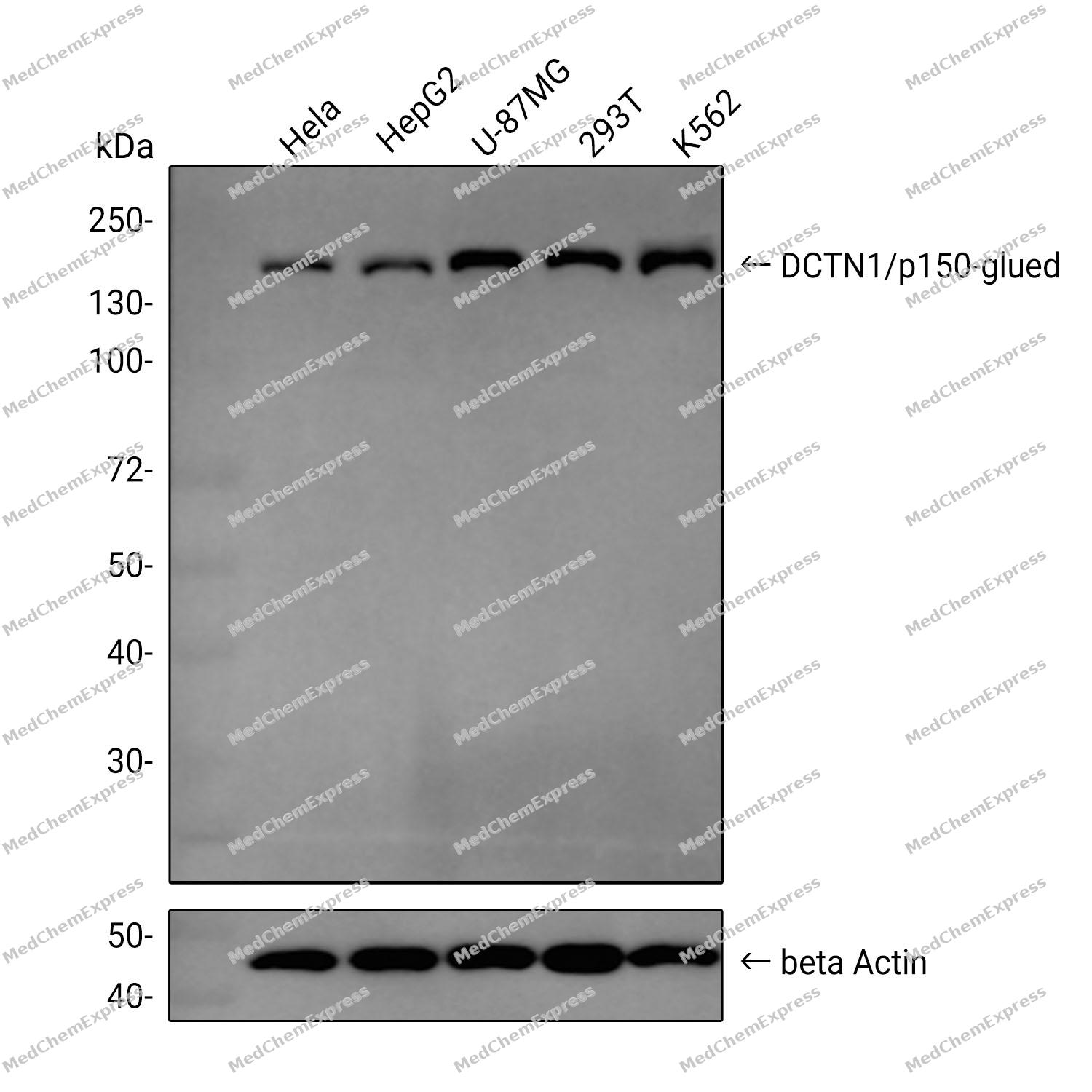 Western blot analysis was performed on extracts from Hela (lane 1, 15 μg), HepG2 (lane 2, 15 μg), U-87MG (lane 3, 15 μg), 293T (lane 4, 15 μg), and K562 (lane 5, 15 μg) using DCTN1/p150-glued Mouse mAb.Proteins were transferred to a PVDF membrane and blocked with 5% non-fat milk in TBST at 4°C overnight.The primary antibody (1:1000 dilution) and the loading control antibody (beta-Actin, HY-P80438, 1:5000 dilution) was incubated in 5% non-fat milk in TBST for 1 hour at 37°C.Goat Anti-Mouse IgG-HRP Secondary Antibody (1:20000 dilution) was then applied for 40 minutes at 37°C.


Background
-
Function
Dynactin 1 is a Part of the dynactin complex that activates the molecular motor dynein for ultra-processive transport along microtubules. Plays a key role in dynein-mediated retrograde transport of vesicles and organelles along microtubules by recruiting and tethering dynein to microtubules. Binds to both dynein and microtubules providing a link between specific cargos, microtubules and dynein. Essential for targeting dynein to microtubule plus ends, recruiting dynein to membranous cargos and enhancing dynein processivity (the ability to move along a microtubule for a long distance without falling off the track). Can also act as a brake to slow the dynein motor during motility along the microtubule. Can regulate microtubule stability by promoting microtubule formation, nucleation and polymerization and by inhibiting microtubule catastrophe in neurons. Inhibits microtubule catastrophe by binding both to microtubules and to tubulin, leading to enhanced microtubule stability along the axon. Plays a role in metaphase spindle orientation. Plays a role in centriole cohesion and subdistal appendage organization and function. Its recruitment to the centriole in a KIF3A-dependent manner is essential for the maintenance of centriole cohesion and the formation of subdistal appendage. Also required for microtubule anchoring at the mother centriole. Plays a role in primary cilia formation[1][2][3][4][5].
-
Subcellular Localization
Cytoplasm; Cytoplasm, cytoskeleton; Cytoplasm, cytoskeleton, microtubule organizing center, centrosome; Cytoplasm, cytoskeleton, microtubule organizing center, centrosome, centriole; Cytoplasm, cytoskeleton, spindle; Nucleus envelope; Cytoplasm, cell cortex
-
Expression
Tissue_specificity:brain -
Isoforms & Post-Translational Modification
Q14203 has 6 isomers: Q14203-1: 141695 Da (predicted); Q14203-2: 127404 Da (predicted); Q14203-3: 136820 Da (predicted); Q14203-4: 138750 Da (predicted); Q14203-5: 126733 Da (predicted); Q14203-6: 140887 Da (predicted).
Ubiquitinated by a SCF complex containing FBXL5, leading to its degradation by the proteasome;Phosphorylation by SLK at Thr-145, Thr-146 and Thr-147 targets DCTN1 to the centrosome. It is uncertain if SLK phosphorylates all three threonines or one or two of them. PLK1-mediated phosphorylation at Ser-179 is essential for its localization in the nuclear envelope, promotes its dissociation from microtubules during early mitosis and positively regulates nuclear envelope breakdown during prophase -
Subunit
Monomer and homodimer (PubMed:23874158). Subunit of dynactin, a multiprotein complex part of a tripartite complex with dynein and a adapter, such as BICDL1, BICD2 or HOOK3.
-
SwissProt ID
-
Synonyms
Dynactin subunit 1, 150 kDa dynein-associated polypeptide, DAP-150, p135, p150-glued, DP-150, DCTN1
-
Research Field
Cell Biology


Documentation
-
Data Sheet (261 KB)
-
SDS (252 KB)
- English - EN (252 KB)
- Français - FR (252 KB)
- Deutsch - DE (252 KB)
- Norwegian - NO (252 KB)
- Español - ES (252 KB)
- Swedish - SV (252 KB)
- Italian - IT (252 KB)
- Korean - KR (252 KB)
- Portuguese - PT (252 KB)
-
User Guide for Antibodies (1077 KB)
References
[1]. Ayloo S, et al. Dynactin functions as both a dynamic tether and brake during dynein-driven motility. Nat Commun. 2014 Sep 4;5:4807. [Content Brief]
[2]. Lazarus JE, et al. Dynactin subunit p150(Glued) is a neuron-specific anti-catastrophe factor. PLoS Biol. 2013 Jul;11(7):e1001611. [Content Brief]
[3]. Kiyomitsu T, et al. Chromosome- and spindle-pole-derived signals generate an intrinsic code for spindle position and orientation. Nat Cell Biol. 2012 Feb 12;14(3):311-7. [Content Brief]
[4]. Kodani A, et al. Kif3a interacts with Dynactin subunit p150 Glued to organize centriole subdistal appendages. EMBO J. 2013 Feb 20;32(4):597-607. [Content Brief]
[5]. Chen TY, et al. Cell Cycle-Dependent Localization of Dynactin Subunit p150 glued at Centrosome. J Cell Biochem. 2015 Sep;116(9):2049-60. [Content Brief]

 Powered by Bioz
