



EDD Antibody (YA2630)
(Synonyms: DD5; EDD; EDD1; hHYD; HYD; Rat100; Ubiquitin protein ligase; UBR5)
Based on 1 Customer Validation
EDD Antibody (YA2630) is a Rabbit-derived and non-conjugated IgG monoclonal antibody, targeting to EDD.
-
Host:
Rabbit
-
Isotype:
IgG
-
Application:
WB
-
Reactivity :
Human, Mouse
-
Formulation:
Supplied in PBS containing 50% glycerol, 0.5% BSA and 0.02% sodium azide, pH 7.3.
-
Conjugation:
Non-conjugated


To place orders, for customer services and technical support, please contact: MedChemExpress USA
Tel: 609-228-6898 E-mail: [email protected] [email protected]





Applications
| Application |
WB

WB: Western Blot
|
|---|---|
| Dilution Ratio | 1:500-1:1000 |


Product Details
EDD Antibody (YA2630) is a Rabbit-derived and non-conjugated IgG monoclonal antibody, targeting to EDD.
-
Host Rabbit

-
Clonality Recombinant,Monoclonal

-
Species ReactivityHuman, Mouse
-
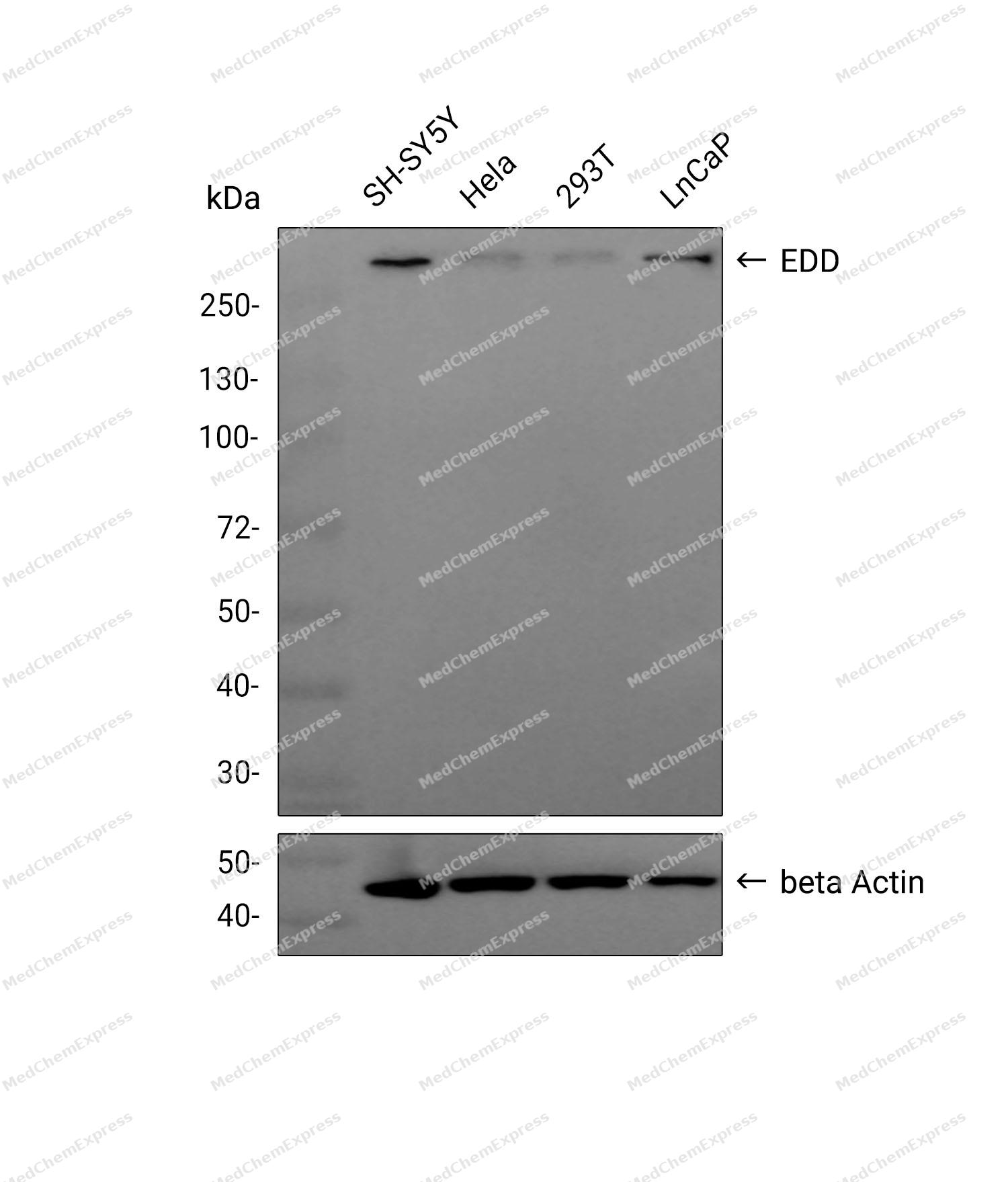
Observed Molecular WeightObserved band size: 309 kDa
Note: Due to possible protein modifications or aggregation, the molecular weight should be confirmed by actual measurement, and the predicted value is for reference only.

-
Calculated Molecular Weight Predicted band size: 309 kDa

Entrez Gene: 51366 Human ; 70790 Mouse ;
SwissProt: O95071 Human ; Q80TP3 Mouse ;
OMIM: 608413 Human
A synthesized peptide derived from human EDD aa1-54/2799.
Endogenous
Affinity Purified
Non-conjugated
Unmodified
IgG


Product Properties
-
Appearance
Liquid
-
Formulation
Supplied in PBS containing 50% glycerol, 0.5% BSA and 0.02% sodium azide, pH 7.3.
-
Concentration
Batch-dependent, Please check the COA for the concentration of each lot. Check Lot Concentration
-
Storage & Stability
Stored at -20°C for 1 year. Avoid repeated freeze / thaw cycles.
-
Shipping
Shipping with blue ice.


Verification Images
-
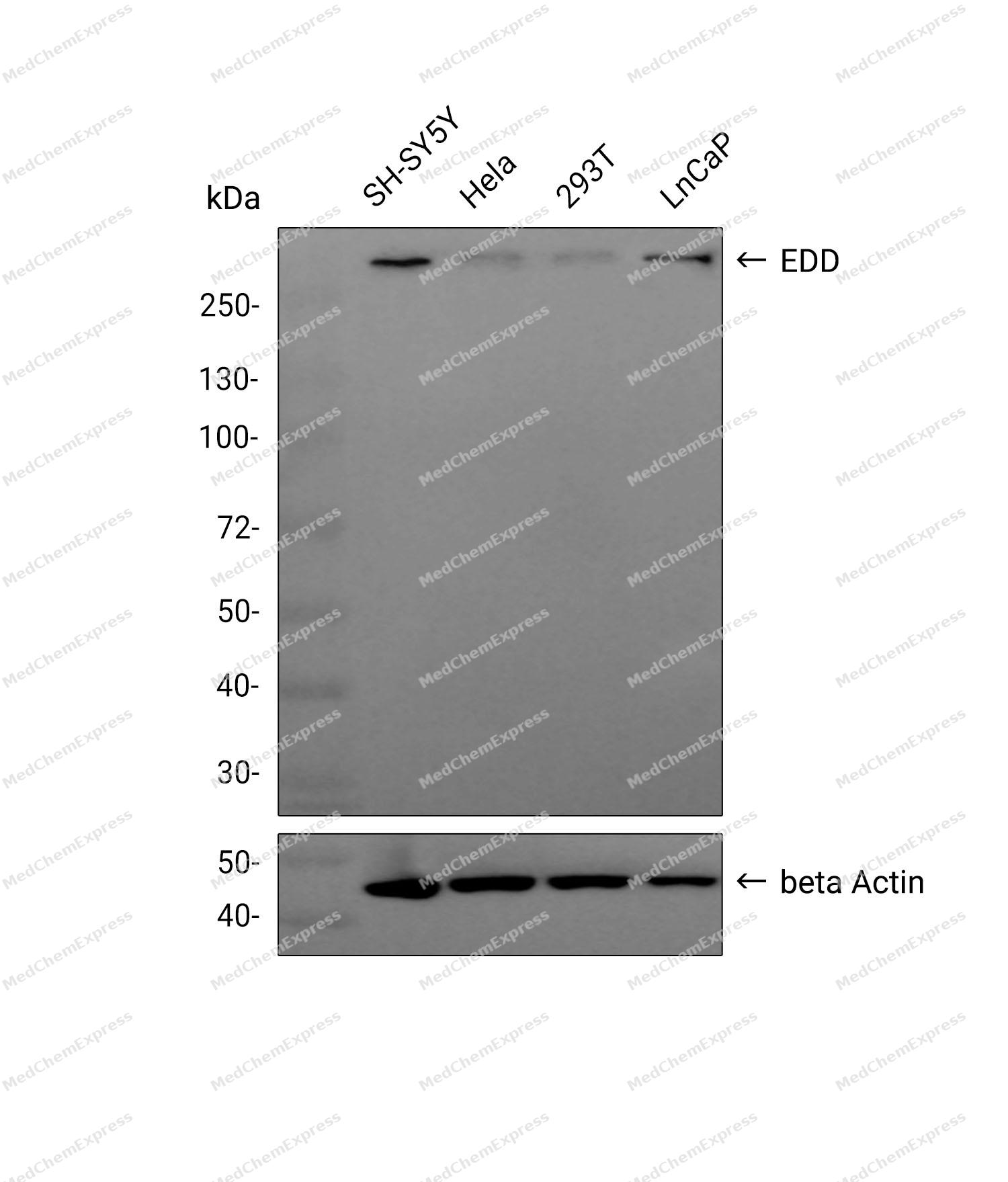 Western blot analysis was performed on extracts from SH-SY5Y (lane 1, 15 μg), Hela (lane 2, 15 μg), 293T (lane 3, 15 μg), and LnCaP (lane 4, 15 μg) using EDD Rabbit mAb.Proteins were transferred to a PVDF membrane and blocked with 5% non-fat milk in TBST at 4°C overnight.The primary antibody (1:1000 dilution) and the loading control antibody (beta-Actin, HY-P80438, 1:20000 dilution) were incubated in 5% non-fat milk in TBST for 1 hour at 37°C.Goat Anti-Rabbit IgG-HRP Secondary Antibody (1:20000 dilution) was then applied for 40 minutes at 37°C.


Background
-
Function
EDD is an E3 ubiquitin-protein ligase involved in different protein quality control pathways in the cytoplasm and nucleus. Mainly acts as a ubiquitin chain elongator that extends pre-ubiquitinated substrates. Component of the N-end rule pathway: ubiquitinates proteins bearing specific N-terminal residues that are destabilizing according to the N-end rule, leading to their degradation. Recognizes type-1 N-degrons, containing positively charged amino acids (Arg, Lys and His). Together with UBR4, part of a cytoplasm protein quality control pathway that prevents protein aggregation by catalyzing assembly of heterotypic 'Lys-11'-/'Lys-48'-linked branched ubiquitin chains on aggregated proteins, leading to substrate recognition by the segregase p97/VCP and degradation by the proteasome: UBR5 is probably branching multiple 'Lys-48'-linked chains of substrates initially modified with mixed conjugates by UBR4. Together with ITCH, catalyzes 'Lys-48'-/'Lys-63'-branched ubiquitination of TXNIP, leading to its degradation: UBR5 mediates branching of 'Lys-48'-linked chains of substrates initially modified with 'Lys-63'-linked conjugates by ITCH. Catalytic component of a nuclear protein quality control pathway that mediates ubiquitination and degradation of unpaired transcription factors (i.e. transcription factors that are not assembled into functional multiprotein complexes): specifically recognizes and binds degrons that are not accessible when transcription regulators are associated with their coactivators. Ubiquitinates various unpaired transcription regulator (MYC, SUPT4H1, SUPT5H, CDC20 and MCRS1), as well as ligand-bound nuclear receptors (ESR1, NR1H3, NR3C1, PGR, RARA, RXRA AND VDR) that are not associated with their nuclear receptor coactivators (NCOAs). Involved in maturation and/or transcriptional regulation of mRNA by mediating polyubiquitination and activation of CDK9. Also acts as a regulator of DNA damage response by acting as a suppressor of RNF168, an E3 ubiquitin-protein ligase that promotes accumulation of 'Lys-63'-linked histone H2A and H2AX at DNA damage sites, thereby acting as a guard against excessive spreading of ubiquitinated chromatin at damaged chromosomes. Regulates DNA topoisomerase II binding protein (TopBP1) in the DNA damage response. Ubiquitinates acetylated PCK1. Acts as a positive regulator of the canonical Wnt signaling pathway by mediating (1) ubiquitination and stabilization of CTNNB1, and (2) 'Lys-48'-linked ubiquitination and degradation of TLE3. Promotes disassembly of the mitotic checkpoint complex (MCC) from the APC/C complex by catalyzing ubiquitination of BUB1B, BUB3 and CDC20. Plays an essential role in extraembryonic development. Required for the maintenance of skeletal tissue homeostasis by acting as an inhibitor of hedgehog (HH) signaling[1][2][3][4][5][6][7][8][9][10][11][12][13].
-
Subcellular Localization
Nucleus; Cytoplasm
-
Expression
Tissue_specificity:Widely expressed. Most abundant in testis and expressed at high levels in brain, pituitary and kidney -
Isoforms & Post-Translational Modification
O95071 has 2 isomers: O95071-1: 309352 Da (predicted); O95071-2: 309224 Da (predicted).
-
Subunit
Homotetramer; composed of a dimer of dimers (PubMed:37040767, PubMed:37409633, PubMed:37620400). Associates with CDK9 and TFIIS/TCEA1 and forms a transcription regulatory complex made of CDK9, RNAP II, UBR5 and TFIIS/TCEA1 that can stimulate target gene transcription (e.g. gamma fibrinogen/FGG) by recruiting their promoters (PubMed:21127351). Associates with the E3 ligase complex containing DYRK2, EDD/UBR5, DDB1 and DCAF1 proteins (EDVP complex) (PubMed:19287380). Binds TOPBP1 (PubMed:11714696). Interacts with PIH1D1 (PubMed:24656813). Interacts with CIB1 (PubMed:12011095)
-
SwissProt ID
-
Synonyms
DD5; EDD; EDD1; hHYD; HYD; Rat100; Ubiquitin protein ligase; UBR5
-
Research Field
Cell Biology


Documentation
-
Data Sheet (235 KB)
-
SDS (251 KB)
- English - EN (251 KB)
- Français - FR (251 KB)
- Deutsch - DE (251 KB)
- Norwegian - NO (251 KB)
- Español - ES (251 KB)
- Swedish - SV (251 KB)
- Italian - IT (251 KB)
- Korean - KR (251 KB)
- Portuguese - PT (251 KB)
-
User Guide for Antibodies (1077 KB)

 Powered by Bioz
