



GALT Antibody (YA2925)
(Synonyms: Gal-1-P uridylyltransferase; UDP-glucose--hexose-1-phosphate uridylyltransferase)
Based on 1 Customer Validation
GALT Antibody (YA2925) is a Rabbit-derived and non-conjugated IgG monoclonal antibody, targeting to GALT.
-
Host:
Rabbit
-
Isotype:
IgG
-
Application:
WB, IP
-
Reactivity :
Human, Mouse, Rat
-
Formulation:
Supplied in 50mM Tris-Glycine(pH 7.4), 0.15M NaCl, 40% Glycerol, 0.01% Sodium azide and 0.05% BSA
-
Conjugation:
Non-conjugated


To place orders, for customer services and technical support, please contact: MedChemExpress USA
Tel: 609-228-6898 E-mail: [email protected] [email protected]





Applications
| Application |
WB

WB: Western Blot
|
IP
IP: Immunoprecipitation
|
|---|---|---|
| Dilution Ratio | 1:500-1:1000 | 1:20 |


Product Details
GALT Antibody (YA2925) is a Rabbit-derived and non-conjugated IgG monoclonal antibody, targeting to GALT.
-
Host Rabbit

-
Clonality Recombinant,Monoclonal

-
Species ReactivityHuman, Mouse, Rat
-
Observed Molecular WeightObserved band size: 43 kDa
Note: Due to possible protein modifications or aggregation, the molecular weight should be confirmed by actual measurement, and the predicted value is for reference only.

-
Calculated Molecular Weight Predicted band size: 43 kDa

Entrez Gene: 2592 Human ; 14430 Mouse ; 298003 Rat
SwissProt: P07902 Human ; Q03249 Mouse ; P43424 Rat
OMIM: 230400 Human
A synthetic peptide of human GALT
Endogenous
Affinity Purified
Non-conjugated
Unmodified
IgG


Product Properties
-
Appearance
Solution
-
Formulation
Supplied in 50mM Tris-Glycine(pH 7.4), 0.15M NaCl, 40% Glycerol, 0.01% Sodium azide and 0.05% BSA
-
Concentration
Batch-dependent, Please check the COA for the concentration of each lot. Check Lot Concentration
-
Storage & Stability
Stored at -20°C for 1 year. Avoid repeated freeze / thaw cycles.
-
Shipping
Shipping with blue ice.


Verification Images
-
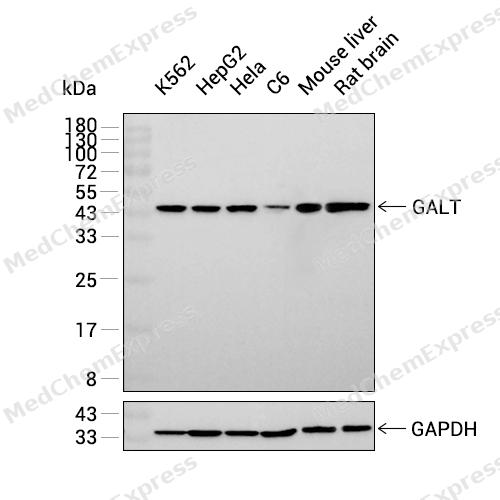
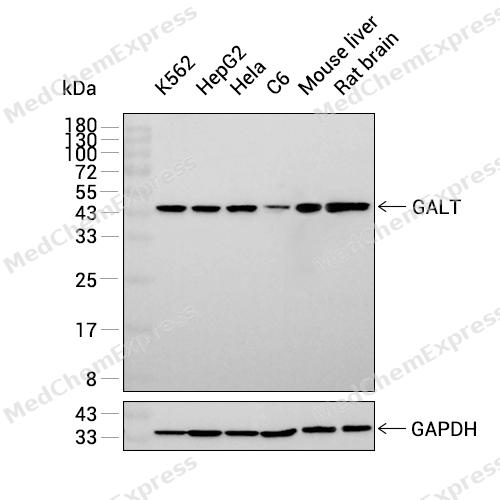 Western blot analysis was performed on extracts from K562 (lane 1, 15 μg), HepG2 (lane 2, 15 μg), Hela (lane 3, 15 μg), C6 (lane 4, 15 μg), Mouse liver (lane 5, 15 μg), and Rat brain (lane 6, 15 μg) using GALT Rabbit mAb.Proteins were transferred to a PVDF membrane and blocked with 5% non-fat milk in TBST at 4°C overnight.The primary antibody (1:1000 dilution) and the loading control antibody (GAPDH, HY-P80137, 1:40000 dilution) were incubated in 5% non-fat milk in TBST for 1 hour at 37°C.Goat Anti-Rabbit IgG-HRP Secondary Antibody (1:20000 dilution) was then applied for 40 minutes at 37°C.
 -
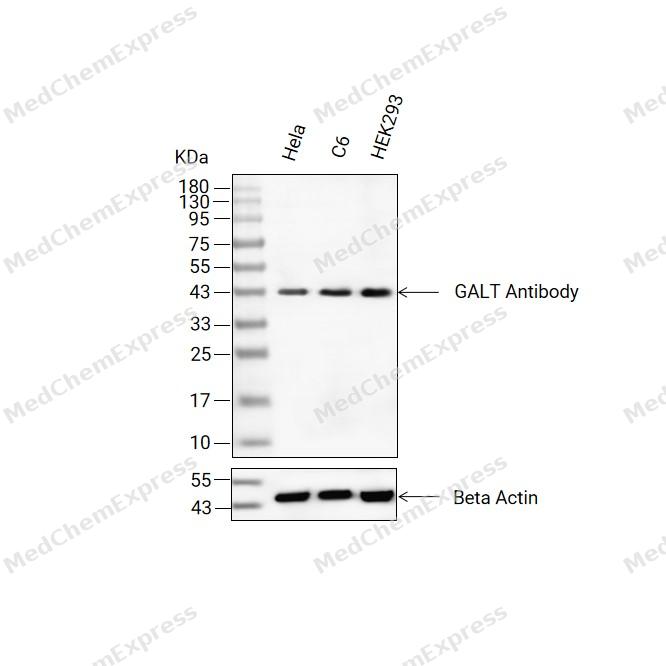 Western blot analysis of extracts from Hela(lane 2(20ug) , C6(lane 3(20ug) and HEK293(lane 4(20ug) using GALT Antibody (HY-P83180) Rabbit mAb. Proteins were transferred to a PVDF membrane and blocked with 5% non-fat milk in TBST for 2 hour at room temperature. The primary antibody (1/1000) and Loading control antibody (Beta Actin, HY-P83730, 1/10000) was used in 5% non-fat milk in TBST at 4°C overnight. Goat Anti-Mouse/Rabbit IgG-HRP Secondary Antibody (1/10000) was used for 1 hour at room temperature.


Background
-
Function
GALT encodes galactose-1-phosphate uridylyltransferase, a homodimeric HIT protein superfamily enzyme that catalyzes the second Leloir pathway step, converting galactose-1-phosphate and UDP-glucose into glucose-1-phosphate and UDP-galactose[1]. Mechanistically, GALT acts after GALM and GALK1 and before GALE, placing it at the central transferase step of galactose metabolism[1][2]. GALT deficiency causes classic galactosemia, a neonatal metabolic disease that can present as life-threatening illness and remains associated with long-term cognitive, social, and reproductive complications despite dietary galactose restriction[3]. In disease models, GALT-deficient mice showed absent GALT activity, reduced litter size, delayed pregnancy, and growth restriction, supporting their use for pathogenesis and therapy studies[4]. Compared with related Leloir enzymes, GALT differs from ATP-dependent GALK1 and SDR-family GALE because it functions as a HIT-family uridylyltransferase with a His-Pro-His active-site motif[1]. Compared with Duarte GALT variants, classic galactosemia shows very low residual GALT activity, whereas Duarte alleles retain partial enzyme function[1][3]. For experimental applications, mutant GALT studies link enzymatic impairment to altered substrate binding, thermal stability, and folding, supporting pharmacological chaperones and proteostasis regulators as research directions[5].- GALT defines the HIT-family transferase step connecting galactose-1-phosphate clearance with UDP-galactose production[1].- Classic galactosemia models support mechanistic studies of fertility, growth, neurological outcomes, and therapy[3][4].- Mutant GALT folding assays provide practical tools for evaluating chaperone-based rescue strategies[5].
-
Isoforms & Post-Translational Modification
P07902 has 2 isomers: P07902-1: 43363 Da (predicted); P07902-2: 31107 Da (predicted).
-
Subunit
Homodimer
-
SwissProt ID
-
Synonyms
Gal-1-P uridylyltransferase; UDP-glucose--hexose-1-phosphate uridylyltransferase
-
Research Field
Signal Transduction


Documentation
-
Data Sheet (261 KB)
-
SDS (251 KB)
- English - EN (251 KB)
- Français - FR (251 KB)
- Deutsch - DE (251 KB)
- Norwegian - NO (251 KB)
- Español - ES (251 KB)
- Swedish - SV (251 KB)
- Italian - IT (251 KB)
- Korean - KR (251 KB)
- Portuguese - PT (251 KB)
-
User Guide for Antibodies (1077 KB)
References
[1]. Succoio M, et al. Galactosemia: Biochemistry, Molecular Genetics, Newborn Screening, and Treatment. Biomolecules. 2022 Jul 11;12(7):968. [Content Brief]
[2]. McCorvie TJ, et al. Molecular basis of classic galactosemia from the structure of human galactose 1-phosphate uridylyltransferase. Hum Mol Genet. 2016 Jun 1;25(11):2234-2244. [Content Brief]
[3]. Coelho AI, et al. Sweet and sour: an update on classic galactosemia. J Inherit Metab Dis. 2017 May;40(3):325-342. [Content Brief]
[4]. Tang M, et al. Subfertility and growth restriction in a new galactose-1 phosphate uridylyltransferase (GALT) - deficient mouse model. Eur J Hum Genet. 2014 Oct;22(10):1172-9. [Content Brief]
[5]. McCorvie TJ, et al. Misfolding of galactose 1-phosphate uridylyltransferase can result in type I galactosemia. Biochim Biophys Acta. 2013 Aug;1832(8):1279-93. [Content Brief]

 Powered by Bioz
