



GSDMD Antibody (YA3443)
(Synonyms: DF 5L; DF5L; DFNA 5L; DFNA5L; FKSG 10; FKSG10; FLJ12150; Gasdermin D; Gasdermin domain containing 1; Gasdermin domain containing protein 1; Gasdermin domain-containing protein 1; Gasdermin-D; GasderminD; GSDMD_HUMAN; GSDMDC 1; GSDMDC1; Gasdermin-D, N-terminal; GSDMD-NT; hGSDMD-NTD; Gasdermin-D, C-terminal; GSDMD-CT; hGSDMD-CTD.)Based on 2 publication(s) in Google Scholar
GSDMD Antibody (YA3443) is a Rabbit-derived and non-conjugated IgG monoclonal antibody, targeting to GSDMD.
-
Host:
Rabbit
-
Isotype:
IgG
-
Application:
WB
-
Reactivity :
Human
-
Formulation:
Supplied in 50mM Tris-Glycine(pH 7.4), 0.15M NaCl, 40% Glycerol, 0.01% Sodium azide and 0.05% BSAl.
-
Conjugation:
Non-conjugated


To place orders, for customer services and technical support, please contact: MedChemExpress USA
Tel: 609-228-6898 E-mail: [email protected] [email protected]



Publications Citing Use of MedChemExpress (MCE) GSDMD Antibody (YA3443)
More

Applications
| Application |
WB

WB: Western Blot
|
|---|---|
| Dilution Ratio | 1:500-1:1000 |


Product Details
GSDMD Antibody (YA3443) is a Rabbit-derived and non-conjugated IgG monoclonal antibody, targeting to GSDMD.
-
Host Rabbit

-
Clonality Monoclonal,Recombinant

-
Species ReactivityHuman
-
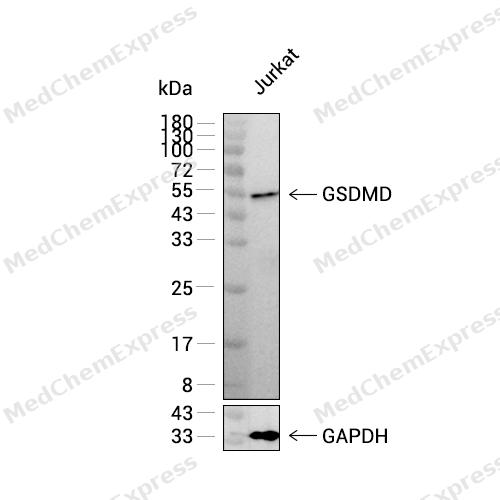
Observed Molecular WeightObserved band size: 53 kDa
Note: Due to possible protein modifications or aggregation, the molecular weight should be confirmed by actual measurement, and the predicted value is for reference only.

-
Calculated Molecular Weight Predicted band size: 53 kDa

Recombinant protein of human GSDMD
affinity purified
Non-conjugated
Unmodified
IgG


Product Properties
-
Appearance
Liquid
-
Formulation
Supplied in 50mM Tris-Glycine(pH 7.4), 0.15M NaCl, 40% Glycerol, 0.01% Sodium azide and 0.05% BSAl.
-
Concentration
Batch-dependent, Please check the COA for the concentration of each lot. Check Lot Concentration
-
Storage & Stability
Stored at -20°C for 1 year. Avoid repeated freeze / thaw cycles.
-
Shipping
Shipping with blue ice.


Publications (2)
-
Journal Impact Factor
-
Most Recent
-
Cell Death Dis
Mitochondrial DNA release via VDAC1 in keratinocytes: a key driver of innate immunity and vitiligo pathogenesis. [Abstract]2026 Mar 18;17(1):318. PMID: 41851094 -
Free Radic Biol Med
VDAC1 Oligomerization-Mediated mtDNA Release under Sublethal Oxidative Stress: A Novel Inflammatory Mechanism in Vitiligo. [Abstract]2025 Sep 11:S0891-5849(25)00975-X. PMID: 40945624


Verification Images
-
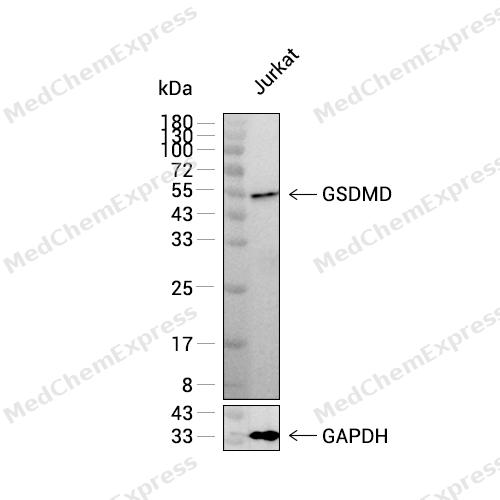 Western blot analysis was performed on extracts from Jurkat (lane 1, 20 μg) using GSDMD Rabbit mAb.Proteins were transferred to a PVDF membrane and blocked with 5% non - fat milk in TBST at 4°C overnight.The primary antibody (1:1000 dilution) and the loading control antibody (GAPDH, HY-P2804, 1:5000 dilution) were incubated in 5% non-fat milk in TBST for 1 hour at 37°C.Goat Anti - Rabbit IgG - HRP Secondary Antibody (1:20000 dilution) was then applied for 40 minutes at 37°C.


Background
-
Function
GSDMD is a Precursor of a pore-forming protein that plays a key role in host defense against pathogen infection and danger signals. This form constitutes the precursor of the pore-forming protein: upon cleavage, the released N-terminal moiety (Gasdermin-D, N-terminal) binds to membranes and forms pores, triggering pyroptosis; Promotes pyroptosis in response to microbial infection and danger signals. Produced by the cleavage of gasdermin-D by inflammatory caspases CASP1, CASP4 or CASP5 in response to canonical, as well as non-canonical (such as cytosolic LPS) inflammasome activators. After cleavage, moves to the plasma membrane where it strongly binds to inner leaflet lipids, including monophosphorylated phosphatidylinositols, such as phosphatidylinositol 4-phosphate, bisphosphorylated phosphatidylinositols, such as phosphatidylinositol (4,5)-bisphosphate, as well as phosphatidylinositol (3,4,5)-bisphosphate, and more weakly to phosphatidic acid and phosphatidylserine. Homooligomerizes within the membrane and forms pores of 10-15 nanometers (nm) of inner diameter, allowing the release of mature interleukin-1 (IL1B and IL18) and triggering pyroptosis. Gasdermin pores also allow the release of mature caspase-7 (CASP7). In some, but not all, cells types, pyroptosis is followed by pyroptotic cell death, which is caused by downstream activation of ninjurin-1 (NINJ1), which mediates membrane rupture (cytolysis). Also forms pores in the mitochondrial membrane, resulting in release of mitochondrial DNA (mtDNA) into the cytosol. Gasdermin-D, N-terminal released from pyroptotic cells into the extracellular milieu rapidly binds to and kills both Gram-negative and Gram-positive bacteria, without harming neighboring mammalian cells, as it does not disrupt the plasma membrane from the outside due to lipid-binding specificity. Under cell culture conditions, also active against intracellular bacteria, such as Listeria monocytogenes. Also active in response to MAP3K7/TAK1 inactivation by Yersinia toxin YopJ, which triggers cleavage by CASP8 and subsequent activation. Required for mucosal tissue defense against enteric pathogens. Activation of the non-canonical inflammasome in brain endothelial cells can lead to excessive pyroptosis, leading to blood-brain barrier breakdown. Strongly binds to bacterial and mitochondrial lipids, including cardiolipin. Does not bind to unphosphorylated phosphatidylinositol, phosphatidylethanolamine nor phosphatidylcholine; Transcription coactivator produced by the cleavage by CASP3 or CASP7 in the upper small intestine in response to dietary antigens. Required to maintain food tolerance in small intestine: translocates to the nucleus and acts as a coactivator for STAT1 to induce the transcription of CIITA and MHC class II molecules, which in turn induce type 1 regulatory T (Tr1) cells in upper small intestine; Produced by the cleavage by papain allergen. After cleavage, moves to the plasma membrane and homooligomerizes within the membrane and forms pores of 10-15 nanometers (nm) of inner diameter, allowing the specific release of mature interleukin-33 (IL33), promoting type 2 inflammatory immune response[1][2][3][4][5][6][7][8][9][10][11][12][13][14][15][16].
-
Subcellular Localization
Cytoplasm, cytosol; Inflammasome; Cell membrane; Multi-pass membrane protein; Secreted; Mitochondrion membrane; Cytoplasm, cytosol; Nucleus; Cytoplasm, cytosol
-
Expression
Tissue_specificity:This gene is expressed in the upper basal layer cells of the esophagus, as well as in the gastric isthmus/neck, gastric pits, and gastric glands, suggesting that it is preferentially expressed in differentiated cells. -
Subunit
Homooligomer; homooligomeric ring-shaped pore complex containing 27-28 subunits when inserted in the membrane (PubMed:33883744, PubMed:34289345, PubMed:38040708).
-
SwissProt ID
-
Synonyms
DF 5L; DF5L; DFNA 5L; DFNA5L; FKSG 10; FKSG10; FLJ12150; Gasdermin D; Gasdermin domain containing 1; Gasdermin domain containing protein 1; Gasdermin domain-containing protein 1; Gasdermin-D; GasderminD; GSDMD_HUMAN; GSDMDC 1; GSDMDC1; Gasdermin-D, N-terminal; GSDMD-NT; hGSDMD-NTD; Gasdermin-D, C-terminal; GSDMD-CT; hGSDMD-CTD.
-
Research Field
Cell Biology
Documentation
-
Data Sheet (231 KB)
-
SDS (254 KB)
- English - EN (254 KB)
- Français - FR (254 KB)
- Deutsch - DE (254 KB)
- Norwegian - NO (254 KB)
- Español - ES (254 KB)
- Swedish - SV (254 KB)
- Italian - IT (254 KB)
- Korean - KR (254 KB)
- Portuguese - PT (254 KB)
-
User Guide for Antibodies (1077 KB)

 Powered by Bioz
