



MC4R Antibody (YA1645)
(Synonyms: MC4R; Melanocortin 4 receptor)
Based on 1 Customer Validation
MC4R Antibody (YA1645) is a Rabbit-derived and non-conjugated IgG monoclonal antibody, targeting to MC4R.
-
Host:
Rabbit
-
Isotype:
IgG
-
Application:
WB
-
Reactivity :
Human, Mouse, Rat
-
Formulation:
Supplied in rabbit IgG in 50mM Tris-Glycine(pH 7.4), 0.15M NaCl, 40%Glycerol, 0.01% sodium azide and 0.05% BSA or 10mM PBS, pH 7.4, 150mM sodium chloride, 0.05% BSA, 0.02% sodium azide and 50% glycerol..
-
Conjugation:
Non-conjugated


To place orders, for customer services and technical support, please contact: MedChemExpress USA
Tel: 609-228-6898 E-mail: [email protected] [email protected]





Applications
| Application |
WB

WB: Western Blot
|
|---|---|
| Dilution Ratio | 1:500-1:1000 |


Product Details
MC4R Antibody (YA1645) is a Rabbit-derived and non-conjugated IgG monoclonal antibody, targeting to MC4R.
-
Host Rabbit

-
Clonality Recombinant,Monoclonal

-
Species ReactivityHuman, Mouse, Rat
-
Calculated Molecular Weight Predicted band size: 37 kDa

Entrez Gene: 4160 Human ; 17202 Mouse ; 25635 Rat
SwissProt: P32245 Human ; P56450 Mouse ; P70596 Rat
OMIM: 601665 Human
A synthesized peptide derived from human MC4 Receptor aa1-50/332.
Endogenous
Affinity Chromatography
Non-conjugated
Unmodified
IgG


Product Properties
-
Appearance
Solution
-
Formulation
Supplied in rabbit IgG in 50mM Tris-Glycine(pH 7.4), 0.15M NaCl, 40%Glycerol, 0.01% sodium azide and 0.05% BSA or 10mM PBS, pH 7.4, 150mM sodium chloride, 0.05% BSA, 0.02% sodium azide and 50% glycerol..
-
Concentration
Batch-dependent, Please check the COA for the concentration of each lot. Check Lot Concentration
-
Storage & Stability
Stored at -20°C for 1 year. Avoid repeated freeze / thaw cycles.
-
Shipping
Shipping with blue ice.


Verification Images
-
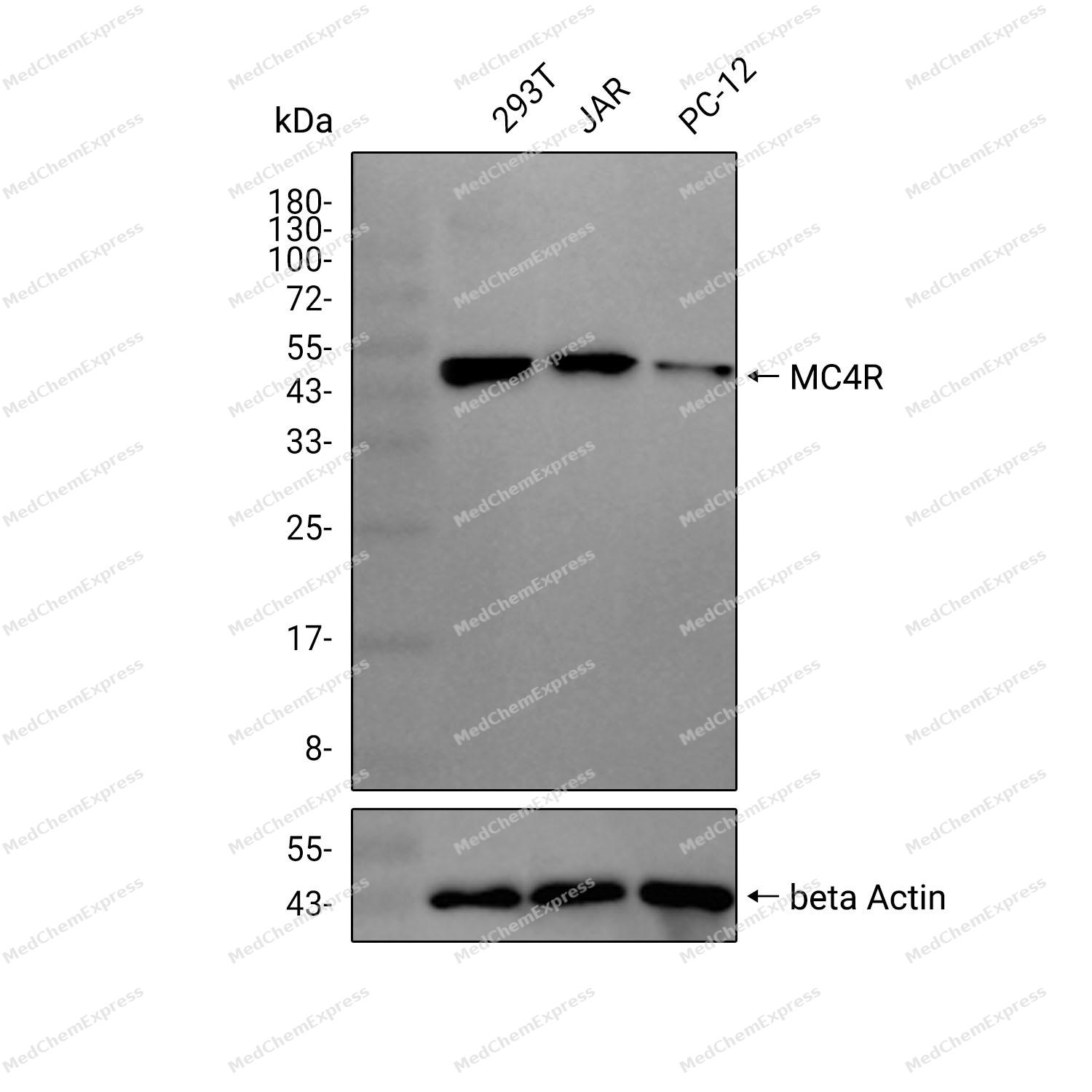
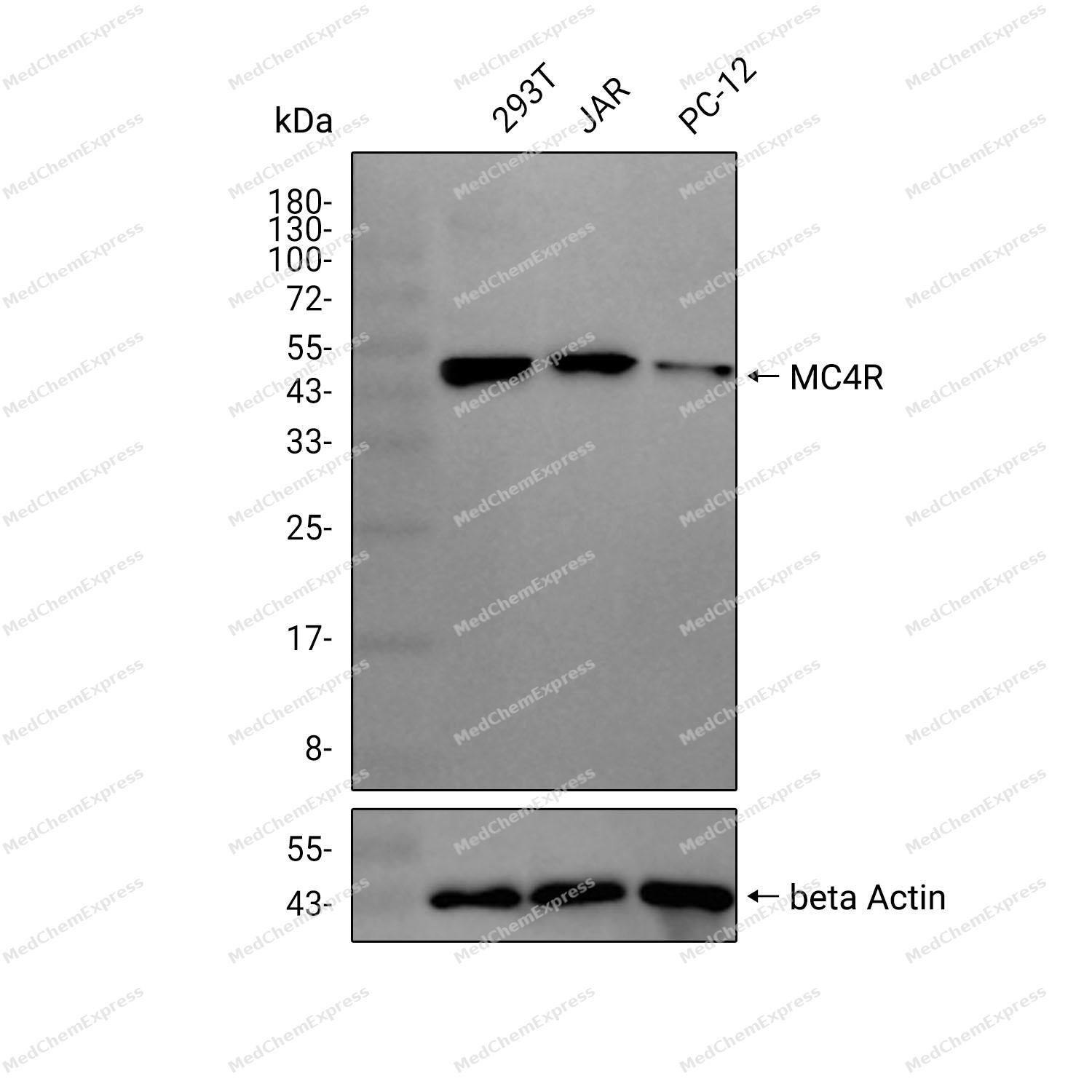 Western blot analysis was performed on extracts from 293T (lane 1, 15 μg), JAR (lane 2, 15 μg), and PC-12 (lane 3, 15 μg) using MC4R Rabbit mAb.Proteins were transferred to a PVDF membrane and blocked with 5% non-fat milk in TBST at 4°C overnight.The primary antibody (1:1000 dilution) and the loading control antibody (beta-Actin, HY-P80438, 1:20000 dilution) were incubated in 5% non-fat milk in TBST for 1 hour at 37°C.Goat Anti-Rabbit IgG-HRP Secondary Antibody (1:20000 dilution) was then applied for 40 minutes at 37°C.


Background
-
Function
MC4R (melanocortin-4 receptor) is a class A G protein-coupled receptor that functions as a central regulator of appetite, energy expenditure, and body-weight homeostasis within the hypothalamic leptin-melanocortin network[1][2]. Activation of proopiomelanocortin (POMC) neurons promotes release of α-melanocyte-stimulating hormone (α-MSH), which activates MC4R signaling and suppresses food intake while increasing energy expenditure, establishing MC4R as a key effector of energy balance regulation[3][1]. Mechanistically, MC4R integrates neuroendocrine signals controlling satiety and metabolic homeostasis, and disruption of MC4R signaling impairs these regulatory processes[2][4]. Disease relevance is strongly supported by human genetics, as MC4R deficiency represents the most common monogenic cause of obesity, and loss-of-function variants are associated with early-onset severe obesity, hyperphagia, and metabolic abnormalities[4][5][6]. In experimental and clinical studies, MC4R pathway dysfunction has therefore become a widely used model for investigating genetic obesity and energy-homeostasis disorders[2][4]. Compared with the closely related melanocortin receptor MC3R, MC4R exhibits a distinct and non-redundant role in body-weight regulation; studies in knockout models indicate that MC3R and MC4R contribute independently and complementarily to energy homeostasis rather than serving interchangeable functions[7]. For experimental applications, selective MC4R agonists, particularly setmelanotide, have demonstrated the ability to restore signaling in subsets of impaired MC4R variants and induce weight loss in MC4R-deficient obesity, supporting their utility as pharmacological tools and therapeutic candidates for melanocortin-pathway research[8][9][10].
-
Subcellular Localization
Cell membrane; Multi-pass membrane protein
-
Expression
Tissue_specificity:Brain, placental, and gut tissues -
Subunit
Homodimer; disulfide-linked, also forms higher order oligomers. Interacts with GNAS (PubMed:33858992). Interacts with ATRNL1 (By similarity). Interacts with MGRN1; this interaction competes with GNAS-binding and thus inhibits agonist-induced cAMP production. Interacts with MRAP and MRAP2; these associated factors increase ligand-sensitivity and generation of cAMP
-
SwissProt ID
-
Synonyms
MC4R; Melanocortin 4 receptor
-
Research Field
Neuroscience


Documentation
-
Data Sheet (261 KB)
-
SDS (251 KB)
- English - EN (251 KB)
- Français - FR (251 KB)
- Deutsch - DE (251 KB)
- Norwegian - NO (251 KB)
- Español - ES (251 KB)
- Swedish - SV (251 KB)
- Italian - IT (251 KB)
- Korean - KR (251 KB)
- Portuguese - PT (251 KB)
-
User Guide for Antibodies (1077 KB)
References
[2]. Fatima MT, et al. Melanocortin-4 receptor complexity in energy homeostasis,obesity and drug development strategies. Diabetes Obes Metab. 2022 Apr;24(4):583-598. [Content Brief]
[3]. D'Agostino G, et al. Alpha-melanocyte stimulating hormone: production and degradation. J Mol Med (Berl). 2010 Dec;88(12):1195-201. [Content Brief]
[4]. Farooqi IS, et al. Clinical spectrum of obesity and mutations in the melanocortin 4 receptor gene. N Engl J Med. 2003 Mar 20;348(12):1085-95. [Content Brief]
[5]. Sridhar GR, et al. Melanocortin 4 receptor mutation in obesity. World J Exp Med. 2024 Dec 20;14(4):99239. [Content Brief]
[6]. Giannopoulou EZ, et al. Monogenic obesity due to MC4R deficiency: lessons from a multigenerational case. Mol Cell Pediatr. 2026 Jan 5;13(1):3. [Content Brief]
[7]. Micioni Di Bonaventura E, et al. The Melanocortin System behind the Dysfunctional Eating Behaviors. Nutrients. 2020 Nov 14;12(11):3502. [Content Brief]
[10]. Sun Y, et al. The effect of melanocortin-4 receptor agonist drugs on obesity and metabolic risk factors: a systematic review and meta-analysis. Diabetol Metab Syndr. 2025 Dec 28;18(1):40. [Content Brief]

 Powered by Bioz
