



WAVE 1 Antibody (YA2416)
(Synonyms: WAVE; SCAR1; WAVE1)
Based on 1 Customer Validation
WAVE 1 Antibody (YA2416) is a Rabbit-derived and non-conjugated IgG monoclonal antibody, targeting to WAVE 1.
-
Host:
Rabbit
-
Isotype:
IgG
-
Application:
WB
-
Reactivity :
Human, Mouse, Rat
-
Formulation:
Supplied in 50mM Tris-Glycine(pH 7.4), 0.15M NaCl, 40% Glycerol, 0.01% Sodium azide and 0.05% BSA
-
Conjugation:
Non-conjugated


To place orders, for customer services and technical support, please contact: MedChemExpress USA
Tel: 609-228-6898 E-mail: [email protected] [email protected]





Applications
| Application |
WB

WB: Western Blot
|
|---|---|
| Dilution Ratio | 1:500-1:1000 |


Product Details
WAVE 1 Antibody (YA2416) is a Rabbit-derived and non-conjugated IgG monoclonal antibody, targeting to WAVE 1.
-
Host Rabbit

-
Clonality Recombinant,Monoclonal

-
Species ReactivityHuman, Mouse, Rat
-
Observed Molecular WeightObserved band size: 90 kDa
Note: Due to possible protein modifications or aggregation, the molecular weight should be confirmed by actual measurement, and the predicted value is for reference only.

-
Calculated Molecular Weight Predicted band size: 62 kDa

Entrez Gene: 8936 Human ; 83767 Mouse ; 294568 Rat
SwissProt: Q92558 Human ; Q8R5H6 Mouse ; Q5BJU7 Rat
OMIM: 618707 Human
Recombinant protein of human WAVE 1 aa1-100.
Endogenous
Affinity Purified
Non-conjugated
Unmodified
IgG


Product Properties
-
Appearance
Solution
-
Formulation
Supplied in 50mM Tris-Glycine(pH 7.4), 0.15M NaCl, 40% Glycerol, 0.01% Sodium azide and 0.05% BSA
-
Concentration
Batch-dependent, Please check the COA for the concentration of each lot. Check Lot Concentration
-
Storage & Stability
Stored at -20°C for 1 year. Avoid repeated freeze / thaw cycles.
-
Shipping
Shipping with blue ice.


Verification Images
-
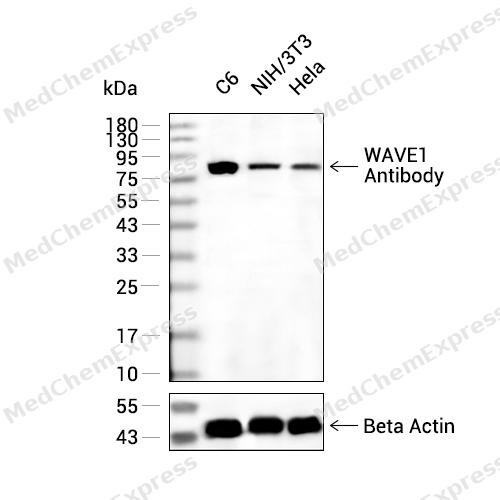 Western blot analysis of extracts from C6(lane 2(20ug) , NIH/3T3(lane 3(20ug) and Hela(lane 4(20ug) using WAVE 1 Antibody (HY-P82671) Rabbit mAb. Proteins were transferred to a PVDF membrane and blocked with 5% non-fat milk in TBST for 2 hour at room temperature. The primary antibody (1/1000) and Loading control antibody (Beta Actin, HY-P80438, 1/10000) was used in 5% non-fat milk in TBST at 4°C overnight. Goat Anti-Mouse/Rabbit IgG-HRP Secondary Antibody (1/10000) was used for 1 hour at room temperature.


Background
-
Function
WAVE 1 is a Downstream effector molecule involved in the transmission of signals from tyrosine kinase receptors and small GTPases to the actin cytoskeleton. Promotes formation of actin filaments. Part of the WAVE complex that regulates lamellipodia formation. The WAVE complex regulates actin filament reorganization via its interaction with the Arp2/3 complex. As component of the WAVE1 complex, required for BDNF-NTRK2 endocytic trafficking and signaling from early endosomes. Also involved in the regulation of mitochondrial dynamics[1].
-
Subcellular Localization
Cytoplasm, cytoskeleton; Synapse; Cell junction, focal adhesion
-
Expression
Tissue_specificity:Highly expressed in brain. Lowly expressed in testis, ovary, colon, kidney, pancreas, thymus, small intestine and peripheral blood -
Subunit
Component of the WAVE1 complex composed of ABI2, CYFIP1 or CYFIP2, BRK1, NCKAP1 and WASF1/WAVE1. Within the complex, a heterodimer containing NCKAP1 and CYFIP1 interacts with a heterotrimer formed by WAVE1, ABI2 and BRK1. CYFIP2 binds to activated RAC1 which causes the complex to dissociate, releasing activated WASF1. The complex can also be activated by NCK1. Binds actin and the Arp2/3 complex. Interacts with BAIAP2. Interacts with SHANK3; the interaction mediates the association of SHANK3 with the WAVE1 complex. Interacts with ABI1 (via N-terminus). Interacts with SORBS2; this interaction greatly enhances phosphorylation by ABL1 and dephosphorylation by PTPN12 and might mediate partial to focal adhesion sites
-
SwissProt ID
-
Synonyms
WAVE; SCAR1; WAVE1
-
Research Field
Signal Transduction


Documentation
-
Data Sheet (260 KB)
-
SDS (252 KB)
- English - EN (252 KB)
- Français - FR (252 KB)
- Deutsch - DE (252 KB)
- Norwegian - NO (252 KB)
- Español - ES (252 KB)
- Swedish - SV (252 KB)
- Italian - IT (252 KB)
- Korean - KR (252 KB)
- Portuguese - PT (252 KB)
-
User Guide for Antibodies (1077 KB)
References

 Powered by Bioz
