



XPD Antibody (YA2434)
(Synonyms: BTF2 p80; COFS2; CXPD; EM9; ERCC2; MAG; TFIIH p80; TTD; XPD; XPDC)
Based on 1 Customer Validation
XPD Antibody (YA2434) is a Rabbit-derived and non-conjugated IgG monoclonal antibody, targeting to XPD.
-
Host:
Rabbit
-
Isotype:
IgG
-
Application:
WB, ICC/IF
-
Reactivity :
Human
-
Formulation:
Supplied in 50mM Tris-Glycine(pH 7.4), 0.15M NaCl, 40% Glycerol, 0.01% Sodium azide and 0.05% BSA
-
Conjugation:
Non-conjugated


To place orders, for customer services and technical support, please contact: MedChemExpress USA
Tel: 609-228-6898 E-mail: [email protected] [email protected]





Applications
| Application |
WB

WB: Western Blot
|
ICC/IF
ICC/IF: Immunocytochemistry/
Immunofluorescence |
|---|---|---|
| Dilution Ratio | 1:500-1:1000 | 1:50-1:200 |


Product Details
XPD Antibody (YA2434) is a Rabbit-derived and non-conjugated IgG monoclonal antibody, targeting to XPD.
-
Host Rabbit

-
Clonality Recombinant, Monoclonal

-
Species ReactivityHuman
-
Observed Molecular WeightObserved band size: 80 kDa
Note: Due to possible protein modifications or aggregation, the molecular weight should be confirmed by actual measurement, and the predicted value is for reference only.

-
Calculated Molecular Weight Predicted band size: 87 kDa

A synthetic peptide of human XPD
Endogenous
Affinity Purified
Non-conjugated
Unmodified
IgG


Product Properties
-
Appearance
Liquid
-
Formulation
Supplied in 50mM Tris-Glycine(pH 7.4), 0.15M NaCl, 40% Glycerol, 0.01% Sodium azide and 0.05% BSA
-
Concentration
Batch-dependent, Please check the COA for the concentration of each lot. Check Lot Concentration
-
Storage & Stability
Stored at -20°C for 1 year. Avoid repeated freeze / thaw cycles.
-
Shipping
Shipping with blue ice.


Verification Images
-
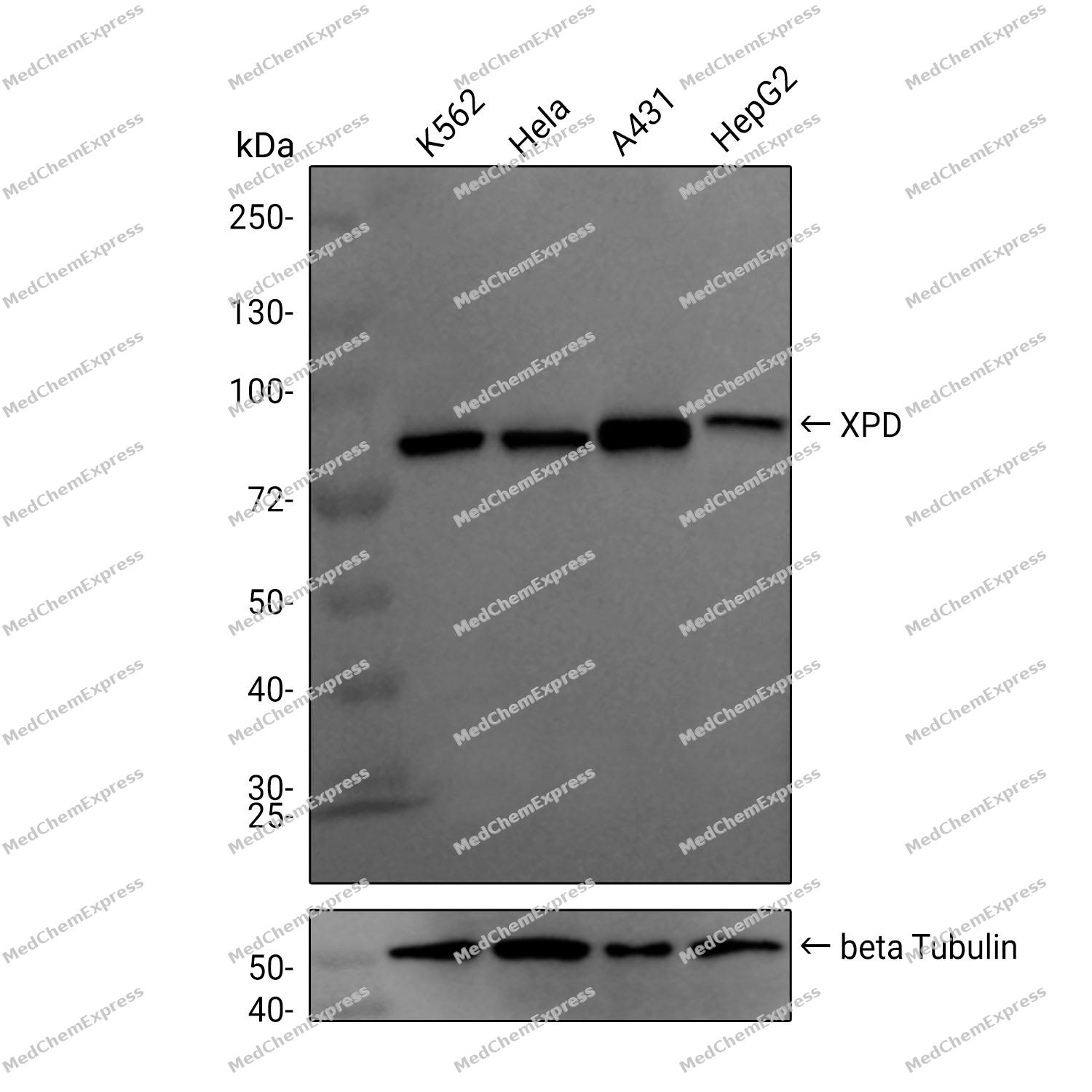 Western blot analysis was performed on extracts from K562 (lane 1, 15 μg), Hela (lane 2, 15 μg), A431 (lane 3, 15 μg), HepG2 (lane 4, 15 μg) using XPD Rabbit mAb.Proteins were transferred to a PVDF membrane and blocked with 5% non-fat milk in TBST at 4°C overnight.The primary antibody (1:1000 dilution) and the loading control antibody (beta-Tubulin, HY-P80955, 1:5000 dilution) were incubated in 5% non-fat milk in TBST for 1 hour at 37°C.Goat Anti-Rabbit IgG-HRP Secondary Antibody (1:20000 dilution) was then applied for 40 minutes at 37°C.


Background
-
Function
XPD is an ATP-dependent 5'-3' DNA helicase. Component of the general transcription and DNA repair factor IIH (TFIIH) core complex, not absolutely essential for minimal transcription in vitro. Required for transcription-coupled nucleotide excision repair (NER) of damaged DNA; recognizes damaged bases. Sequestered in chromatin on UV-damaged DNA. When complexed to CDK-activating kinase (CAK), involved in transcription by RNA polymerase II. In NER, TFIIH acts by opening DNA around the lesion to allow the excision of the damaged oligonucleotide and its replacement by a new DNA fragment. The ATP-dependent helicase activity of XPD/ERCC2 is required for DNA opening. Involved in DNA lesion verification. In transcription, TFIIH has an essential role in transcription initiation. When the pre-initiation complex (PIC) has been established, TFIIH is required for promoter opening and promoter escape. Phosphorylation of the C-terminal tail (CTD) of the largest subunit of RNA polymerase II by the kinase module CAK controls the initiation of transcription. XPD/ERCC2 acts by forming a bridge between CAK and the core-TFIIH complex. The structure of the TFIIH transcription complex differs from the NER-TFIIH complex; large movements by XPD/ERCC2 and XPB/ERCC3 are stabilized by XPA which allow this subunit to contact ssDNA. Involved in the regulation of vitamin-D receptor activity. As part of the mitotic spindle-associated MMXD complex it plays a role in chromosome segregation. Might have a role in aging process and could play a causative role in the generation of skin cancers[1][2][3][4][5][6][7].
-
Subcellular Localization
Nucleus; Cytoplasm, cytoskeleton, spindle
-
Isoforms & Post-Translational Modification
P18074 has 2 isomers: P18074-1: 86909 Da (predicted); P18074-2: 46274 Da (predicted).
ISGylated -
Subunit
Component of the 7-subunit TFIIH core complex composed of XPB/ERCC3, XPD/ERCC2, GTF2H1, GTF2H2, GTF2H3, GTF2H4 and GTF2H5, which is active in NER (PubMed:9771713, PubMed:9852112). The core complex associates with the 3-subunit CDK-activating kinase (CAK) module composed of CCNH/cyclin H, CDK7 and MNAT1 to form the 10-subunit holoenzyme (holo-TFIIH) active in transcription (PubMed:9771713, PubMed:9852112). Interacts with GTF2H2 (p44) which stimulates the 5'-3' helicase activity of this subunit (PubMed:9771713). Component of the MMXD complex, which includes CIAO1, ERCC2, CIAO2B, MMS19 and SLC25A5 (PubMed:20797633). Interacts with CIAO1 and CIAO2B; the interaction WITH CIAO2B is direct (PubMed:23891004). Interacts with ATF7IP (PubMed:19106100). Interacts directly with MMS19 (PubMed:23585563). Part of TBP-based Pol II pre-initiation complex (PIC), in which Pol II core assembles with general transcription factors and other specific initiation factors including GTF2E1, GTF2E2, GTF2F1, GTF2F2, TCEA1, ERCC2, ERCC3, GTF2H2, GTF2H3, GTF2H4, GTF2H5, GTF2A1, GTF2A2, GTF2B and TBP; this large multi-subunit PIC complex mediates DNA unwinding and targets Pol II core to the transcription start site where the first phosphodiester bond forms
-
SwissProt ID
-
Synonyms
BTF2 p80; COFS2; CXPD; EM9; ERCC2; MAG; TFIIH p80; TTD; XPD; XPDC
-
Research Field
Epigenetics and Nuclear Signaling


Documentation
-
Data Sheet (234 KB)
-
SDS (252 KB)
- English - EN (252 KB)
- Français - FR (252 KB)
- Deutsch - DE (252 KB)
- Norwegian - NO (252 KB)
- Español - ES (252 KB)
- Swedish - SV (252 KB)
- Italian - IT (252 KB)
- Korean - KR (252 KB)
- Portuguese - PT (252 KB)
-
User Guide for Antibodies (1077 KB)

 Powered by Bioz
