



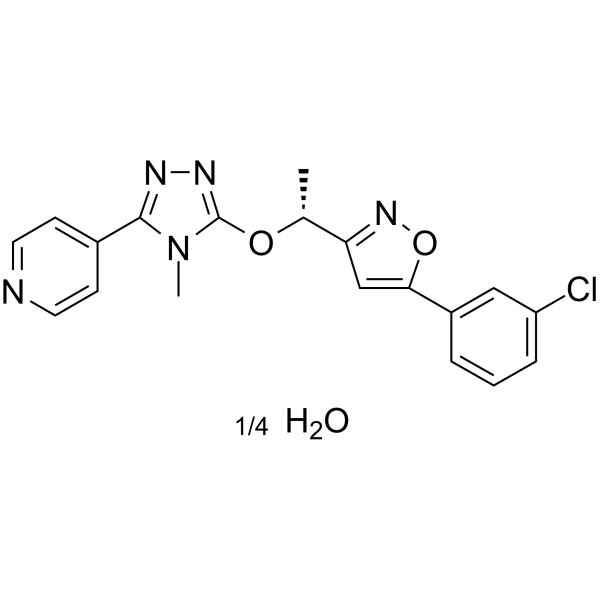
AZD 2066 hydrate
Based on 1 publication(s) in Google Scholar
AZD-2066 hydrate is a selective, orally active and blood-brain barrier-permeating mGluR5 antagonist. AZD 2066 hydrate activates the BDNF/trkB signaling pathway. AZD 2066 hydrate can be used in the research of neuropathic pain, major depressive disorder and gastroesophageal reflux disease.
Nos produits utilisent uniquement pour la recherche. Nous ne vendons pas aux patients.
- Formule: C19H16ClN5O2.1/4H2O
- Masse moléculaire:386.33
-
Stockage:Powder -20°C, 3 years , 4°C, 2 years ; In solvent -80°C, 6 months , -20°C, 1 month

To place orders, for customer services and technical support, please contact: MedChemExpress USA
Tel: 609-228-6898 E-mail: [email protected] [email protected]


-
 Activité biologique
-
Chemical Information
- Pureté et documentation
- Références
-
 Help & FAQs


Publications Citing Use of MedChemExpress (MCE) AZD 2066 hydrate
MoreVoir tous les produits spécifiques à Isoform Calcium Channel
More

Activité biologique
Description
IC50 & Target
[1]|
mGluR5 |
In Vitro
AZD 2066 (1-10 μM) hydrate inhibits Ca2+ response, with IC50s of 27.2, 3.56, 96.2, and 380 nM in mGlu5/HEK cells and striatal, hippocampal, and cortical cultures respectively[4].
AZD 2066 (1-10 μM) hydrate inhibits the oscillatory Ca2+ response which induced by bath application of DHPG (HY-12598A), and blocks either DHPG or Quis effects in mGlu5/HEK cells[4].
MedChemExpress (MCE) has not independently confirmed the accuracy of these methods. They are for reference only.
In Vivo
AZD-2066 (10 µM, perfusion of brain slide) hydrate alleviates dihydroxyphenylglycine (DHPG)-facilitated long-term depression (LTD) expression in chronic social defeat stress (CSDS)-treated mice via BDNF/trkB signaling pathway[5].
AZD-2066 (5 mg/kg, i.p., 2 × 12 h) hydrate alleviates chronic social defeat stress (CSDS)-induced depressive behaviors in mice[5].
MedChemExpress (MCE) has not independently confirmed the accuracy of these methods. They are for reference only.
-
Animal Model:Male Wistar rats (weighing 240-250 g)[2]
-
Dosage:0.03, 0.1, 0.3, 1, 3, 10, 30 mg/kg
-
Administration:P.o. (60 minutes after administration)
-
Result:Caused full and dose-dependent AZD9272-appropriate responding.
-
Animal Model:Depressive model (C57BL/6 mice were subjected to physical defeats that were generated by a CD-1 aggressor for 5 min every day for 10 days)[5]
-
Dosage:5 mg/kg
-
Administration:Intraperitoneal injection (i.p.), 2 × 12 h
-
Result:Increased social interaction ratio.
Reversed time spent in interaction zone.
Increased sucrose preference scores.
Essai clinique
| NCT Number | Sponsor | Condition | Start Date |
Phase

|
|---|---|---|---|---|
| NCT01329991 | Plexxikon| | 2011-05 | PHASE1 |


Chemical Information
-
Appearance Solid
-
Masse moléculaire 386.33
-
Formule C19H16ClN5O2.1/4H2O
-
Color Off-white to light yellow
-
SMILES
CN1C(C2=CC=NC=C2)=NN=C1O[C@@H](C3=NOC(C4=CC(Cl)=CC=C4)=C3)C.O.[1/4]
-
Livraison
Room temperature in continental US; may vary elsewhere.
-
Stockage
Powder -20°C 3 years 4°C 2 years In solvent -80°C 6 months -20°C 1 month


Publications (1)
-
Journal Impact Factor
-
Most Recent
-
ACS Chem Neurosci
Location and Cell-Type-Specific Bias of Metabotropic Glutamate Receptor, mGlu5, Negative Allosteric Modulators. [Abstract]2019 Nov 20;10(11):4558-4570. PMID: 31609579


Pureté et documentation
-
Fiche technique (275 KB)
-
SDS (252 KB)
- English - EN (252 KB)
- Français - FR (252 KB)
- Deutsch - DE (252 KB)
- Norwegian - NO (252 KB)
- Español - ES (252 KB)
- Swedish - SV (252 KB)
- Italian - IT (252 KB)
- Korean - KR (252 KB)
- Portuguese - PT (252 KB)
-
Instruction de manipulation (2659 KB)
Références
[1]. Kågedal M, et al. A positron emission tomography study in healthy volunteers to estimate mGluR5 receptor occupancy of AZD2066-estimating occupancy in the absence of a reference region. Neuroimage. 2013 Nov 15;82:160-9. [Content Brief]
[2]. Swedberg MD, et al. AZD9272 and AZD2066: selective and highly central nervous system penetrant mGluR5 antagonists characterized by their discriminative effects. J Pharmacol Exp Ther. 2014 Aug;350(2):212-22. [Content Brief]
[3]. Antoniu SA. Discontinued drugs for pulmonary, allergy, gastrointestinal, arthritis (2012). Expert Opin Investig Drugs. 2013 Nov;22(11):1453-64. [Content Brief]
[4]. Jong YI, et al. Location and Cell-Type-Specific Bias of Metabotropic Glutamate Receptor, mGlu5, Negative Allosteric Modulators. ACS Chem Neurosci. 2019 Nov 20;10(11):4558-4570. [Content Brief]
[5]. Jiang X, et al. mGluR5 Facilitates Long-Term Synaptic Depression in a Stress-Induced Depressive Mouse Model. Can J Psychiatry. 2020 May;65(5):347-355. [Content Brief]

Calculators
Concentration (start) × Volume (start) = Concentration (final) × Volume (final)


AZD 2066 hydrate Related Classifications
HY-110255A Related Classifications
 Powered by Bioz