



3-Indolepropionic acid (Standard)

Based on 1 Customer Validation
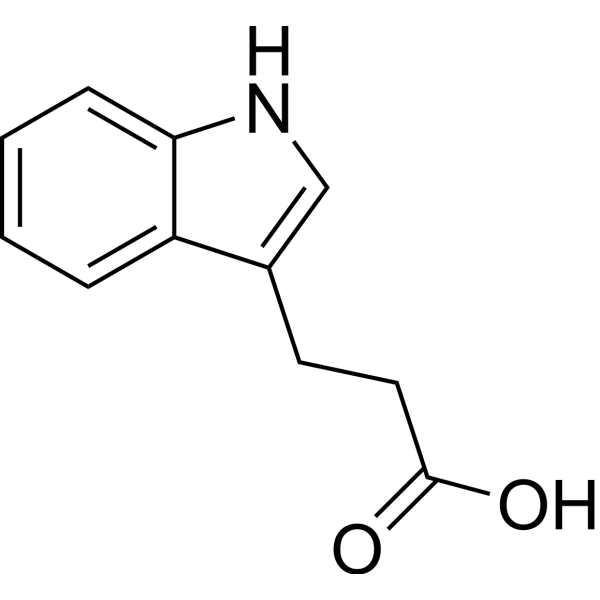
3-Indolepropionic acid (Standard) is the analytical standard of 3-Indolepropionic acid. This product is intended for research and analytical applications. 3-Indolepropionic acid is shown to be a powerful antioxidant and has potential in the treatment for Alzheimer’s disease. In Vitro: 3-Indolepropionic acid is shown to be a powerful antioxidant and has potential in the treatment for Alzheimer’s disease. 3-Indolepropionic acid is a more potent scavenger of hydroxyl radicals than melatonin. Similar to melatonin but unlike other antioxidants, 3-Indolepropionic acid scavenges radicals without subsequently generating reactive and pro-oxidant intermediate compounds. It is also suggested that indolepropionic acid, a gut microbiota-produced metabolite, is a potential biomarker for the development of type 2 diabetes (T2D) that may mediate its protective effect by preservation of β-cell function.
Nos produits utilisent uniquement pour la recherche. Nous ne vendons pas aux patients.
- Pureté: 99.97%
- CAS No.: 830-96-6
- Formule: C11H11NO2
- Masse moléculaire:189.21
-
Stockage:
Please store the product under the recommended conditions in the Certificate of Analysis.


To place orders, for customer services and technical support, please contact: MedChemExpress USA
Tel: 609-228-6898 E-mail: [email protected] [email protected]


-
 Product Information
-
Chemical Information
- Pureté et documentation
-
 Help & FAQs


-

HY-18569R
3-Indoleacetic acid (standard) -
HY-18569
3-Indoleacetic acid -
HY-W015229
3-Indolepropionic acid -
HY-104026R
L-Kynurenine (Standard) -

HY-W010155R
Tryptophol (Standard) -

HY-N0186R
Indole-3-butyric acid (Standard) -
HY-100806R
Kynurenic acid (Standard) -

HY-W007355R
Skatole (Standard) -

HY-18569B
3-Indoleacetic acid,suitable for plant cell culture -

HY-W001132R
Indole (standard) -
HY-100807R
Quinolinic acid (Standard) -

HY-B0075R
Melatonin (standard)


Product Information
Information
Application
The compound is the grade of analytical standard, which is the reference standard supplied assay. It is commonly used in qualitative, quantitative and methodological research experiments in HPLC, GC and MS.


Chemical Information
-
CAS No. 830-96-6
-
Appearance Solid
-
Masse moléculaire 189.21
-
Formule C11H11NO2
-
Color White to off-white
-
SMILES
C1=CC=CC2=C1C(=C[NH]2)CCC(O)=O
-
Synonyms
Indole-3-propionic acid (Standard); 3-IPA (Standard)
-
Structure Classification
-
Initial Source
-
Livraison
Room temperature in continental US; may vary elsewhere.
-
Stockage
Please store the product under the recommended conditions in the Certificate of Analysis.


Pureté et documentation
-
SDS (252 KB)
- English - EN (252 KB)
- Français - FR (252 KB)
- Deutsch - DE (252 KB)
- Norwegian - NO (252 KB)
- Español - ES (252 KB)
- Swedish - SV (252 KB)
- Italian - IT (252 KB)
- Korean - KR (252 KB)
- Portuguese - PT (252 KB)
-
Instruction de manipulation (2659 KB)
Références
[1]. Wikoff WR, et al. Metabolomics analysis reveals large effects of gut microflora on mammalian blood metabolites. Proc Natl Acad Sci U S A. 2009 Mar 10;106(10):3698-703. [Content Brief]
[2]. Reiter RJ, et al. Reactive oxygen intermediates, molecular damage, and aging. Relation to melatonin. Ann N Y Acad Sci. 1998 Nov 20;854:410-24. [Content Brief]
[3]. de Mello VDet al. Indolepropionic acid and novel lipid metabolites are associated with a lower risk of type 2 diabetes in the Finnish Diabetes Prevention Study. Sci Rep. 2017 Apr 11;7:46337. doi: 10.1038/srep46337. [Content Brief]

Calculators
Concentration (start) × Volume (start) = Concentration (final) × Volume (final)


3-Indolepropionic acid (Standard) Related Classifications
HY-W015229R Related Classifications
 Powered by Bioz