



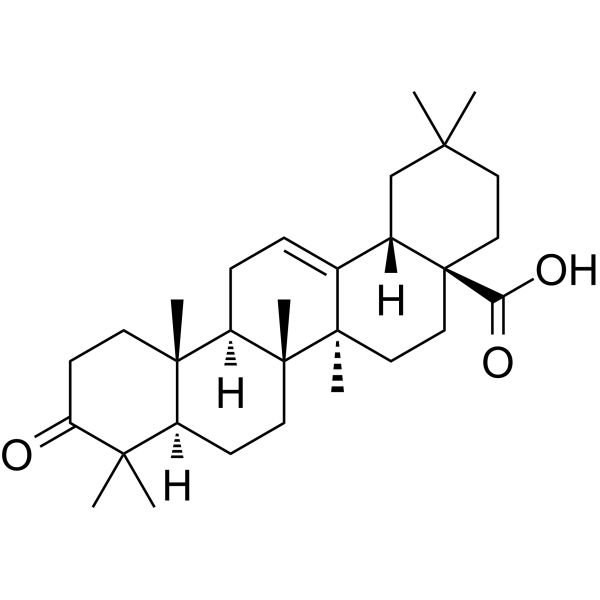
Oleanonic acid
Based on 2 publication(s) in Google Scholar
Oleanonic acid (3-Oxooleanolic acid) is an orally available triterpene that has anti-inflammatory and insecticidal properties. In vitro, oleanonic acid can improve oxidative stress, autophagy defects, ferroptosis, mitochondrial damage, and endoplasmic reticulum stress induced by Amyloid-β, and in vivo, it can alleviate myocardial hypertrophy in rats.
Nos produits utilisent uniquement pour la recherche. Nous ne vendons pas aux patients.
- Pureté : 99.91%
- CAS No.: 17990-42-0
- Formule: C30H46O3
- Masse moléculaire:454.68
-
Stockage:Powder -20°C, 3 years , 4°C, 2 years ; In solvent -80°C, 2 years , -20°C, 1 year

To place orders, for customer services and technical support, please contact: MedChemExpress USA
Tel: 609-228-6898 E-mail: [email protected] [email protected]


-
 Activité biologique
-
Chemical Information
-
Solvant et solubilité
- Protocole
- Pureté et documentation
- Références
-
 Help & FAQs




Publications Citing Use of MedChemExpress (MCE) Oleanonic acid
More

Activité biologique
Description
IC50 & Target
|
HIV-1 |
Cellular Effect
|
Cell Line

|
Type | Value | Description | References |
|---|---|---|---|---|
| A549 | IC50 |
>20 μg/mL
Compound: Oleanonic acid
|
Cytotoxicity against human A549 cells by MTT assay
Cytotoxicity against human A549 cells by MTT assay
|
[PMID: 21106454] |
| A549 | IC50 |
49.5 μM
Compound: 4a
|
Cytotoxicity against human A549 cells incubated for 72 hrs by MTS assay
Cytotoxicity against human A549 cells incubated for 72 hrs by MTS assay
|
[PMID: 31677446] |
| A549 | IC50 |
50 μM
Compound: 3a
|
Cytotoxicity against human A549 cells assessed as reduction in cell viability incubated for 72 hrs by MTS assay
Cytotoxicity against human A549 cells assessed as reduction in cell viability incubated for 72 hrs by MTS assay
|
[PMID: 36174412] |
| BJ | IC50 |
>50 μM
Compound: 4a
|
Cytotoxicity against human BJ cells incubated for 72 hrs by MTS assay
Cytotoxicity against human BJ cells incubated for 72 hrs by MTS assay
|
[PMID: 31677446] |
| BJ | IC50 |
>50 μM
Compound: 3a
|
Cytotoxicity against human BJ cells assessed as reduction in cell viability incubated for 72 hrs by MTS assay
Cytotoxicity against human BJ cells assessed as reduction in cell viability incubated for 72 hrs by MTS assay
|
[PMID: 36174412] |
| Ca9-22 | IC50 |
18.04 μg/mL
Compound: Oleanonic acid
|
Cytotoxicity against human Ca9-22 cells by MTT assay
Cytotoxicity against human Ca9-22 cells by MTT assay
|
[PMID: 21106454] |
| CCRF-CEM | IC50 |
15.1 μM
Compound: 4a
|
Cytotoxicity against human CCRF-CEM cells incubated for 72 hrs by MTS assay
Cytotoxicity against human CCRF-CEM cells incubated for 72 hrs by MTS assay
|
[PMID: 31677446] |
| CCRF-CEM | IC50 |
9.5 μM
Compound: 3a
|
Cytotoxicity against human CCRF-CEM cells assessed as reduction in cell viability incubated for 72 hrs by MTS assay
Cytotoxicity against human CCRF-CEM cells assessed as reduction in cell viability incubated for 72 hrs by MTS assay
|
[PMID: 36174412] |
| CEM-DNR | IC50 |
17 μM
Compound: 3a
|
Cytotoxicity against human CEM-DNR cells assessed as reduction in cell viability incubated for 72 hrs by MTS assay
Cytotoxicity against human CEM-DNR cells assessed as reduction in cell viability incubated for 72 hrs by MTS assay
|
[PMID: 36174412] |
| H9 | EC50 |
0.11 μg/mL
Compound: 27
|
Cytotoxicity against mock-infected human H9 cells after 4 days
Cytotoxicity against mock-infected human H9 cells after 4 days
|
[PMID: 9748372] |
| H9 | IC50 |
0.8 μg/mL
Compound: 27
|
Antiviral activity against HIV1 3B in human H9 cells after 4 days by p24 antigen ELISA
Antiviral activity against HIV1 3B in human H9 cells after 4 days by p24 antigen ELISA
|
[PMID: 9748372] |
| HCT-116 | IC50 |
>50 μM
Compound: 4a
|
Cytotoxicity against p53 knockout human HCT116 cells incubated for 72 hrs by MTS assay
Cytotoxicity against p53 knockout human HCT116 cells incubated for 72 hrs by MTS assay
|
[PMID: 31677446] |
| HCT-116 | IC50 |
45 μM
Compound: 3a
|
Cytotoxicity against human HCT-116 cells assessed as reduction in cell viability incubated for 72 hrs by MTS assay
Cytotoxicity against human HCT-116 cells assessed as reduction in cell viability incubated for 72 hrs by MTS assay
|
[PMID: 36174412] |
| HCT-116 | IC50 |
45.1 μM
Compound: 4a
|
Cytotoxicity against human HCT116 cells incubated for 72 hrs by MTS assay
Cytotoxicity against human HCT116 cells incubated for 72 hrs by MTS assay
|
[PMID: 31677446] |
| Hep 3B2 | IC50 |
>20 μg/mL
Compound: Oleanonic acid
|
Cytotoxicity against human Hep3B cells by MTT assay
Cytotoxicity against human Hep3B cells by MTT assay
|
[PMID: 21106454] |
| HepG2 | IC50 |
>20 μg/mL
Compound: Oleanonic acid
|
Cytotoxicity against human HepG2 cells by MTT assay
Cytotoxicity against human HepG2 cells by MTT assay
|
[PMID: 21106454] |
| J774.A1 | IC50 |
38.8 μM
Compound: 3
|
Inhibition of LPS-induced NO production in mouse J774A1 cells compound preincubated for 1 hr before LPS treatment by Griess reaction
Inhibition of LPS-induced NO production in mouse J774A1 cells compound preincubated for 1 hr before LPS treatment by Griess reaction
|
[PMID: 25113933] |
| J774.A1 | IC50 |
87.72 μM
Compound: 3
|
Cytotoxicity against mouse J774A1 cells assessed as cell viability by MTT assay relative to control
Cytotoxicity against mouse J774A1 cells assessed as cell viability by MTT assay relative to control
|
[PMID: 25113933] |
| K562 | IC50 |
>50 μM
Compound: 4a
|
Cytotoxicity against human K562 cells incubated for 72 hrs by MTS assay
Cytotoxicity against human K562 cells incubated for 72 hrs by MTS assay
|
[PMID: 31677446] |
| K562 | IC50 |
>50 μM
Compound: 3a
|
Cytotoxicity against human K562 cells assessed as reduction in cell viability incubated for 72 hrs by MTS assay
Cytotoxicity against human K562 cells assessed as reduction in cell viability incubated for 72 hrs by MTS assay
|
[PMID: 36174412] |
| MCF7 | IC50 |
>20 μg/mL
Compound: Oleanonic acid
|
Cytotoxicity against human MCF7 cells by MTT assay
Cytotoxicity against human MCF7 cells by MTT assay
|
[PMID: 21106454] |
| MDA-MB-231 | IC50 |
>20 μg/mL
Compound: Oleanonic acid
|
Cytotoxicity against human MDA-MB-231 cells by MTT assay
Cytotoxicity against human MDA-MB-231 cells by MTT assay
|
[PMID: 21106454] |
| MRC5 | IC50 |
>50 μM
Compound: 4a
|
Cytotoxicity against human MRC5 cells incubated for 72 hrs by MTS assay
Cytotoxicity against human MRC5 cells incubated for 72 hrs by MTS assay
|
[PMID: 31677446] |
| MRC5 | IC50 |
>50 μM
Compound: 3a
|
Cytotoxicity against human MRC5 cells assessed as reduction in cell viability incubated for 72 hrs by MTS assay
Cytotoxicity against human MRC5 cells assessed as reduction in cell viability incubated for 72 hrs by MTS assay
|
[PMID: 36174412] |
| RAW264.7 | IC50 |
38.5 μM
Compound: 3
|
Inhibition of LPS-induced NO production in mouse RAW264.7 cells compound preincubated for 1 hr before LPS treatment by Griess reaction
Inhibition of LPS-induced NO production in mouse RAW264.7 cells compound preincubated for 1 hr before LPS treatment by Griess reaction
|
[PMID: 25113933] |
| RAW264.7 | IC50 |
89.6 μM
Compound: 3
|
Cytotoxicity mouse RAW264.7 cells assessed as cell viability by MTT assay relative to control
Cytotoxicity mouse RAW264.7 cells assessed as cell viability by MTT assay relative to control
|
[PMID: 25113933] |
| SK-MEL | IC50 |
31 μM
Compound: 19
|
Compound was tested for its cytotoxicity against human malignant melanoma cell line SK-MEL
Compound was tested for its cytotoxicity against human malignant melanoma cell line SK-MEL
|
[PMID: 10450948] |
| U2OS | IC50 |
48.5 μM
Compound: 4a
|
Cytotoxicity against human U2OS cells incubated for 72 hrs by MTS assay
Cytotoxicity against human U2OS cells incubated for 72 hrs by MTS assay
|
[PMID: 31677446] |
| U2OS | IC50 |
49 μM
Compound: 3a
|
Cytotoxicity against human U2OS cells assessed as reduction in cell viability incubated for 72 hrs by MTS assay
Cytotoxicity against human U2OS cells assessed as reduction in cell viability incubated for 72 hrs by MTS assay
|
[PMID: 36174412] |
In Vitro
Oleanonic acid inhibits HIV-1 infection in PBMCs in vitro, with EC50 values for naturally infected PBMCs and monocytes/macrophages being 22.7 mM, 24.6 mM, and 57.4 mM, respectively. Furthermore, it can inhibit the production of leukotriene B4 by mouse peritoneal leukocytes, with an IC50 of 17 μM[2].
Oleanonic acid has strong anti-insect activity against Rhipicephalus (Kreyszig) and Amazon ticks, with IC50 values of 18.5 µM and 29.9 µM[3].
Oleanonic acid (0-45 μM, 24 h) inhibits the increase of NF-κB transcription activity in cardiomyocytes treated with phenylephrine (PE) and reduces the mRNA expression of hypertrophic genes like atrial natriuretic factor (ANF) and brain natriuretic peptide (BNP) in a dose-dependent manner[4].
Oleanonic acid (15 μM, 24 h) inhibits the phosphorylation of protein kinase Cζ (PKCζ) at the Thr410 site in cardiomyocytes, subsequently reducing NF-κB activation in PE-treated cardiomyocytes[4].
Oleanonic acid (1-5 μM, 48 h) reduces APP expression in SH-SY5Y cells, lessens damage induced by oxidative stress, repairs autophagy defects, and inhibits ferroptosis[5].
MedChemExpress (MCE) has not independently confirmed the accuracy of these methods. They are for reference only.
-
Cell Line:NRCMs
-
Concentration:0, 5, 15, 45 μM
-
Incubation Time:24 h
-
Result:Inhibited NF-κB transcriptional activity and reduced the expression of hypertrophic genes such as Atrial Natriuretic Factor (ANF) and Brain Natriuretic Peptide (BNP).
-
Cell Line:NRCMs
-
Concentration:15 μM
-
Incubation Time:24 h
-
Result:Inhibited the phosphorylation of the Thr410 site protein kinase PKCζ, and suppressed NF-κB.
-
Cell Line:SH-SY5Y, SH-SY5Y-APP
-
Concentration:1, 2.5, 5 μM
-
Incubation Time:48 h
-
Result:Reduced APP expression, inhibited mTOR phosphorylation, increased autophagy markers ATG5 and LC3-II, suppressed Nrf2 and HO-1, and restored the levels of GPX4, NCOA, and COX2.
In Vivo
MedChemExpress (MCE) has not independently confirmed the accuracy of these methods. They are for reference only.
-
Animal Model:AAC rats[4]
-
Dosage:15, 45 mg/kg; daily; 8 weeks
-
Administration:Oral
-
Result:Reduced heart size and visibly decreased the thickness of the left ventricular wall, and in a dose-dependent manner, there was also a reduction in myocardial cell diameter and the heart weight to body weight ratio (HW/BW) under 400x HE staining.


Chemical Information
-
CAS No. 17990-42-0
-
Appearance Solid
-
Masse moléculaire 454.68
-
Formule C30H46O3
-
Color White to off-white
-
SMILES
CC1(C)C(CC[C@]2(C)[C@@]3([H])CC=C4[C@]5([H])CC(C)(C)CC[C@@](C(O)=O)5CC[C@](C)4[C@@](C)3CC[C@@]12[H])=O
-
Synonyms
3-Oxooleanolic acid
-
Structure Classification
-
Initial Source
-
Livraison
Room temperature in continental US; may vary elsewhere.
-
Stockage
Powder -20°C 3 years 4°C 2 years In solvent -80°C 2 years -20°C 1 year


Publications (2)
-
Journal Impact Factor
-
Most Recent
-
Pharmacol Res
2024 Jun:204:107208. PMID: 38729587 -
Vet Microbiol
The Chinese medicine monomer Schisandrin C inhibits PRRSV infection by regulating the OGT-PI3K/AKT/mTOR signaling pathway. [Abstract]2026 May:316:110992. PMID: 41865607


Solvant et solubilité
In Vitro:
DMSO : 50 mg/mL (109.97 mM; Need ultrasonic; Hygroscopic DMSO has a significant impact on the solubility of product, please use newly opened DMSO)
H2O : ≥ mg/mL
* "≥" means soluble, but saturation unknown.
Please refer to the solubility information to select the appropriate solvent. Once prepared, please aliquot and store the solution to prevent product inactivation from repeated freeze-thaw cycles.
Storage method and period of stock solution: -80°C, 2 years; -20°C, 1 year. When stored at -80°C, please use it within 2 years. When stored at -20°C, please use it within 1 year.
* Note: If you choose water as the stock solution, please dilute it to the working solution, then filter and sterilize it with a 0.22 μm filter before use.
Please refer to the solubility information to select the appropriate solvent. Once prepared, please aliquot and store the solution to prevent product inactivation from repeated freeze-thaw cycles.
Storage method and period of stock solution: -80°C, 2 years; -20°C, 1 year. When stored at -80°C, please use it within 2 years. When stored at -20°C, please use it within 1 year.
* Note: If you choose water as the stock solution, please dilute it to the working solution, then filter and sterilize it with a 0.22 μm filter before use.
Concentration (start) × Volume (start) = Concentration (final) × Volume (final)
In Vivo:
Select the appropriate dissolution method based on your experimental animal and administration route.
- For the following dissolution methods, please ensure to first prepare a clear stock solution using an In Vitro approach and then sequentially add co-solvents:
- To ensure reliable experimental results, the clarified stock solution can be appropriately stored based on storage conditions. As for the working solution for In Vivo experiments, it is recommended to prepare freshly and use it on the same day.
- The percentages shown for the solvents indicate their volumetric ratio in the final prepared solution. If precipitation or phase separation occurs during preparation, heat and/or sonication can be used to aid dissolution.
Add each solvent one by one: 10% DMSO 40% PEG300 5% Tween-80 45% Saline
Solubility: ≥ 2.5 mg/mL (5.50 mM); Clear solution
This protocol yields a clear solution of ≥ 2.5 mg/mL (saturation unknown).
Taking 1 mL working solution as an example, add 100 μL DMSO stock solution (25.0 mg/mL) to 400 μL PEG300, and mix evenly; then add 50 μL Tween-80 and mix evenly; then add 450 μL Saline to adjust the volume to 1 mL.
Preparation of Saline: Dissolve 0.9 g sodium chloride in ddH₂O and dilute to 100 mL to obtain a clear Saline solution.
Add each solvent one by one: 10% DMSO 90% (20% SBE-β-CD in Saline)
Solubility: 2.5 mg/mL (5.50 mM); Suspended solution; Need ultrasonic
This protocol yields a suspended solution of 2.5 mg/mL. Suspended solution can be used for oral and intraperitoneal injection.
Taking 1 mL working solution as an example, add 100 μL DMSO stock solution (25.0 mg/mL) to 900 μL 20% SBE-β-CD in Saline, and mix evenly.
Preparation of 20% SBE-β-CD in Saline (4°C, storage for one week): 2 g SBE-β-CD powder is dissolved in 10 mL Saline, completely dissolve until clear.
In Vivo Dissolution Calculator
Please enter the basic information of animal experiments:
-
-
-
-
Recommended: Prepare an additional quantity of animals to account for potential losses during experiments.
Please enter your animal formula composition:
-
%DMSO +
Recommended: Keep the proportion of DMSO in working solution below 2% if your animal is weak.
-
%+
-
+%Tween-80 + +
-
%Saline +
The co-solvents required include: DMSO, . All of co-solvents are available by MedChemExpress (MCE). , Tween 80. All of co-solvents are available by MedChemExpress (MCE).
Working solution concentration: 0.22 mg/mL
Method for preparing stock solution: mg drug dissolved in μL DMSO. Stock solution concentration: mg/mL.
1. Take μL DMSO stock solution;
2. Add μL .
μL , mix evenly;
3. Then add μL Tween 80, mix evenly;
4. Then add μL
Please ensure that the stock solution in the first step is dissolved to a clear state, and add co-solvents in sequence. You can use ultrasonic heating (ultrasonic cleaner, recommended frequency 20-40 kHz), vortexing, etc. to assist dissolution.


Pureté et documentation
-
Fiche technique (284 KB)
-
SDS (396 KB)
- English - EN (396 KB)
- Français - FR (396 KB)
- Deutsch - DE (396 KB)
- Norwegian - NO (396 KB)
- Español - ES (396 KB)
- Swedish - SV (396 KB)
- Italian - IT (396 KB)
- Korean - KR (396 KB)
- Portuguese - PT (396 KB)
-
Instruction de manipulation (2659 KB)
Références
[1]. Giner-Larza EM et al.Oleanonic acid, a 3-oxotriterpene from Pistacia, inhibits leukotriene synthesis and has anti-inflammatory activity.Eur J Pharmacol.Sep 28;428(1):137-43.doi:10.1016/S0014-2999(01)01290-0(2001) [Content Brief]
[2]. Fabio Mengoni.Anti-HIV Activity of Oleanolic Acid on Infected Human Mononuclear Cells.Planta Med 68(2): 111-114.DOI: 10.1055/s-2002-20256(2002) [Content Brief]
[4]. Hui Gao, et al. Oleanonic acid ameliorates pressure overload-induced cardiac hypertrophy in rats: The role of PKCζ-NF-κB pathway. Mol Cell Endocrinol. 2018 Jul 15:470:259-268. [Content Brief]
[5]. Liqing Tao, et al. Oleanonic acid ameliorates mutant Aβ precursor protein-induced oxidative stress, autophagy deficits, ferroptosis, mitochondrial damage, and ER stress in vitro. Biochim Biophys Acta Mol Basis Dis. 2024 Dec;1870(8):167459. [Content Brief]


Complete Stock Solution Preparation Table
Please refer to the solubility information to select the appropriate solvent. Once prepared, please aliquot and store the solution to prevent product inactivation from repeated freeze-thaw cycles.
Storage method and period of stock solution: -80°C, 2 years; -20°C, 1 year. When stored at -80°C, please use it within 2 years. When stored at -20°C, please use it within 1 year.
| Optional Solvent | Concentration Solvent Mass | 1 mg | 5 mg | 10 mg | 25 mg |
|---|---|---|---|---|---|
| DMSO | 1 mM | 2.1993 mL | 10.9967 mL | 21.9935 mL | 54.9837 mL |
| 5 mM | 0.4399 mL | 2.1993 mL | 4.3987 mL | 10.9967 mL | |
| 10 mM | 0.2199 mL | 1.0997 mL | 2.1993 mL | 5.4984 mL | |
| 15 mM | 0.1466 mL | 0.7331 mL | 1.4662 mL | 3.6656 mL | |
| 20 mM | 0.1100 mL | 0.5498 mL | 1.0997 mL | 2.7492 mL | |
| 25 mM | 0.0880 mL | 0.4399 mL | 0.8797 mL | 2.1993 mL | |
| 30 mM | 0.0733 mL | 0.3666 mL | 0.7331 mL | 1.8328 mL | |
| 40 mM | 0.0550 mL | 0.2749 mL | 0.5498 mL | 1.3746 mL | |
| 50 mM | 0.0440 mL | 0.2199 mL | 0.4399 mL | 1.0997 mL | |
| 60 mM | 0.0367 mL | 0.1833 mL | 0.3666 mL | 0.9164 mL | |
| 80 mM | 0.0275 mL | 0.1375 mL | 0.2749 mL | 0.6873 mL | |
| 100 mM | 0.0220 mL | 0.1100 mL | 0.2199 mL | 0.5498 mL |
* Note: If you choose water as the stock solution, please dilute it to the working solution, then filter and sterilize it with a 0.22 μm filter before use.


Oleanonic acid Related Classifications
HY-N1487 Related Classifications
 Powered by Bioz