



PD176252 (Standard)
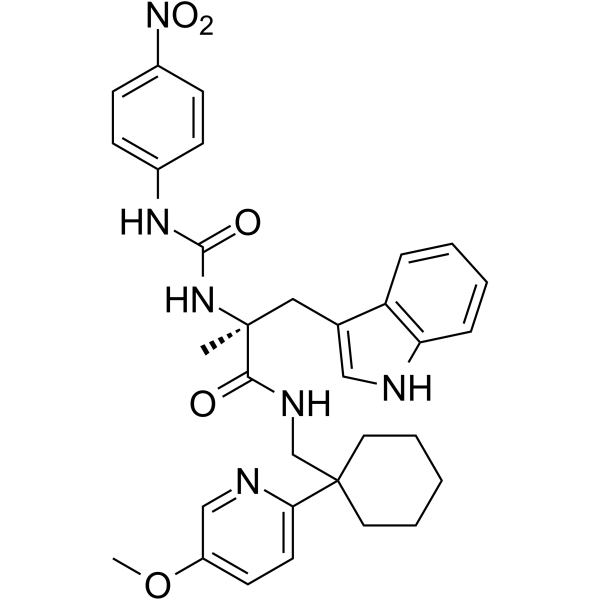
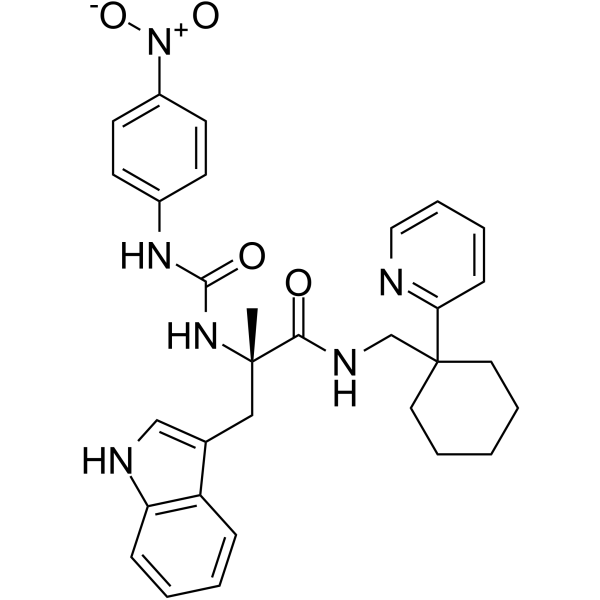
PD176252 (Standard) is the analytical standard of PD176252 (HY-103286). This product is intended for research and analytical applications. PD176252 is a potent antagonist of neuromedin-B preferring (BB1) and gastrin-releasing peptide-preferring (BB2) receptor with Kis of 0.17 nM and 1 nM for human BB1 and BB2 receptors, and 0.66 nM, 16 nM for Rat BB1 and BB2 receptors, respectively; PD176252 is also an agonist of N-Formyl peptide receptor1/2 (FPR1/FPR2), with EC50s of 0.31 and 0.66 μM in HL-60 cells.
Nur für Forschungszwecke. Wir verkaufen nicht an Patienten.
- CAS. Nr.: 204067-01-6
- Formel: C32H36N6O5
- Molecular Weight:584.67
-
Speicherung:
Please store the product under the recommended conditions in the Certificate of Analysis.


To place orders, for customer services and technical support, please contact: MedChemExpress USA
Tel: 609-228-6898 E-mail: [email protected] [email protected]


-
 Product Information
-
Chemical Information
- Reinheit & Dokumentation
-
 Help & FAQs




Product Information
Information
Anwendung
The compound is the grade of analytical standard, which is the reference standard supplied assay. It is commonly used in qualitative, quantitative and methodological research experiments in HPLC, GC and MS.


Chemical Information
-
CAS. Nr. 204067-01-6
-
Molecular Weight 584.67
-
Formel C32H36N6O5
-
SMILES
O=C(NC1=CC=C([N+]([O-])=O)C=C1)N[C@](CC2=CNC3=C2C=CC=C3)(C)C(NCC4(C5=CC=C(OC)C=N5)CCCCC4)=O
-
Versand
Room temperature in continental US; may vary elsewhere.
-
Speicherung
Please store the product under the recommended conditions in the Certificate of Analysis.


Reinheit & Dokumentation
Verweise
[1]. Ashwood V, et al. PD 176252--the first high affinity non-peptide gastrin-releasing peptide (BB2) receptor antagonist. Bioorg Med Chem Lett. 1998 Sep 22;8(18):2589-94. [Content Brief]
[2]. Schepetkin IA, et al. Gastrin-releasing peptide/neuromedin B receptor antagonists PD176252, PD168368, and related analogs are potent agonists of human formyl-peptide receptors. Mol Pharmacol. 2011 Jan;79(1):77-90. [Content Brief]
[3]. Moody TW, et al. Nonpeptide gastrin releasing peptide receptor antagonists inhibit the proliferation of lung cancer cells. Eur J Pharmacol. 2003 Aug 1;474(1):21-9. [Content Brief]

Calculators
Konzentration (Stammlösung) × Volumen (Stammlösung) = Konzentration (Ziellösung) × Volumen (Ziellösung)


PD176252 (Standard) Related Classifications
HY-103286R Related Classifications
 Powered by Bioz