



Phospho-CDK1/2/3 (Thr14) Antibody (YA218)
(Synonyms: CDC2; CDC28A; P34CDC2)
Based on 1 Customer Validation
Phospho-CDK1/2/3 (Thr14) Antibody (YA218) is a Rabbit-derived and non-conjugated IgG monoclonal antibody, targeting to Phospho-CDK1/2/3 (Thr14).
-
Host:
Rabbit
-
Isotype:
IgG
-
Application:
WB, IP
-
Reactivity :
Human, Hamster
-
Formulation:
Supplied in 50 mM Tris-Glycine (pH 7.4), 0.15 M NaCl, 40% Glycerol and 0.05% BSA. Preservative: 0.01% Sodium azide
-
Conjugation:
Non-conjugated


To place orders, for customer services and technical support, please contact: MedChemExpress USA
Tel: 609-228-6898 E-mail: [email protected] [email protected]





Applications
| Application |
WB

WB: Western Blot
|
IP
IP: Immunoprecipitation
|
|---|---|---|
| Dilution Ratio | 1:500-1:1000 | 1:20 |


Product Details
Phospho-CDK1/2/3 (Thr14) Antibody (YA218) is a Rabbit-derived and non-conjugated IgG monoclonal antibody, targeting to Phospho-CDK1/2/3 (Thr14).
-
Host Rabbit

-
Clonality Recombinant,Monoclonal

-
Species ReactivityHuman, Hamster
-
Observed Molecular WeightObserved band size: 34 kDa
Note: Due to possible protein modifications or aggregation, the molecular weight should be confirmed by actual measurement, and the predicted value is for reference only.

-
Calculated Molecular Weight Predicted band size: 34 kDa

Entrez Gene: 983 Human ; 1017 Human ; 1018 Human
SwissProt: P06493 Human ; P24941 Human ; Q00526 Human
Synthetic phosphopeptide corresponding to residues surrounding Thr14 of Human Cdk1.The exact sequence is proprietary to MCE.
Endogenous
affinity purified
Non-conjugated
Phosphorylated
IgG


Product Properties
-
Appearance
Solution
-
Formulation
Supplied in 50 mM Tris-Glycine (pH 7.4), 0.15 M NaCl, 40% Glycerol and 0.05% BSA. Preservative: 0.01% Sodium azide
-
Concentration
Batch-dependent, Please check the COA for the concentration of each lot. Check Lot Concentration
-
Storage & Stability
Stored at -20°C for 1 year. Avoid repeated freeze / thaw cycles.
-
Shipping
Shipping with blue ice.


Verification Images
-
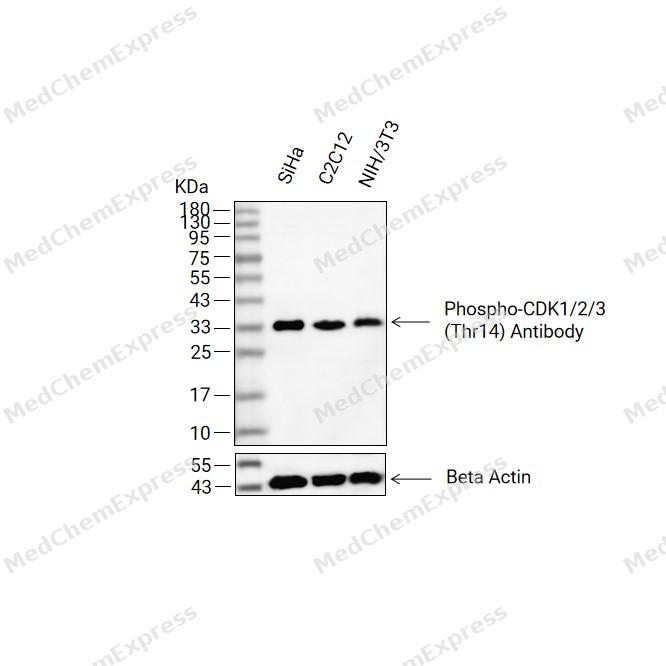 Western blot analysis of extracts from SiHa(lane 2(20ug) , C2C12(lane 3(20ug) and NIH/3T3(lane 4(20ug) using Phospho-CDK1/2/3 Antibody (HY-P80797) Rabbit mAb. Proteins were transferred to a PVDF membrane and blocked with 5% non-fat milk in TBST for 2 hour at room temperature. The primary antibody (1/1000) and Loading control antibody (Beta Actin, HY-P83730, 1/10000) was used in 5% non-fat milk in TBST at 4°C overnight. Goat Anti-Mouse/Rabbit IgG-HRP Secondary Antibody (1/10000) was used for 1 hour at room temperature.


Background
-
Function
CDK1/2/3 is a P06493: Plays a key role in the control of the eukaryotic cell cycle by modulating the centrosome cycle as well as mitotic onset; promotes G2-M transition via association with multiple interphase cyclins. Phosphorylates PARVA/actopaxin, APC, AMPH, APC, BARD1, Bcl-xL/BCL2L1, BRCA2, CALD1, CASP8, CDC7, CDC20, CDC25A, CDC25C, CC2D1A, CENPA, CSNK2 proteins/CKII, FZR1/CDH1, CDK7, CEBPB, CHAMP1, DMD/dystrophin, EEF1 proteins/EF-1, EZH2, KIF11/EG5, EGFR, FANCG, FOS, GFAP, GOLGA2/GM130, GRASP1, UBE2A/hHR6A, HIST1H1 proteins/histone H1, HMGA1, HIVEP3/KRC, KAT5, LMNA, LMNB, LBR, MKI67, LATS1, MAP1B, MAP4, MARCKS, MCM2, MCM4, MKLP1, MLST8, MYB, NEFH, NFIC, NPC/nuclear pore complex, PITPNM1/NIR2, NPM1, NCL, NUCKS1, NPM1/numatrin, ORC1, PRKAR2A, EEF1E1/p18, EIF3F/p47, p53/TP53, NONO/p54NRB, PAPOLA, PLEC/plectin, RB1, TPPP, UL40/R2, RAB4A, RAP1GAP, RBBP8/CtIP, RCC1, RPS6KB1/S6K1, KHDRBS1/SAM68, ESPL1, SKI, BIRC5/survivin, STIP1, TEX14, beta-tubulins, MAPT/TAU, NEDD1, VIM/vimentin, TK1, FOXO1, RUNX1/AML1, SAMHD1, SIRT2, CGAS and RUNX2.
P24941: Serine/threonine-protein kinase involved in the control of the cell cycle; essential for meiosis, but dispensable for mitosis. Phosphorylates CABLES1, CTNNB1, CDK2AP2, ERCC6, NBN, USP37, p53/TP53, NPM1, CDK7, RB1, BRCA2, MYC, NPAT, EZH2. Triggers duplication of centrosomes and DNA. Acts at the G1-S transition to promote the E2F transcriptional program and the initiation of DNA synthesis, and modulates G2 progression; controls the timing of entry into mitosis/meiosis by controlling the subsequent activation of cyclin B/CDK1 by phosphorylation, and coordinates the activation of cyclin B/CDK1 at the centrosome and in the nucleus.
Q00526: Serine/threonine-protein kinase that plays a critical role in the control of the eukaryotic cell cycle; involved in G0-G1 and G1-S cell cycle transitions. Interacts with CCNC/cyclin-C during interphase. Phosphorylates histone H1, ATF1, RB1 and CABLES1. ATF1 phosphorylation triggers ATF1 transactivation and transcriptional activities, and promotes cell proliferation and transformation. CDK3/cyclin-C mediated RB1 phosphorylation is required for G0-G1 transition. Promotes G1-S transition probably by contributing to the activation of E2F1, E2F2 and E2F3 in a RB1-independent manner
[1][2][3][4][5][6][7][8][9][10][11][12][13][14][15][16][17][18][19][20][21][22][23][24][25][26][27][28]. -
Subcellular Localization
P06493: Nucleus; Cytoplasm; Mitochondrion; Cytoplasm, cytoskeleton, microtubule organizing center, centrosome; Cytoplasm, cytoskeleton, spindle
P24941: Cytoplasm, cytoskeleton, microtubule organizing center, centrosome; Nucleus, Cajal body; Cytoplasm; Endosome -
Expression
Tissue_specificity: P06493: Found in breast cancer tissues
Q00526: Expressed in cancer cell lines and glioblastoma tissue
Induction: P06493: Follows a cyclic expression; during interphase, accumulates gradually following G1, S to reach a critical threshold at the end of G2, which promotes self-activation and triggers onset of mitosis. Induced transiently by TGFB1 at an early phase of TGFB1-mediated apoptosis, but later repressed. Triggered by CKS1B during mitotic entry in breast cancer cells. Down-regulated under genotoxic stresses triggered by PKR/EIF2AK2-mediated phosphorylation
P24941: Induced transiently by TGFB1 at an early phase of TGFB1-mediated apoptosis -
Subunit
P06493: Forms a stable but non-covalent complex with a regulatory subunit and with a cyclin (PubMed:20360007). The cyclin subunit imparts substrate specificity to the complex (PubMed:20360007).
P24941: Found in a complex with CABLES1, CCNA1 and CCNE1. Interacts with CABLES1 (By similarity). Interacts with UHRF2. Part of a complex consisting of UHRF2, CDK2 and CCNE1. Interacts with the Speedy/Ringo proteins SPDYA and SPDYC (PubMed:15611625).
Q00526: Interacts with CABLES1 and CABLES2 (By similarity). Interacts with ATF1. Binding to CCNC/cyclin-C promotes RB1 phosphorylation -
Synonyms
CDC2; CDC28A; P34CDC2
-
Research Field
Cell Biology


Documentation
-
Data Sheet (267 KB)
-
SDS (251 KB)
- English - EN (251 KB)
- Français - FR (251 KB)
- Deutsch - DE (251 KB)
- Norwegian - NO (251 KB)
- Español - ES (251 KB)
- Swedish - SV (251 KB)
- Italian - IT (251 KB)
- Korean - KR (251 KB)
- Portuguese - PT (251 KB)
-
User Guide for Antibodies (1077 KB)
References
[1]. Qiao M, et al. Cell cycle-dependent phosphorylation of the RUNX2 transcription factor by cdc2 regulates endothelial cell proliferation. J Biol Chem. 2006 Mar 17;281(11):7118-28. [Content Brief]
[2]. Southwood CM, et al. Microtubule deacetylases, SirT2 and HDAC6, in the nervous system. Neurochem Res. 2007 Feb;32(2):187-95. [Content Brief]
[3]. Hu X, et al. TGFbeta regulates the expression and activities of G2 checkpoint kinases in human myeloid leukemia cells. Cytokine. 2007 Feb;37(2):155-62. [Content Brief]
[4]. Yuan Z, et al. Activation of FOXO1 by Cdk1 in cycling cells and postmitotic neurons. Science. 2008 Mar 21;319(5870):1665-8. [Content Brief]
[5]. Zhang X, et al. Sequential phosphorylation of Nedd1 by Cdk1 and Plk1 is required for targeting of the gammaTuRC to the centrosome. J Cell Sci. 2009 Jul 1;122(Pt 13):2240-51. [Content Brief]
[6]. Terrano DT, et al. Cyclin-dependent kinase 1-mediated Bcl-xL/Bcl-2 phosphorylation acts as a functional link coupling mitotic arrest and apoptosis. Mol Cell Biol. 2010 Feb;30(3):640-56. [Content Brief]
[7]. Nakamura A, et al. Mitotic phosphorylation of Aki1 at Ser208 by cyclin B1-Cdk1 complex. Biochem Biophys Res Commun. 2010 Mar 19;393(4):872-6. [Content Brief]
[8]. Chen S, et al. Cyclin-dependent kinases regulate epigenetic gene silencing through phosphorylation of EZH2. Nat Cell Biol. 2010 Nov;12(11):1108-14. [Content Brief]
[9]. Matthess Y, et al. Cdk1/cyclin B1 controls Fas-mediated apoptosis by regulating caspase-8 activity. Mol Cell Biol. 2010 Dec;30(24):5726-40. [Content Brief]
[10]. Itoh G, et al. CAMP (C13orf8, ZNF828) is a novel regulator of kinetochore-microtubule attachment. EMBO J. 2011 Jan 5;30(1):130-44. [Content Brief]
[11]. Ward GE, et al. Identification of cell cycle-regulated phosphorylation sites on nuclear lamin C. Cell. 1990 May 18;61(4):561-77. [Content Brief]
[12]. Schofield AV, et al. Tubulin polymerization promoting protein 1 (Tppp1) phosphorylation by Rho-associated coiled-coil kinase (rock) and cyclin-dependent kinase 1 (Cdk1) inhibits microtubule dynamics to increase cell proliferation. J Biol Chem. 2013 Mar 15;288(11):7907-7917. [Content Brief]
[13]. Heald R, et al. Mutations of phosphorylation sites in lamin A that prevent nuclear lamina disassembly in mitosis. Cell. 1990 May 18;61(4):579-89. [Content Brief]
[14]. White TE, et al. The retroviral restriction ability of SAMHD1, but not its deoxynucleotide triphosphohydrolase activity, is regulated by phosphorylation. Cell Host Microbe. 2013 Apr 17;13(4):441-51. [Content Brief]
[15]. Cribier A, et al. Phosphorylation of SAMHD1 by cyclin A2/CDK1 regulates its restriction activity toward HIV-1. Cell Rep. 2013 Apr 25;3(4):1036-43. [Content Brief]
[16]. Yu Z, et al. Dynamic phosphorylation of CENP-A at Ser68 orchestrates its cell-cycle-dependent deposition at centromeres. Dev Cell. 2015 Jan 12;32(1):68-81. [Content Brief]
[17]. Mo F, et al. Acetylation of Aurora B by TIP60 ensures accurate chromosomal segregation. Nat Chem Biol. 2016 Apr;12(4):226-32. [Content Brief]
[18]. Deshpande RA, et al. Nbs1 Converts the Human Mre11/Rad50 Nuclease Complex into an Endo/Exonuclease Machine Specific for Protein-DNA Adducts. Mol Cell. 2016 Nov 3;64(3):593-606. [Content Brief]
[19]. Saldivar JC, et al. An intrinsic S/G(2) checkpoint enforced by ATR. Science. 2018 Aug 24;361(6404):806-810. [Content Brief]
[20]. Cheng X, et al. Pacer Is a Mediator of mTORC1 and GSK3-TIP60 Signaling in Regulation of Autophagosome Maturation and Lipid Metabolism. Mol Cell. 2019 Feb 21;73(4):788-802.e7. [Content Brief]
[21]. Huertas P, et al. Human CtIP mediates cell cycle control of DNA end resection and double strand break repair. J Biol Chem. 2009 Apr 3;284(14):9558-65. [Content Brief]
[22]. Takagi M, et al. Ki67 antigen contributes to the timely accumulation of protein phosphatase 1γ on anaphase chromosomes. J Biol Chem. 2014 Aug 15;289(33):22877-22887. [Content Brief]
[23]. Zhong L, et al. Phosphorylation of cGAS by CDK1 impairs self-DNA sensing in mitosis. Cell Discov. 2020;6:26. [Content Brief]
[24]. Zhang E, et al. CDK1/FBXW7 facilitates degradation and ubiquitination of MLST8 to inhibit progression of renal cell carcinoma. Cancer Sci. 2022 Jan;113(1):91-108. [Content Brief]
[25]. Okuda M, et al. Nucleophosmin/B23 is a target of CDK2/cyclin E in centrosome duplication. Cell. 2000 Sep 29;103(1):127-40. [Content Brief]
[26]. De Boer L, et al. Cyclin A/cdk2 coordinates centrosomal and nuclear mitotic events. Oncogene. 2008 Jul 17;27(31):4261-8. [Content Brief]
[27]. Malumbres M, et al. Cell cycle, CDKs and cancer: a changing paradigm. Nat Rev Cancer. 2009 Mar;9(3):153-66. [Content Brief]
[28]. Satyanarayana A, et al. Mammalian cell-cycle regulation: several Cdks, numerous cyclins and diverse compensatory mechanisms. Oncogene. 2009 Aug 20;28(33):2925-39. [Content Brief]

 Powered by Bioz
