



Neuroserpin Protein, Human (CHO)
Based on 1 Customer Validation
Neuroserpin Protein, Human (CHO) is a member of the serpin family of serine protease inhibitors, playing an important role in synaptic plasticity and memory formation in the hippocampus.
- Species: Human
- Source: CHO
-
Storage:Stored at -20°C for 2 years from date of receipt. After reconstitution, it is stable at 4°C for 1 week or -20°C for longer (with carrier protein). It is recommended to freeze aliquots at -20°C or -80°C for extended storage.


To place orders, for customer services and technical support, please contact: MedChemExpress USA
Tel: 609-228-6898 E-mail: [email protected] [email protected]


-
 Biological Activity
-
Technical Parameters
-
Product Properties
- Documentation
- References
- Help & FAQs




Biological Activity
Description
Neuroserpin Protein, Human (CHO) is a member of the serpin family of serine protease inhibitors, playing an important role in synaptic plasticity and memory formation in the hippocampus.
Background
Neuroserpin is a member of the serpin family of serine protease inhibitors predominantly expressed in the nervous system. Neuroserpin plays an important role in synaptic plasticity and memory formation in the hippocampus. Neuroserpin expression is particularly prominent at late stages of neuronal development in most regions of the central nervous system (CNS), whereas it is restricted to regions related to learning and memory in the adult brain[1].
Verified Bioactivity
The ED50 determined by a cell proliferation assay using rat C6 cells. The ED50 for this effect is ≤ 2.218 μg/mL, corresponding to a specific activity of ≥ 450.857 units/mg.
MCE Validation Data
-
Purity - SDS-PAGE
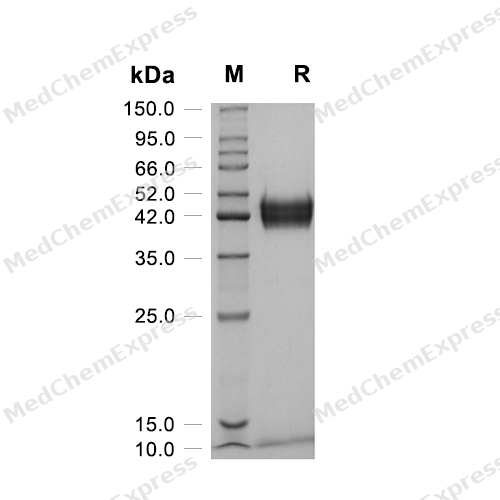
Purity - SDS-PAGE
-
Bioactivity - Cell-Based Assay
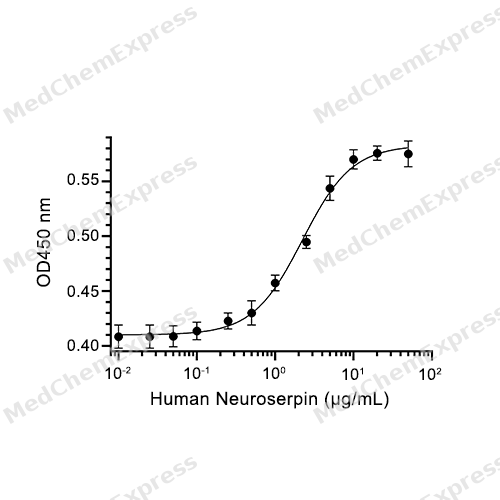
Bioactivity - Cell-Based Assay


Technical Parameters
-
Species Human
-
Source CHO
-
Tag Tag Free
-
Accession
Q99574 (T17-L410)
-
Molecular Construction
-
N-term
-
Neuroserpin (T17-L410)
Accession # Q99574 -
C-term
-
-
Protein Length
Full Length of Mature Protein
-
Synonyms
SERPINI1; PI-12; Prev. PI12; Serpin Peptidase Inhibitor Clade I Member 1 Isoform 2; Neuroserpin; Serpin Peptidase Inhibitor Clade I Member 1 Isoform 1; Serine (Or Cysteine) Proteinase Inhibitor, Clade I (Neuroserpin), Member 1; Serpin Peptidase Inhibitor
-
AA Sequence
TGATFPEEAIADLSVNMYNRLRATGEDENILFSPLSIALAMGMMELGAQGSTQKEIRHSMGYDSLKNGEEFSFLKEFSNMVTAKESQYVMKIANSLFVQNGFHVNEEFLQMMKKYFNAAVNHVDFSQNVAVANYINKWVENNTNNLVKDLVSPRDFDAATYLALINAVYFKGNWKSQFRPENTRTFSFTKDDESEVQIPMMYQQGEFYYGEFSDGSNEAGGIYQVLEIPYEGDEISMMLVLSRQEVPLATLEPLVKAQLVEEWANSVKKQKVEVYLPRFTVEQEIDLKDVLKALGITEIFIKDANLTGLSDNKEIFLSKAIHKSFLEVNEEGSEAAAVSGMIAISRMAVLYPQVIVDHPFFFLIRNRRTGTILFMGRVMHPETMNTSGHDFEEL
-
Molecular Weight
Approximately 40-45 kDa, based on SDS-PAGE under reducing conditions, due to the glycosylation.
-
Glycosylation
Yes
-
Purity
≥ 95%, as determined by reducing SDS-PAGE.


Product Properties
Lyophilized powder.
Lyophilized from a 0.22 μm filtered solution of 20 mM PB, 150 mM NaCl, pH 7.4.
< 0.2 EU/μg, determined by LAL method.
It is not recommended to reconstitute to a concentration less than 100 μg/mL in ddH2O. For long term storage it is recommended to add a carrier protein (0.1% BSA, 5% HSA, 10% FBS or 5% Trehalose).
Stored at -20°C for 2 years from date of receipt. After reconstitution, it is stable at 4°C for 1 week or -20°C for longer (with carrier protein). It is recommended to freeze aliquots at -20°C or -80°C for extended storage.
Room temperature in continental US; may vary elsewhere.


Documentation
-
Data Sheet (263 KB)
-
SDS (251 KB)
- English - EN (251 KB)
- Français - FR (251 KB)
- Deutsch - DE (251 KB)
- Norwegian - NO (251 KB)
- Español - ES (251 KB)
- Swedish - SV (251 KB)
- Italian - IT (251 KB)
- Korean - KR (251 KB)
- Portuguese - PT (251 KB)
-
Handling Instructions (2659 KB)


References

Calculators
Concentration (start) × Volume (start) = Concentration (final) × Volume (final)


 Powered by Bioz

