



L-Glutamic acid (Standard)
Based on 1 publication(s) in Google Scholar
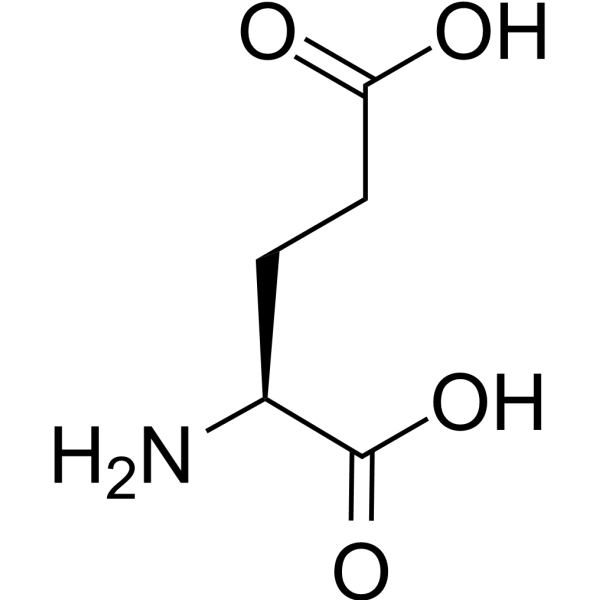
L-Glutamic acid (Standard) is the analytical standard of L-Glutamic acid. This product is intended for research and analytical applications. L-Glutamic acid is an excitatory amino acid neurotransmitter that acts as an agonist for all subtypes of glutamate receptors (metabolic rhodophylline, NMDA, and AMPA). L-Glutamic acid has an agonist effect on the release of DA from dopaminergic nerve endings. L-Glutamic acid can be used in the study of neurological diseases.
IC50 & Target:DA.
In Vitro: L-Glutamic acid (120, 500, 750, 1000 mg/dL) can reduce the harmful effect of lithium on the embryonic development of Xenopus Xenopus.
L-Glutamic acid (2, 5, 10, 20 mM, 24-48 h) can induce neuroexcitotoxicity in neuroblastoma.
In Vivo: L-Glutamic acid (3 g/kg, subcutaneous injection) can promote excitotoxic degeneration of retinal ganglion cells in mice.
L-Glutamic acid (750 mg/kg, intraperitoneal injection) can reduce and inhibit oxidative stress induced by chlorpyrifos (CPF) in rats.
Nos produits utilisent uniquement pour la recherche. Nous ne vendons pas aux patients.
- Pureté : 99.93%
- CAS No.: 56-86-0
- Formule: C5H9NO4
- Masse moléculaire:147.13
-
Stockage:
Please store the product under the recommended conditions in the Certificate of Analysis.


To place orders, for customer services and technical support, please contact: MedChemExpress USA
Tel: 609-228-6898 E-mail: [email protected] [email protected]


-
 Product Information
-
Chemical Information
- Pureté et documentation
-
 Help & FAQs


-

HY-N0666R
L-Aspartic acid (Standard)Reference Standard -

HY-N0390R
L-Glutamine (Standard)Reference Standard -

HY-N0229R
L-Alanine (Standard)Endogenous Metabolite -

HY-N0469R
L-Lysine (Standard)Essential Amino Acids -

HY-Y0252R
L-Proline (Standard) -
HY-14608
L-Glutamic acidGlutamate Receptors Agonist -
HY-N0455
L-ArginineeNOS Substrate -
HY-N0067R
γ-Aminobutyric acid (Standard)Neurotransmitter -

HY-N0771R
L-Isoleucine (Standard)Endogenous Metabolite, L-enantiomer of Isoleucine -
HY-P0201
Substance PNeurotransmitter -

HY-N0455R
L-Arginine (Standard)eNOS Substrate -

HY-N0486R
L-Leucine (Standard)mTOR activator
Publications Citing Use of MedChemExpress (MCE) L-Glutamic acid (Standard)
More

Product Information
Information
L-Glutamic acid (2, 5, 10, 20 mM, 24-48 h) can induce neuroexcitotoxicity in neuroblastoma.
In Vivo: L-Glutamic acid (3 g/kg, subcutaneous injection) can promote excitotoxic degeneration of retinal ganglion cells in mice.
L-Glutamic acid (750 mg/kg, intraperitoneal injection) can reduce and inhibit oxidative stress induced by chlorpyrifos (CPF) in rats.
Application
The compound is the grade of analytical standard, which is the reference standard supplied assay. It is commonly used in qualitative, quantitative and methodological research experiments in HPLC, GC and MS.


Chemical Information
-
CAS No. 56-86-0
-
Appearance Solid
-
Masse moléculaire 147.13
-
Formule C5H9NO4
-
Color White to off-white
-
SMILES
OC(CC[C@H](N)C(O)=O)=O
-
Structure Classification
-
Livraison
Room temperature in continental US; may vary elsewhere.
-
Stockage
Please store the product under the recommended conditions in the Certificate of Analysis.


Publications (1)
-
Journal Impact Factor
-
Most Recent


Pureté et documentation
-
SDS (393 KB)
- English - EN (393 KB)
- Français - FR (393 KB)
- Deutsch - DE (393 KB)
- Norwegian - NO (393 KB)
- Español - ES (393 KB)
- Swedish - SV (393 KB)
- Italian - IT (393 KB)
- Korean - KR (393 KB)
- Portuguese - PT (393 KB)
-
Instruction de manipulation (2659 KB)
Références
[1]. Liberatore F, et al. Permissive role for mGlu1 metabotropic glutamate receptors in excitotoxic retinal degeneration. Neuroscience. 2017 Nov 5;363:142-149. [Content Brief]
[2]. Giorguieff MF, et al. Presynaptic effect of L-glutamic acid on the release of dopamine in rat striatal slices. Neurosci Lett. 1977 Oct;6(1):73-7. [Content Brief]
[3]. Boga Pekmezekmek A, et al. L-Glutamic acid monosodium salt reduces the harmful effect of lithium on the development of Xenopus laevis embryos. Environ Sci Pollut Res Int. 2020 Nov;27(33):42124-42132. [Content Brief]
[4]. Croce N, et al. Hydrochloric acid alters the effect of L-glutamic acid on cell viability in human neuroblastoma cell cultures. J Neurosci Methods. 2013 Jul 15;217(1-2):26-30. [Content Brief]
[5]. Salyha N, et al. Protective role of l-glutamic acid and l-cysteine in mitigation the chlorpyrifos-induced oxidative stress in rats. Environ Toxicol Pharmacol. 2018 Dec;64:155-163. [Content Brief]

Calculators
Concentration (start) × Volume (start) = Concentration (final) × Volume (final)


L-Glutamic acid (Standard) Related Classifications
HY-14608R Related Classifications
 Powered by Bioz