



L-Aspartic acid (Standard)
Based on 1 publication(s) in Google Scholar
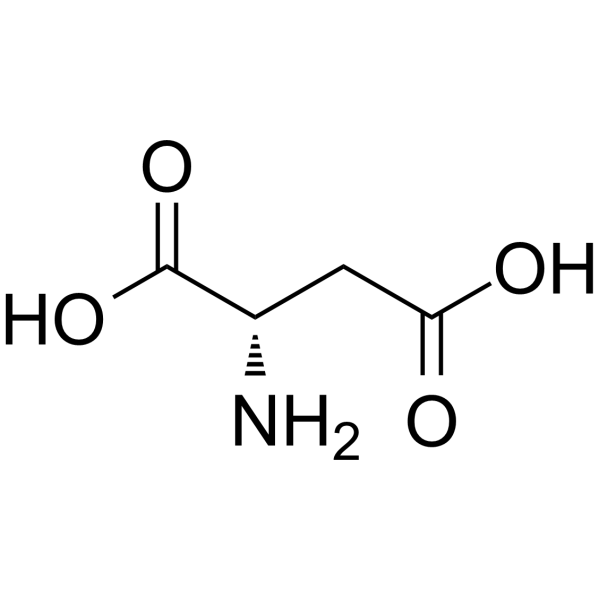
L-Aspartic acid (Standard) is the analytical standard of L-Aspartic acid (HY-N0666). This product is intended for research and analytical applications. L-Aspartic acid is a NMDA receptor agonist and acidic amino acid. L-Aspartic acid has no independent analgesic activity. L-Aspartic acid can antagonize the analgesic effects of D-Aspartic acid and Morphine. L-Aspartic acid regulates polymorph transformation, crystal growth/aggregation and nucleation processes of calcium carbonate, and can serve as a biomineralization template. L-Aspartic acid promotes burst firing of central neurons. L-Aspartic acid can be used in studies related to cerebral ischemia and epilepsy.
For research use only. We do not sell to patients.
- Assay : 97.87%
- CAS No.: 56-84-8
- Formula: C4H7NO4
- Molecular Weight:133.10
-
Storage:
Please store the product under the recommended conditions in the Certificate of Analysis.


To place orders, for customer services and technical support, please contact: MedChemExpress USA
Tel: 609-228-6898 E-mail: [email protected] [email protected]


-
 Product Information
-
Chemical Information
- Purity & Documentation
-
 Help & FAQs


-

HY-14608R
L-Glutamic acid (Standard)Glutamate Receptors Agonist -

HY-N0229R
L-Alanine (Standard)Endogenous Metabolite -

HY-N0771R
L-Isoleucine (Standard)Endogenous Metabolite, L-enantiomer of Isoleucine -

HY-N0469R
L-Lysine (Standard)Essential Amino Acids -

HY-N0486R
L-Leucine (Standard)mTOR activator -

HY-N0717R
L-Valine (Standard)Analytical Standard -

HY-N0455R
L-Arginine (Standard)eNOS Substrate -

HY-N0391R
L-Citrulline (Standard)Endogenous Metabolite -
HY-N0666
L-Aspartic acidNMDA Receptor Agonist -
HY-N0326
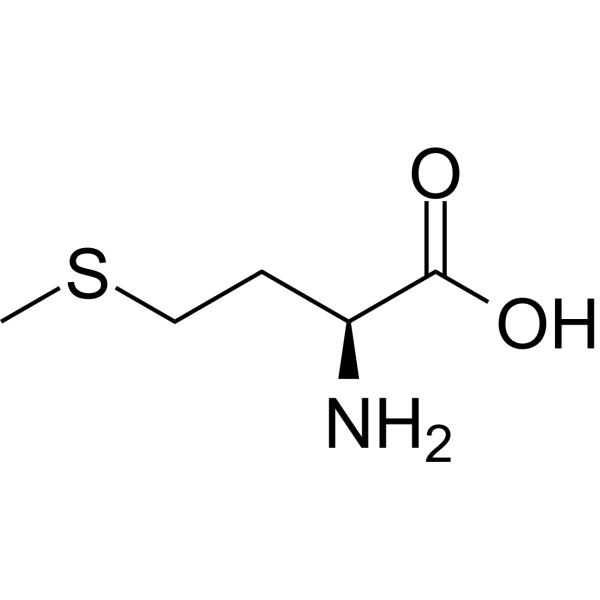
L-MethionineEndogenous Metabolite -
HY-N0455
L-ArginineeNOS Substrate -
HY-N0650
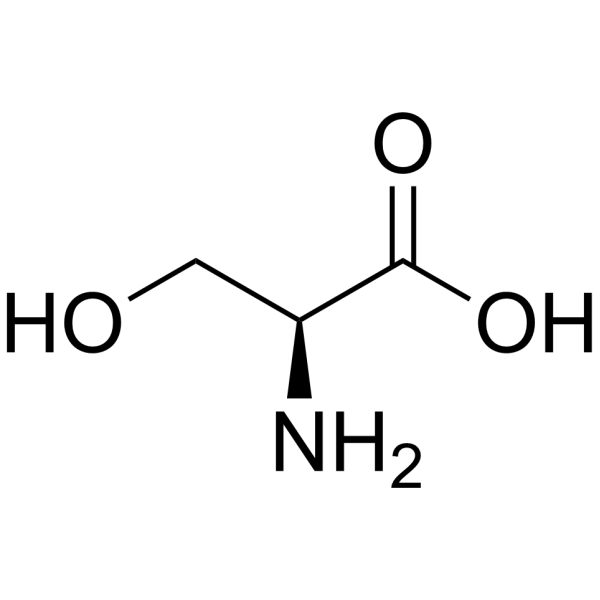
L-SerineAmino Acid
Publications Citing Use of MedChemExpress (MCE) L-Aspartic acid (Standard)
More

Product Information
Information
Application
The compound is the grade of analytical standard, which is the reference standard supplied assay. It is commonly used in qualitative, quantitative and methodological research experiments in HPLC, GC and MS.


Chemical Information
-
CAS No. 56-84-8
-
Appearance Solid
-
Molecular Weight 133.10
-
Formula C4H7NO4
-
Color White to off-white
-
SMILES
N[C@H](C(O)=O)CC(O)=O
-
Structure Classification
-
Shipping
Room temperature in continental US; may vary elsewhere.
-
Storage
Please store the product under the recommended conditions in the Certificate of Analysis.


Publications (1)
-
Journal Impact Factor
-
Most Recent
-
J Adv Res
Antimycin A inhibits alpha-herpesvirus replication by disrupting the formation of pyrimidinosomes. [Abstract]2025 May 10:S2090-1232(25)00309-1. PMID: 40354935


Purity & Documentation
-
SDS (252 KB)
- Français - FR (252 KB)
- Deutsch - DE (252 KB)
- Norwegian - NO (252 KB)
- Español - ES (252 KB)
- Swedish - SV (252 KB)
- Italian - IT (252 KB)
- Korean - KR (252 KB)
- Portuguese - PT (252 KB)
-
Handling Instructions (2659 KB)
References
[1]. Onat F, et al. Antinociceptive effect of D-aspartic acid in mice. Pharmacology, biochemistry, and behavior. 1995 Aug;51(4):715-9. [Content Brief]
[2]. Hosoya K, et al. Blood-brain barrier produces significant efflux of L-aspartic acid but not D-aspartic acid: in vivo evidence using the brain efflux index method. Journal of neurochemistry. 1999 Sep;73(3):1206-11. [Content Brief]
[3]. Tong H, et al. Control over the crystal phase, shape, size and aggregation of calcium carbonate via a L-aspartic acid inducing process. Biomaterials. 2004 Aug;25(17):3923-9. [Content Brief]
[4]. MacDonald JF, et al. L-Aspartic acid induces a region of negative slope conductance in the current-voltage relationship of cultured spinal cord neurons. Brain research. 1982 Apr 08;237(1):248-53. [Content Brief]

Calculators
Concentration (start) × Volume (start) = Concentration (final) × Volume (final)


L-Aspartic acid (Standard) Related Classifications
HY-N0666R Related Classifications
 Powered by Bioz