



Myosin H Chain Fragment, mouse acetate
Based on 4 publication(s) in Google Scholar
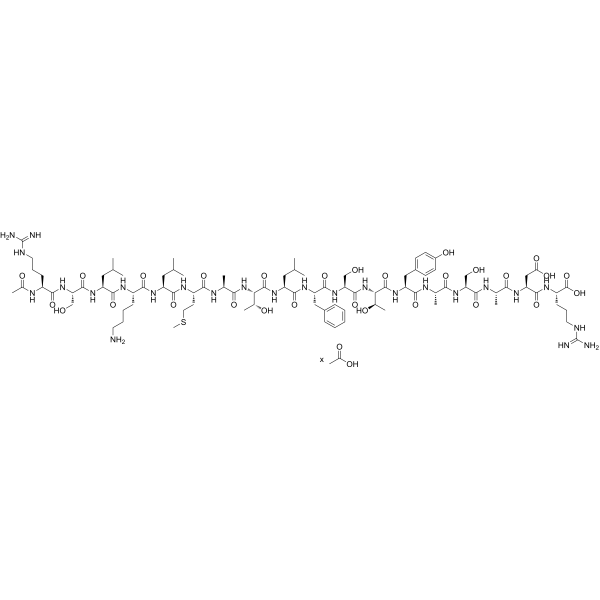
Myosin H Chain Fragment, mouse acetate salt is a fragment of the α-Myosin heavy chain peptide. Myosin H Chain Fragment can be used to induce experimental autoimmune myocarditis (EAM) mouse model.
For research use only. We do not sell to patients.
- Formula: C91H149N25O28S.xC2H4O2
- Molecular Weight:2073.37 (free acid)
-
Storage:
Please store the product under the recommended conditions in the Certificate of Analysis.

To place orders, for customer services and technical support, please contact: MedChemExpress USA
Tel: 609-228-6898 E-mail: [email protected] [email protected]


-
 Biological Activity
-
Chemical Information
- Purity & Documentation
- References
-
 Help & FAQs


Publications Citing Use of MedChemExpress (MCE) Myosin H Chain Fragment, mouse acetate
More Customer Validation & Images

-
In Vivo Imaging
-
In Vivo Imaging
-
In Vivo Efficacy Study


Biological Activity
Description
In Vivo
Please do not refer to only one article to determine the experimental conditions. It is recommended to determine the optimal experimental conditions (animal strain, age, dosage, frequency and cycle, detection time and indicators, etc.) through preliminary experiments before the formal experiment.
Myosin H Chain Fragment, mouse can be used in animal modeling to create myocarditis models[1][3].
Administration: 150 μg • s.c. • days 0 and 7
(2) Echocardiography was performed on days 0, 7, and 21 using an anaesthesia system under continuous 2%-3% isoflurane anaesthesia, and the temperature of the mice was adjusted to 37 ± 0.5 °C using a heating pad and rectal probe.
(3) Mice were executed 21 days after drug administration, and the hearts were immediately excised and cut along the short axis of the left ventricle at the level of the middle ventricle, then fixed overnight in 4% formaldehyde, paraffin sections were prepared and stained with hematoxylin and eosin for histopathological examination.
Echocardiography: Decreased left ventricular systolic function and increased left ventricular internal diastolic diameter (LVIDd) and systolic internal diameter (LVID).
MedChemExpress (MCE) has not independently confirmed the accuracy of these methods. They are for reference only.


Chemical Information
-
Molecular Weight 2073.37 (free acid)
-
Formula C91H149N25O28S.xC2H4O2
-
Sequence
Ac-Arg-Ser-Leu-Lys-Leu-Met-Ala-Thr-Leu-Phe-Ser-Thr-Tyr-Ala-Ser-Ala-Asp-Arg
-
Sequence Shortening
Ac-RSLKLMATLFSTYASADR
-
Shipping
Room temperature in continental US; may vary elsewhere.
-
Storage
Please store the product under the recommended conditions in the Certificate of Analysis.


Publications (4)
-
Journal Impact Factor
-
Most Recent
-
Myosin H Chain Fragment, mouse acetate purchased from MedChemExpress. Usage Cited in: Adv Funct Mater. 2025 Jun 17.
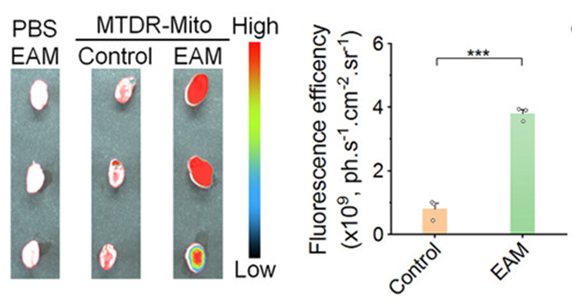
Ex vivo fluorescence images and quantitative data showing the accumulation of MTDR-labeled Mito in the hearts isolated from mice with or without experimental autoimmune myocarditis (EAM). To induce EAM, mice were subcutaneously immunized with 200 µg Myosin H Chain Fragment (HY-P2464) emulsified with CFA on days 0 and 7. In addition, pertussis toxin (500 ng) was injected intraperitoneally (i.p.) at the same time on day 0 to induce EAM in mice.
-
J Control Release
Multifunctional nanoparticles for immune regulation and oxidative stress alleviation in myocarditis. [Abstract]2025 May 10:381:113607. PMID: 40054631 -
Mol Pharm
STING-Targeted PET Imaging for Specific Detection and Therapeutic Monitoring of Myocarditis. [Abstract]2024 Jun 3;21(6):2865-2877. PMID: 38666508
Myosin H Chain Fragment, mouse acetate purchased from MedChemExpress. Usage Cited in: Mol Pharm. 2024 Jun 3;21(6):2865-2877. [Abstract]
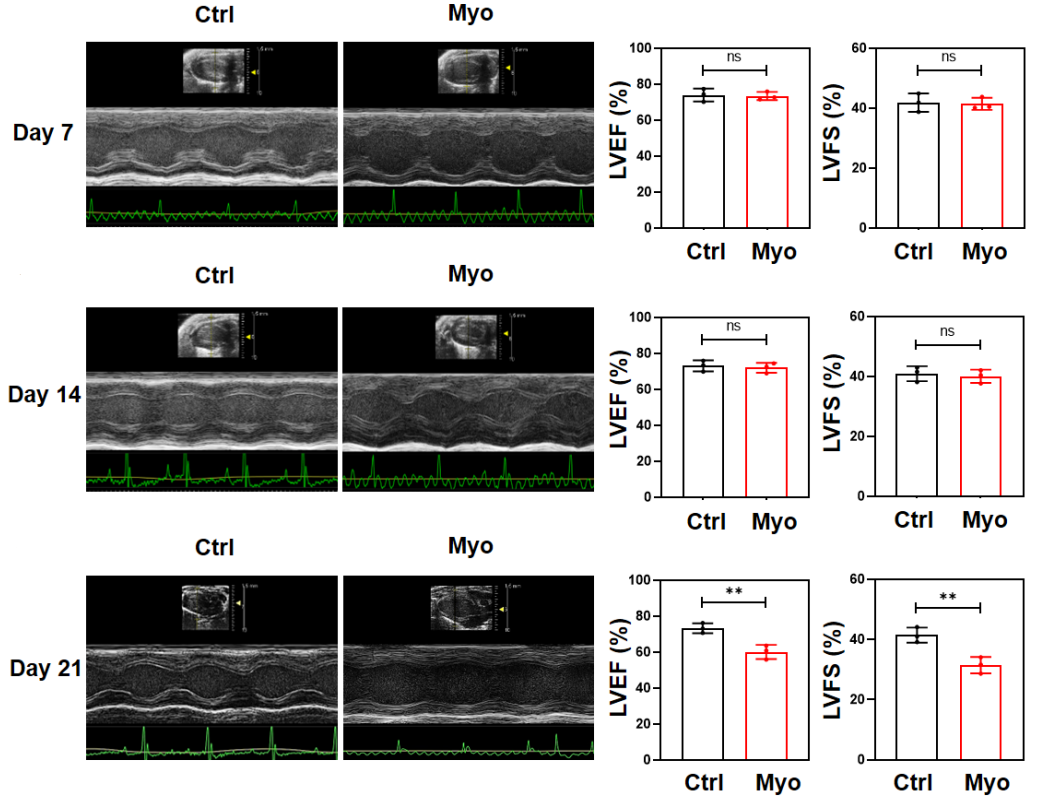
To induce autoimmune myocarditis, 200 μg of myosin heavy chain fragment (HY-P2464), emulsified with complete Freund’s adjuvant (F5881; 1:1, w/w), was injected subcutaneously into 5-week-old male Balb/c mice on days 0 and 7.Left ventricular ejection fraction (LVEF) and left ventricular fractional shortening (LVFS) were derived from M-mode echocardiography in the control group (Ctrl) and myocarditis group (Myo), respectively. Echocardiography revealed that both left ventricular ejection fraction (LVEF) and left ventricular fractional shortening (LVFS) showed significant reductions in the myocarditis group at day 21 compared with the control group.
Myosin H Chain Fragment, mouse acetate purchased from MedChemExpress. Usage Cited in: Mol Pharm. 2024 Jun 3;21(6):2865-2877. [Abstract]
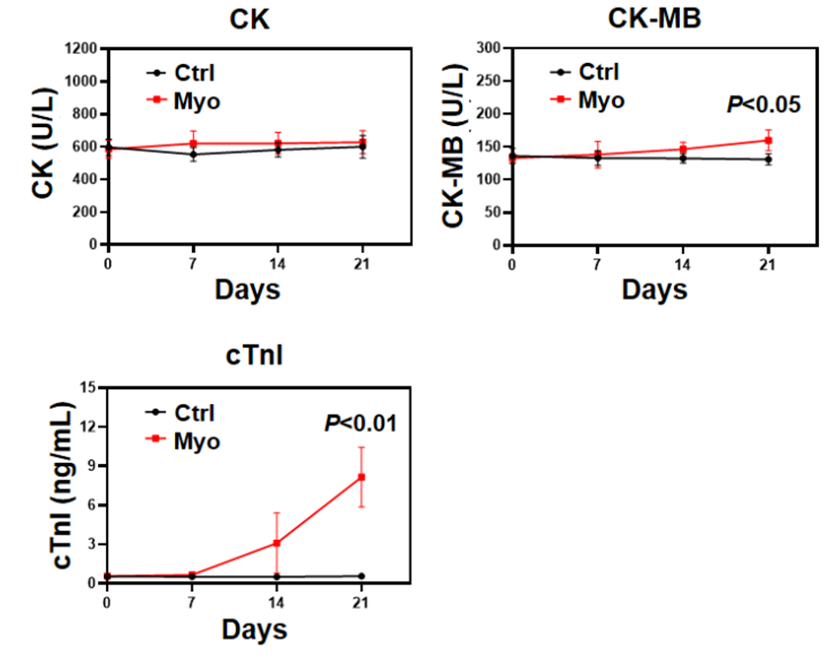
To induce autoimmune myocarditis, 200 μg Myosin H Chain Fragment (HY-P2464) emulsified with complete Freund adjuvant (F5881; 1:1, w/w) was injected subcutaneously in 5-week-old male Balb/c mice, on days 0 and 7. Serum cardiac troponin I (cTnI), creatine kinase (CK), creatine kinase-MB (CK-MB) in Ctrl group and Myo group, respectively. The results showed that the levels of cardiac troponin I (cTnI) and CK-MB were also significantly elevated in the myocarditis group at day 21 compared with the control group.
-
Bull Exp Biol Med
Biomolecular Changes in the Myocardium of Female and Male BALB/c Mice with Autoimmune Myocarditis. [Abstract]2026 Feb;180(4):492-498. PMID: 42026355


Purity & Documentation
References
[1]. Moritz Mirna, et al. Autoimmune myocarditis is not associated with left ventricular systolic dysfunction. Eur J Clin Invest. 2019 Aug;49(8):e13132. [Content Brief]
[2]. Ludwig T. Weckbach, et al. Blocking LFA-1 Aggravates Cardiac Inflammation in Experimental Autoimmune Myocarditis. Cells. 2019 Oct; 8(10): 1267. [Content Brief]
[3]. Hoetzenecker K, et al. Mononuclear cell secretome protects from experimental autoimmune myocarditis[J]. European heart journal, 2015, 36(11): 676-685. [Content Brief]

Calculators
Concentration (start) × Volume (start) = Concentration (final) × Volume (final)


Myosin H Chain Fragment, mouse acetate Related Classifications
HY-P2464A Related Classifications
 Powered by Bioz
Keywords