



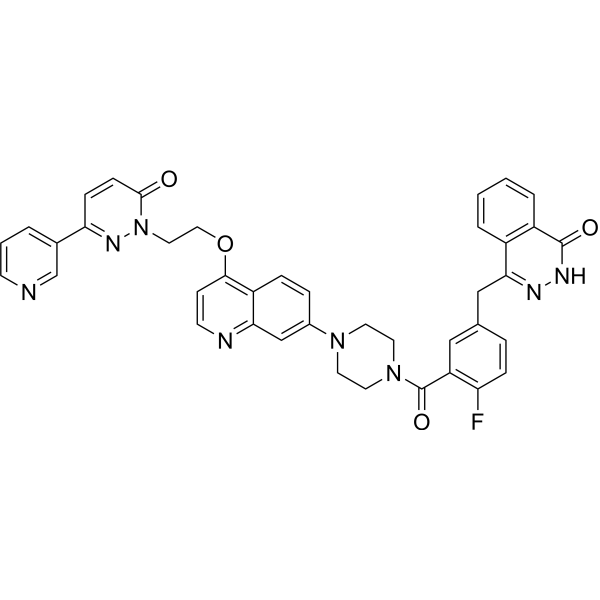
PARP1/c-Met-IN-1
PARP1/c-Met-IN-1 (Compound 16) is a selective dual inhibitor for PARP1 and c-Met, with IC50s of 3.3 and 32.2 nM, respectively. PARP1/c-Met-IN-1 induces cell apoptosis and cell cycle arrest in G2/M phase in MDA-MB-231 cells. PARP1/c-Met-IN-1 exhibits antitumor activity in mice.
For research use only. We do not sell to patients.
- CAS No.: 2944101-99-7
- Formula: C40H33FN8O4
- Molecular Weight:708.74
-
Storage:
Please store the product under the recommended conditions in the Certificate of Analysis.

To place orders, for customer services and technical support, please contact: MedChemExpress USA
Tel: 609-228-6898 E-mail: [email protected] [email protected]


-
 Biological Activity
-
Chemical Information
- Purity & Documentation
- References
-
 Help & FAQs




Biological Activity
Description
IC50 & Target
|
PARP1 3.3 nM (IC50) |
c-Met 32.2 nM (IC50) |
Cellular Effect
|
Cell Line

|
Type | Value | Description | References |
|---|---|---|---|---|
| MDA-MB-231 | IC50 |
0.045 μM
Compound: 16
|
Antiproliferative activity against human MDA-MB-231 cells harboring wild type BRCA and c-Met amplification assessed as inhibition of cell growth incubated for 7 days by MTT assay
Antiproliferative activity against human MDA-MB-231 cells harboring wild type BRCA and c-Met amplification assessed as inhibition of cell growth incubated for 7 days by MTT assay
|
[PMID: 38477575] |
| MDA-MB-468 | IC50 |
0.17 μM
Compound: 16
|
Antiproliferative activity against human MDA-MB-468 cells harboring wild type BRCA1/2, HR-proficient and non-c-Met amplification assessed as inhibition of cell growth incubated for 7 days by MTT assay
Antiproliferative activity against human MDA-MB-468 cells harboring wild type BRCA1/2, HR-proficient and non-c-Met amplification assessed as inhibition of cell growth incubated for 7 days by MTT assay
|
[PMID: 38477575] |
| NRK | IC50 |
8.73 μM
Compound: 16
|
Cytotoxicity against NRK cells assessed as inhibition of cell growth incubated for 72 hrs by MTT assay
Cytotoxicity against NRK cells assessed as inhibition of cell growth incubated for 72 hrs by MTT assay
|
[PMID: 38477575] |
In Vitro
PARP1/c-Met-IN-1 (1 μM) improves the thermal stability of PARP1 and c-Met[1].
PARP1/c-Met-IN-1 (1 μM) inhibits the expressions of PARP1 and c-Met related proteins PAR, p-c-Met and p-AKT, affects the interactions of PARP1/c-Met, causes DNA damage[1].
PARP1/c-Met-IN-1 (0.5-1 μM) diminishes the homologous recombination (HR) function in MDA-MB-231 cells through downregulating expressions of BRCA1 and Rad51[1].
MedChemExpress (MCE) has not independently confirmed the accuracy of these methods. They are for reference only.
-
Cell Line:MDA-MB-231
-
Concentration:1 μM
-
Incubation Time:72 h
-
Result:Enhanced the thermostability of these proteins within the temperature range of 43–55 °C.
Decreased expressions of BRCA1 and Rad51.
In Vivo
Pharmacokinetic Analysis of PARP1/c-Met-IN-1 in BALB/c mice[1]
| route | Dose (mg/kg) | T1/2 (h) | Tmax (h) | Cmax (ng/mL) | AUC0-t (ng·h/mL) | AUC0-inf (ng·h/mL) | MRT0-t (h) | MRT0-inf (h) | CLblood (mL/h/kg) |
| i.p. | 10 | 1.42 | 0.25 | 152.47 | 95.42 | 96.70 | 1.67 | 1.77 | 121232 |
MedChemExpress (MCE) has not independently confirmed the accuracy of these methods. They are for reference only.
-
Animal Model:MDA-MB-231 and HCT116OR xenograft BALB/c nude mice[1]
-
Dosage:12.5-50 mg/kg for MDA-MB-231 xenograft mice, 20-100 mg/kg for HCT116OR xenograft mice
-
Administration:I.p., 21 days for HCT116OR xenograft mice, 28 days for MDA-MB-231 xenograft mice
-
Result:Inhibited tumor growth with TGI of 49-77% in MDA-MB-231 xenograft mice.
Inhibited tumor growth with TGI of 62-70% in HCT116OR xenograft mice.


Chemical Information
-
CAS No. 2944101-99-7
-
Molecular Weight 708.74
-
Formula C40H33FN8O4
-
SMILES
O=C1C=CC(C2=CC=CN=C2)=NN1CCOC3=C4C(C=C(C=C4)N5CCN(CC5)C(C6=C(C=CC(CC7=NNC(C8=C7C=CC=C8)=O)=C6)F)=O)=NC=C3
-
Shipping
Room temperature in continental US; may vary elsewhere.
-
Storage
Please store the product under the recommended conditions in the Certificate of Analysis.


Purity & Documentation
References

Calculators
Concentration (start) × Volume (start) = Concentration (final) × Volume (final)


PARP1/c-Met-IN-1 Related Classifications
HY-161372 Related Classifications
 Powered by Bioz