



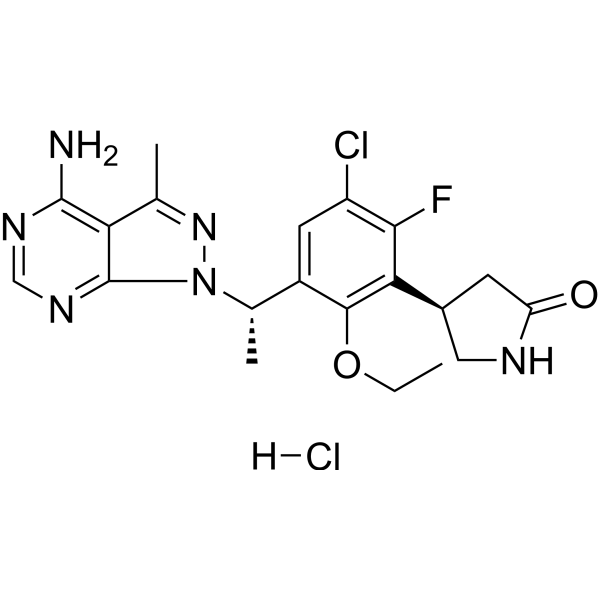
Parsaclisib hydrochloride
Based on 3 publication(s) in Google Scholar
Parsaclisib hydrochloride (INCB050465 hydrochloride) is a potent, selective and orally active inhibitor of PI3Kδ, with an IC50 of 1 nM at 1 mM ATP. Parsaclisib hydrochloride shows approximately 20000-fold selectivity over other PI3K class I isoforms. Parsaclisib hydrochloride can be used for the research of relapsed or refractory B-cell malignancies.
For research use only. We do not sell to patients.
- Purity : 99.33%
- CAS No.: 1995889-48-9
- Formula: C20H23Cl2FN6O2
- Molecular Weight:469.34
-
Storage:
4°C, stored under nitrogen, away from moisture
* In solvent : -80°C, 6 months; -20°C, 1 month (stored under nitrogen, away from moisture)

To place orders, for customer services and technical support, please contact: MedChemExpress USA
Tel: 609-228-6898 E-mail: [email protected] [email protected]


-
 Biological Activity
-
Chemical Information
-
Solvent & Solubility
- Protocols
- Purity & Documentation
- References
-
 Help & FAQs


Publications Citing Use of MedChemExpress (MCE) Parsaclisib hydrochloride
More

Biological Activity
Description
IC50 & Target
[1]|
PI3Kδ 1 nM (IC50) |
In Vitro
Parsaclisib (0.1-3000 nM; 4 d) inhibits proliferation of MCL and DLBCL cell lines[2].
Parsaclisib (0.1-1000 nM; 2 h) inhibits anti-IgM-induced pAKT (Ser473) in the Ramos Burkitt’s lymphoma cell line, with an IC50 of 1 nM[2].
Parsaclisib inhibits the proliferation of human, dog, rat, and mouse primary B cells after activation of these receptors, with IC50s ranging from 0.2 to 1.7 nM[2].
MedChemExpress (MCE) has not independently confirmed the accuracy of these methods. They are for reference only. Further protocols information, click here.
-
Cell Line:Jeko-1, Mino, JVM2, Rec-1, Pfeiffer, SU-DHL-5, SU-DHL-6, WSU-NHL, SU-DHL-4, SU-DHL-8, and WILL-2 cells
-
Concentration:0.1-3000 nM
-
Incubation Time:4 days
-
Result:Resulted in a maximal inhibition of 70-90%, with IC50s of ≤10 nM in the four MCL cell lines.
Pfeiffer, SU-DHL-5, SU-DHL-6, and WSU-NHL were highly sensitive, with IC50s from 2 to 8 nM.
In Vivo
Parsaclisib (0.1-10 mg/kg; p.o. twice daily) slows Pfeiffer xenograft tumor growth in a dose-dependent manner. And Parsaclisib was well tolerated[2].
Parsaclisib (0.5-1 mg/kg; a single p.o.) inhibits pAKT (Ser473) in Pfeiffer subcutaneous mouse xenograft models[2].
MedChemExpress (MCE) has not independently confirmed the accuracy of these methods. They are for reference only.
-
Animal Model:Female BALB/c mice (5-9 weeks) were inoculated with A20 cells[2]
-
Dosage:10 mg/kg
-
Administration:Oral gavage twice daily for 7-19 days
-
Result:Resulted in significant tumor growth inhibition (TGI).
Reduced the percentage of Tregs (CD4+CD25+FOXP3+) in tumors and spleens.
Increased the ratio of CD4+ and CD8+ T cells to Tregs in spleens and tumors.
Decreased the number of CD4+CD44high and CD8+CD44high T cells in both spleens and tumors.
Clinical Trial
| NCT Number | Sponsor | Condition | Start Date |
Phase

|
|---|---|---|---|---|
| NCT01329991 | Plexxikon| | 2011-05 | PHASE1 |


Chemical Information
-
CAS No. 1995889-48-9
-
Appearance Solid
-
Molecular Weight 469.34
-
Formula C20H23Cl2FN6O2
-
Color White to off-white
-
SMILES
CCOC1=C([C@@H](C2)CNC2=O)C(F)=C(Cl)C=C1[C@@H](N3C4=NC=NC(N)=C4C(C)=N3)C.[H]Cl
-
Synonyms
INCB050465 hydrochloride; IBI-376 hydrochloride
-
Shipping
Room temperature in continental US; may vary elsewhere.
-
Storage
4°C, stored under nitrogen, away from moisture
* In solvent : -80°C, 6 months; -20°C, 1 month (stored under nitrogen, away from moisture)


Publications (3)
-
Journal Impact Factor
-
Most Recent
-
Nat Commun
A class I PI3K signalling network regulates primary cilia disassembly in normal physiology and disease. [Abstract]2024 Aug 21;15(1):7181. PMID: 39168978 -
Cell Rep Methods
Tumor immune microenvironment reconstitution in patient-derived organoids enables therapy modeling for NSCLC. [Abstract]2026 Jun 15;6(6):101339. PMID: 42134319 -
Am J Cancer Res
A long-lasting PI3Kδ inhibitor zandelisib forms a water-shielded hydrogen bond with p110δ and demonstrates sustained inhibitory effects. [Abstract]2025 May 15;15(5):2097-2110. PMID: 40520883


Solvent & Solubility
In Vitro:
DMSO : 100 mg/mL (213.07 mM; Need ultrasonic; Hygroscopic DMSO has a significant impact on the solubility of product, please use newly opened DMSO)
Please refer to the solubility information to select the appropriate solvent. Once prepared, please aliquot and store the solution to prevent product inactivation from repeated freeze-thaw cycles.
Storage method and period of stock solution: -80°C, 6 months; -20°C, 1 month (stored under nitrogen, away from moisture). When stored at -80°C, please use it within 6 months. When stored at -20°C, please use it within 1 month.
Please refer to the solubility information to select the appropriate solvent. Once prepared, please aliquot and store the solution to prevent product inactivation from repeated freeze-thaw cycles.
Storage method and period of stock solution: -80°C, 6 months; -20°C, 1 month (stored under nitrogen, away from moisture). When stored at -80°C, please use it within 6 months. When stored at -20°C, please use it within 1 month.
Concentration (start) × Volume (start) = Concentration (final) × Volume (final)
In Vivo:
Select the appropriate dissolution method based on your experimental animal and administration route.
- For the following dissolution methods, please ensure to first prepare a clear stock solution using an In Vitro approach and then sequentially add co-solvents:
- To ensure reliable experimental results, the clarified stock solution can be appropriately stored based on storage conditions. As for the working solution for In Vivo experiments, it is recommended to prepare freshly and use it on the same day.
- The percentages shown for the solvents indicate their volumetric ratio in the final prepared solution. If precipitation or phase separation occurs during preparation, heat and/or sonication can be used to aid dissolution.
Add each solvent one by one: 10% DMSO 40% PEG300 5% Tween-80 45% Saline
Solubility: ≥ 5 mg/mL (10.65 mM); Clear solution
This protocol yields a clear solution of ≥ 5 mg/mL (saturation unknown).
Taking 1 mL working solution as an example, add 100 μL DMSO stock solution (50.0 mg/mL) to 400 μL PEG300, and mix evenly; then add 50 μL Tween-80 and mix evenly; then add 450 μL Saline to adjust the volume to 1 mL.
Preparation of Saline: Dissolve 0.9 g sodium chloride in ddH₂O and dilute to 100 mL to obtain a clear Saline solution.
Add each solvent one by one: 10% DMSO 90% (20% SBE-β-CD in Saline)
Solubility: ≥ 5 mg/mL (10.65 mM); Clear solution
This protocol yields a clear solution of ≥ 5 mg/mL (saturation unknown).
Taking 1 mL working solution as an example, add 100 μL DMSO stock solution (50.0 mg/mL) to 900 μL 20% SBE-β-CD in Saline, and mix evenly.
Preparation of 20% SBE-β-CD in Saline (4°C, storage for one week): 2 g SBE-β-CD powder is dissolved in 10 mL Saline, completely dissolve until clear.
For the following dissolution methods, please prepare the working solution directly:
It is recommended to prepare fresh solutions and use them promptly within a short period of time.
The percentages shown for the solvents indicate their volumetric ratio in the final prepared solution. If precipitation or phase separation occurs during preparation, heat and/or sonication can be used to aid dissolution.
Add each solvent one by one: PBS
Solubility: 50 mg/mL (106.53 mM); Clear solution; Need ultrasonic
In Vivo Dissolution Calculator
Please enter the basic information of animal experiments:
-
-
-
-
Recommended: Prepare an additional quantity of animals to account for potential losses during experiments.
Please enter your animal formula composition:
-
%DMSO +
Recommended: Keep the proportion of DMSO in working solution below 2% if your animal is weak.
-
%+
-
+%Tween-80 + +
-
%Saline +
The co-solvents required include: DMSO, . All of co-solvents are available by MedChemExpress (MCE). , Tween 80. All of co-solvents are available by MedChemExpress (MCE).
Working solution concentration: 0.22 mg/mL
Method for preparing stock solution: mg drug dissolved in μL DMSO. Stock solution concentration: mg/mL. * In solvent : -80°C, 6 months; -20°C, 1 month (stored under nitrogen, away from moisture)
1. Take μL DMSO stock solution;
2. Add μL .
μL , mix evenly;
3. Then add μL Tween 80, mix evenly;
4. Then add μL
Please ensure that the stock solution in the first step is dissolved to a clear state, and add co-solvents in sequence. You can use ultrasonic heating (ultrasonic cleaner, recommended frequency 20-40 kHz), vortexing, etc. to assist dissolution.

Protocols
-
Cell Cytotoxicity Assay
Cytotoxicity assays are usually based on the assessment of cell membrane damage, which can also be indirectly detected by measuring cell viability. Detection methods include MTT assay, CKK-8 assay, LDH assay and ATP assay, etc.


Purity & Documentation
-
Data Sheet (280 KB)
-
SDS (252 KB)
- English - EN (252 KB)
- Français - FR (252 KB)
- Deutsch - DE (252 KB)
- Norwegian - NO (252 KB)
- Español - ES (252 KB)
- Swedish - SV (252 KB)
- Italian - IT (252 KB)
- Korean - KR (252 KB)
- Portuguese - PT (252 KB)
-
Handling Instructions (2659 KB)
References
[2]. Shin N, et, al. Parsaclisib Is a Next-Generation Phosphoinositide 3-Kinase δ Inhibitor with Reduced Hepatotoxicity and Potent Antitumor and Immunomodulatory Activities in Models of B-Cell Malignancy. J Pharmacol Exp Ther. 2020 Jul;374(1):211-222. [Content Brief]
[3]. Yue EW, et, al. INCB050465 (Parsaclisib), a Novel Next-Generation Inhibitor of Phosphoinositide 3-Kinase Delta (PI3Kδ). ACS Med Chem Lett. 2019 Oct 17;10(11):1554-1560. [Content Brief]


Complete Stock Solution Preparation Table
Please refer to the solubility information to select the appropriate solvent. Once prepared, please aliquot and store the solution to prevent product inactivation from repeated freeze-thaw cycles.
Storage method and period of stock solution: -80°C, 6 months; -20°C, 1 month (stored under nitrogen, away from moisture). When stored at -80°C, please use it within 6 months. When stored at -20°C, please use it within 1 month.
| Optional Solvent | Concentration Solvent Mass | 1 mg | 5 mg | 10 mg | 25 mg |
|---|---|---|---|---|---|
| DMSO | 1 mM | 2.1307 mL | 10.6533 mL | 21.3065 mL | 53.2663 mL |
| 5 mM | 0.4261 mL | 2.1307 mL | 4.2613 mL | 10.6533 mL | |
| 10 mM | 0.2131 mL | 1.0653 mL | 2.1307 mL | 5.3266 mL | |
| 15 mM | 0.1420 mL | 0.7102 mL | 1.4204 mL | 3.5511 mL | |
| 20 mM | 0.1065 mL | 0.5327 mL | 1.0653 mL | 2.6633 mL | |
| 25 mM | 0.0852 mL | 0.4261 mL | 0.8523 mL | 2.1307 mL | |
| 30 mM | 0.0710 mL | 0.3551 mL | 0.7102 mL | 1.7755 mL | |
| 40 mM | 0.0533 mL | 0.2663 mL | 0.5327 mL | 1.3317 mL | |
| 50 mM | 0.0426 mL | 0.2131 mL | 0.4261 mL | 1.0653 mL | |
| 60 mM | 0.0355 mL | 0.1776 mL | 0.3551 mL | 0.8878 mL | |
| 80 mM | 0.0266 mL | 0.1332 mL | 0.2663 mL | 0.6658 mL | |
| 100 mM | 0.0213 mL | 0.1065 mL | 0.2131 mL | 0.5327 mL |


Parsaclisib hydrochloride Related Classifications
HY-109068A Related Classifications
 Powered by Bioz