



Poly(deoxyadenylic-thymidylic) acid sodium
Based on 6 publication(s) in Google Scholar
Poly(deoxyadenylic-thymidylic) acid (Poly(dA:dT)) sodium is a double-stranded DNA stimulant. Poly(deoxyadenylic-thymidylic) acid sodium is recognized by the intracellular DNA sensor DDX41 and activates the innate immune pathway via the adaptor protein STING, inducing the production of cytokines such as type I interferons. Poly(deoxyadenylic-thymidylic) acid sodium also serves as an in vitro transcription template for free RNA polymerase.
For research use only. We do not sell to patients.
- CAS No.: 86828-69-5
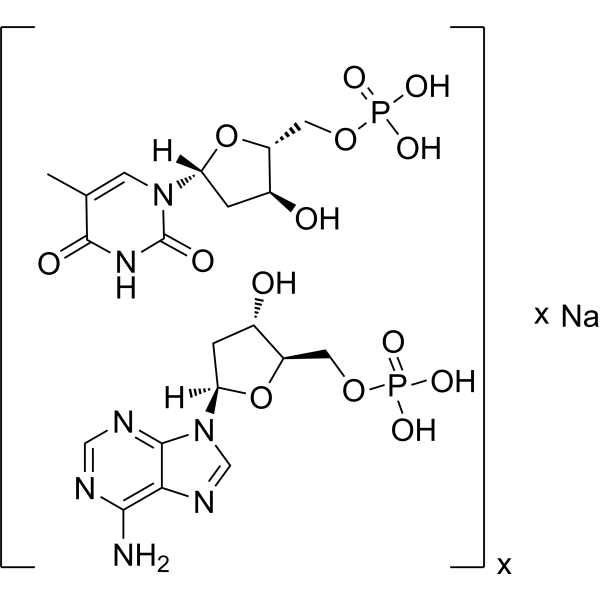
- Formula: (C10H15N2O8P.C10H14N5O6P)x.xNa
-
Storage:
-20°C, sealed storage, away from moisture
* In solvent : -80°C, 6 months; -20°C, 1 month (sealed storage, away from moisture)

To place orders, for customer services and technical support, please contact: MedChemExpress USA
Tel: 609-228-6898 E-mail: [email protected] [email protected]


-
 Biological Activity
-
Chemical Information
- Purity & Documentation
- References
-
 Help & FAQs


Publications Citing Use of MedChemExpress (MCE) Poly(deoxyadenylic-thymidylic) acid sodium
More

Biological Activity
Description
In Vitro
Poly(deoxyadenylic-thymidylic) acid sodium (25 min) serves as a functional exogenous template for free RNA polymerase I, II, and III in the nuclei of isolated fetal rat cerebral cortical neurons, allowing the determination of their activities, which increase with fetal age[1].
Poly(deoxyadenylic-thymidylic) acid sodium stimulates the production of heat-resistant STING activators and induces IRF3 dimerization in cytoplasmic extracts of L929-shSTING[3].
MedChemExpress (MCE) has not independently confirmed the accuracy of these methods. They are for reference only.


Chemical Information
-
CAS No. 86828-69-5
-
Appearance Solid
-
Formula (C10H15N2O8P.C10H14N5O6P)x.xNa
-
Color White to light yellow
-
SMILES
O=C(NC1=O)N(C=C1C)[C@](C[C@@H]2O)([H])O[C@@H]2CO[P](O)(O)=O.NC3=C4C(N([C@](C[C@@H]5O)([H])O[C@@H]5CO[P](O)(O)=O)C=N4)=NC=N3.[Na].[x].[x]
-
Synonyms
Poly(dA:dT) sodium
-
Shipping
Room temperature in continental US; may vary elsewhere.
-
Storage
-20°C, sealed storage, away from moisture
* In solvent : -80°C, 6 months; -20°C, 1 month (sealed storage, away from moisture)


Publications (6)
-
Journal Impact Factor
-
Most Recent
-
-
Redox Biol
Neutrophil extracellular traps exacerbate inflammatory arthritis by inhibiting γδ Treg cell differentiation via the AIM2 inflammasome. [Abstract]2025 Sep 30:87:103881. PMID: 41046783 -
Biochem Pharmacol
Targeting the DYNLL2-PAK1 axis inhibits caspase-11-dependent pyroptosis to alleviate sepsis. [Abstract]2026 Feb:244:117614. PMID: 41360226 -
Neurochem Int
Ferritinophagy promotes microglia ferroptosis to aggravate neuroinflammation induced by cerebral ischemia-reperfusion injury via activation of the cGAS-STING signaling pathway. [Abstract]2025 Feb:183:105920. PMID: 39732341 -
PLoS Pathog
Duck plague virus LORF2 utilizes RNF34 to inhibit antiviral innate immunity by ubiquitination and degradation of IRF7. [Abstract]2026 Apr 24;22(4):e1014174. PMID: 42030364 -


Purity & Documentation
-
Data Sheet (279 KB)
-
SDS (252 KB)
- English - EN (252 KB)
- Français - FR (252 KB)
- Deutsch - DE (252 KB)
- Norwegian - NO (252 KB)
- Español - ES (252 KB)
- Swedish - SV (252 KB)
- Italian - IT (252 KB)
- Korean - KR (252 KB)
- Portuguese - PT (252 KB)
-
Handling Instructions (2659 KB)
References
[1]. Graham EM, et al. Effect of gestational age and hypoxia on activity of ribonucleic acid polymerase in fetal guinea pig brain. Am J Obstet Gynecol. 2001;184(4):736-742. [Content Brief]
[2]. Zhang Z, et al. The helicase DDX41 senses intracellular DNA mediated by the adaptor STING in dendritic cells. Nat Immunol. 2011;12(10):959-965. Published 2011 Sep 4. [Content Brief]
[3]. Wu J, et al. Cyclic GMP-AMP is an endogenous second messenger in innate immune signaling by cytosolic DNA. Science. 2013;339(6121):826-830. [Content Brief]

Calculators
Concentration (start) × Volume (start) = Concentration (final) × Volume (final)


Poly(deoxyadenylic-thymidylic) acid sodium Related Classifications
HY-138646 Related Classifications
 Powered by Bioz