



Polyphyllin H
Based on 1 publication(s) in Google Scholar
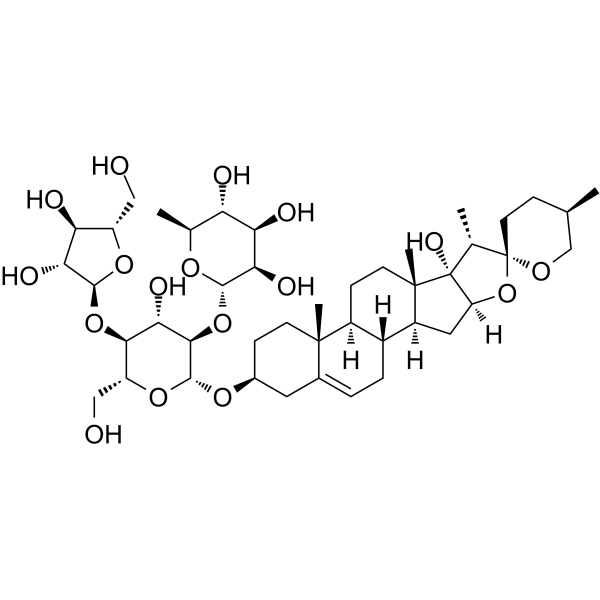
Polyphyllin H is a steroidal saponin. Polyphyllin H is isolated from Paris polyphylla. Polyphyllin H potently inhibits the activities of CYP1A2 (IC50 = 6.44 μM, competitive), CYP2D6 (IC50 = 13.88 μM, competitive) and CYP3A4 (IC50 = 4.52 μM, non-competitive, time-dependent). Polyphyllin H downregulates the expression of ABCB1 and ABCC3. Polyphyllin H binds to membrane cholesterol and disrupts lipid raft structures. Polyphyllin H restores the sensitivity of paclitaxel-resistant breast cancer cells to paclitaxel.
연구목적의 판매만을 진행합니다. 환자를 대상으로 한 판매는 하지 않습니다.
- Purity : 99.89%
- CAS No.: 81917-50-2
- 화학식: C44H70O17
- 분자량:871.02
-
보관:Powder -20°C, 3 years , 4°C, 2 years ; In solvent -80°C, 6 months , -20°C, 1 month

To place orders, for customer services and technical support, please contact: MedChemExpress USA
Tel: 609-228-6898 E-mail: [email protected] [email protected]


-
 Biological Activity
-
Chemical Information
-
용액&용해도
- Protocol
- 순도&문서
- References
-
 Help & FAQs


Publications Citing Use of MedChemExpress (MCE) Polyphyllin H
More

Biological Activity
제품 설명
IC50 & Target
[1]|
CYP1A2 6.44 μM (IC50) |
CYP2D6 13.88 μM (IC50) |
CYP3A4 4.52 μM (IC50) |
In Vitro
Polyphyllin H (0-100 μM; 1 h) potently inhibits the activities of CYP1A2 (IC50 = 6.44 μM, competitive), CYP2D6 (IC50 = 13.88 μM, competitive) and CYP3A4 (IC50 = 4.52 μM, non-competitive, time-dependent) in pooled HLMs in a concentration-dependent manner[1].
Polyphyllin H (5-50 μM) specifically binds to cholesterol-containing membranes and induces calcein release in a dose-dependent manner, whereas it has no effect on cholesterol-free membranes[2].
Polyphyllin H (100-300 μM) binds directly to cholesterol in a concentration-dependent manner, which is evidenced by the enhanced fluorescence intensity of DHE[2].
Polyphyllin H (1 μM; 48 h) reverses paclitaxel resistance in MCF-7/PTX cells and reduces the IC50 of paclitaxel to 119.229 nM[2].
Polyphyllin H (1-2 μM) disrupts the plasma membrane integrity of MCF-7/PTX cells in a concentration-dependent manner in vitro[2].
Polyphyllin H (1 μM; 48 h) downregulates the protein expression of efflux transporters in MCF-7/PTX cells[2].
Polyphyllin H (1-2 μM) disrupts the plasma membrane integrity of MCF-7/PTX cells in a concentration-dependent manner in vitro[2].
MedChemExpress (MCE) has not independently confirmed the accuracy of these methods. They are for reference only. Further protocols information, click here.
-
Cell Line:paclitaxel-resistant MCF-7/PTX human breast cancer cells
-
Concentration:1 μM (in combination with paclitaxel); 200 μM exogenous cholesterol (co-incubated with 1 μM Polyphyllin H and paclitaxel)
-
Incubation Time:48 h
-
Result:Reduced the IC50 of paclitaxel in MCF-7/PTX cells to 119.229 nM, resulting in a resistance reversal fold of 5.5.
Had this effect significantly attenuated by addition of exogenous cholesterol.
-
Cell Line:paclitaxel-resistant MCF-7/PTX human breast cancer cells
-
Concentration:1 μM; 200 μM exogenous cholesterol (co-incubated with 1 μM Polyphyllin H)
-
Incubation Time:48 h
-
Result:Significantly reduced protein expression levels of lipid raft marker CAV-1, and efflux transporters ABCB1 and ABCC3 in MCF-7/PTX cells.
Had this downregulation partially restored by co-treatment with exogenous cholesterol.
In Vivo
MedChemExpress (MCE) has not independently confirmed the accuracy of these methods. They are for reference only.
-
Animal Model:BALB/c nude (female, 4 weeks old)[2]
-
Dosage:2.5 mg/kg (monotherapy); 2.5 mg/kg + 5 mg/kg paclitaxel (combination therapy)
-
Administration:i.p.; every 2 days; 21 days (monotherapy); i.p. (Polyphyllin H) + i.v. (paclitaxel); every 2 days; 21 days (combination therapy)
-
Result:Reduced tumor volume and weight compared to the control group.
Reduced total cholesterol levels in tumor tissue compared to the control and paclitaxel-only groups.
Achieved an ~80% tumor inhibition rate (based on final tumor volume), significantly higher than the 55% inhibition rate of lovastatin plus paclitaxel.
Significantly reduced total cholesterol levels in tumor tissue compared to lovastatin plus paclitaxel.
Markedly downregulated protein expression of CAV-1, ABCB1, and ABCC3 in tumor tissue to a greater degree than lovastatin plus paclitaxel.
Caused no significant pathological changes in heart, liver, spleen, lungs, or kidneys of treated mice.


Chemical Information
-
CAS No. 81917-50-2
-
Appearance Solid
-
분자량 871.02
-
화학식 C44H70O17
-
Color White to off-white
-
SMILES
O[C@@]([C@](O[C@]1(OC2)CC[C@H]2C)([H])C[C@@]3([H])[C@@](CC=C(C4)[C@@]5(CC[C@@H]4O[C@H](O[C@@H]6CO)[C@@H]([C@H]([C@@H]6O[C@@H]([C@@H]([C@H]7O)O)O[C@H]7CO)O)O[C@H](O[C@H]8C)[C@@H]([C@@H]([C@H]8O)O)O)C)([H])[C@]5([H])CC9)([C@@H]1C)[C@]39C
-
Structure Classification
-
Initial Source
-
선적
Room temperature in continental US; may vary elsewhere.
-
보관
Powder -20°C 3 years 4°C 2 years In solvent -80°C 6 months -20°C 1 month


Publications (1)
-
Journal Impact Factor
-
Most Recent


용액&용해도
In Vitro:
DMSO : ≥ 100 mg/mL (114.81 mM; Hygroscopic DMSO has a significant impact on the solubility of product, please use newly opened DMSO)
* "≥" means soluble, but saturation unknown.
Please refer to the solubility information to select the appropriate solvent. Once prepared, please aliquot and store the solution to prevent product inactivation from repeated freeze-thaw cycles.
Storage method and period of stock solution: -80°C, 6 months; -20°C, 1 month. When stored at -80°C, please use it within 6 months. When stored at -20°C, please use it within 1 month.
Please refer to the solubility information to select the appropriate solvent. Once prepared, please aliquot and store the solution to prevent product inactivation from repeated freeze-thaw cycles.
Storage method and period of stock solution: -80°C, 6 months; -20°C, 1 month. When stored at -80°C, please use it within 6 months. When stored at -20°C, please use it within 1 month.
Concentration (start) × Volume (start) = Concentration (final) × Volume (final)
In Vivo:
Select the appropriate dissolution method based on your experimental animal and administration route.
- For the following dissolution methods, please ensure to first prepare a clear stock solution using an In Vitro approach and then sequentially add co-solvents:
- To ensure reliable experimental results, the clarified stock solution can be appropriately stored based on storage conditions. As for the working solution for In Vivo experiments, it is recommended to prepare freshly and use it on the same day.
- The percentages shown for the solvents indicate their volumetric ratio in the final prepared solution. If precipitation or phase separation occurs during preparation, heat and/or sonication can be used to aid dissolution.
Add each solvent one by one: 10% DMSO 40% PEG300 5% Tween-80 45% Saline
Solubility: 2.5 mg/mL (2.87 mM); Suspended solution; Need ultrasonic
This protocol yields a suspended solution of 2.5 mg/mL. Suspended solution can be used for oral and intraperitoneal injection.
Taking 1 mL working solution as an example, add 100 μL DMSO stock solution (25.0 mg/mL) to 400 μL PEG300, and mix evenly; then add 50 μL Tween-80 and mix evenly; then add 450 μL Saline to adjust the volume to 1 mL.
Preparation of Saline: Dissolve 0.9 g sodium chloride in ddH₂O and dilute to 100 mL to obtain a clear Saline solution.
Add each solvent one by one: 10% DMSO 90% (20% SBE-β-CD in Saline)
Solubility: ≥ 2.5 mg/mL (2.87 mM); Clear solution
This protocol yields a clear solution of ≥ 2.5 mg/mL (saturation unknown).
Taking 1 mL working solution as an example, add 100 μL DMSO stock solution (25.0 mg/mL) to 900 μL 20% SBE-β-CD in Saline, and mix evenly.
Preparation of 20% SBE-β-CD in Saline (4°C, storage for one week): 2 g SBE-β-CD powder is dissolved in 10 mL Saline, completely dissolve until clear.
In Vivo Dissolution Calculator
Please enter the basic information of animal experiments:
-
-
-
-
Recommended: Prepare an additional quantity of animals to account for potential losses during experiments.
Please enter your animal formula composition:
-
%DMSO +
Recommended: Keep the proportion of DMSO in working solution below 2% if your animal is weak.
-
%+
-
+%Tween-80 + +
-
%Saline +
The co-solvents required include: DMSO, . All of co-solvents are available by MedChemExpress (MCE). , Tween 80. All of co-solvents are available by MedChemExpress (MCE).
Working solution concentration: 0.22 mg/mL
Method for preparing stock solution: mg drug dissolved in μL DMSO. Stock solution concentration: mg/mL.
1. Take μL DMSO stock solution;
2. Add μL .
μL , mix evenly;
3. Then add μL Tween 80, mix evenly;
4. Then add μL
Please ensure that the stock solution in the first step is dissolved to a clear state, and add co-solvents in sequence. You can use ultrasonic heating (ultrasonic cleaner, recommended frequency 20-40 kHz), vortexing, etc. to assist dissolution.

Protocol
-
RNA extraction experimental
By lysing cells, releasing RNA, and removing impurities such as proteins and DNA, high-purity RNA products are finally obtained. The commonly used traditional method is the guanidine isothiocyanate/phenol/chloroform method (Trizol), which is suitable for a variety of animal materials including animal tissues, microorganisms, cultured cells, etc., and most plant materials.
-
Cell Cytotoxicity Assay
Cytotoxicity assays are usually based on the assessment of cell membrane damage, which can also be indirectly detected by measuring cell viability. Detection methods include MTT assay, CKK-8 assay, LDH assay and ATP assay, etc.
-
Breast Cancer Modeling
Breast cancer is a heterogeneous cancer, and it has been distinguished into four subtypes: luminal A, luminal B, HER2-positive and basal-like. Molecular mutations, epigenetic alterations, hormone exposure and immune microenvironment are related to the progression of breast cancer.


순도&문서
-
Data Sheet (285 KB)
-
SDS (251 KB)
- English - EN (251 KB)
- Français - FR (251 KB)
- Deutsch - DE (251 KB)
- Norwegian - NO (251 KB)
- Español - ES (251 KB)
- Swedish - SV (251 KB)
- Italian - IT (251 KB)
- Korean - KR (251 KB)
- Portuguese - PT (251 KB)
-
Handling Instructions (2659 KB)
References
[1]. Wang E, et al. Probe substrates assay estimates the effect of polyphyllin H on the activity of cytochrome P450 enzymes in human liver microsomes. Pharmacol Res Perspect. 2024;12(5):e70002. [Content Brief]
[2]. Ye Z, et al. Polyphyllin H Reverses Paclitaxel Resistance in Breast Cancer by Binding Membrane Cholesterol to Inhibit Both ABCB1 and ABCC3. Pharmaceuticals (Basel). 2025;18(11):1699. Published 2025 Nov 9. [Content Brief]


Complete Stock Solution Preparation Table
Please refer to the solubility information to select the appropriate solvent. Once prepared, please aliquot and store the solution to prevent product inactivation from repeated freeze-thaw cycles.
Storage method and period of stock solution: -80°C, 6 months; -20°C, 1 month. When stored at -80°C, please use it within 6 months. When stored at -20°C, please use it within 1 month.
| Optional Solvent | Concentration Solvent Mass | 1 mg | 5 mg | 10 mg | 25 mg |
|---|---|---|---|---|---|
| DMSO | 1 mM | 1.1481 mL | 5.7404 mL | 11.4808 mL | 28.7020 mL |
| 5 mM | 0.2296 mL | 1.1481 mL | 2.2962 mL | 5.7404 mL | |
| 10 mM | 0.1148 mL | 0.5740 mL | 1.1481 mL | 2.8702 mL | |
| 15 mM | 0.0765 mL | 0.3827 mL | 0.7654 mL | 1.9135 mL | |
| 20 mM | 0.0574 mL | 0.2870 mL | 0.5740 mL | 1.4351 mL | |
| 25 mM | 0.0459 mL | 0.2296 mL | 0.4592 mL | 1.1481 mL | |
| 30 mM | 0.0383 mL | 0.1913 mL | 0.3827 mL | 0.9567 mL | |
| 40 mM | 0.0287 mL | 0.1435 mL | 0.2870 mL | 0.7175 mL | |
| 50 mM | 0.0230 mL | 0.1148 mL | 0.2296 mL | 0.5740 mL | |
| 60 mM | 0.0191 mL | 0.0957 mL | 0.1913 mL | 0.4784 mL | |
| 80 mM | 0.0144 mL | 0.0718 mL | 0.1435 mL | 0.3588 mL | |
| 100 mM | 0.0115 mL | 0.0574 mL | 0.1148 mL | 0.2870 mL |


Polyphyllin H Related Classifications
HY-N2382 Related Classifications
 Powered by Bioz