



Pyridostatin trihydrochloride
Based on 34 publication(s) in Google Scholar
Pyridostatin (RR82) trihydrochloride is a G-quadruplex (G4) inducer/stabilizer with a Kd of 490 nM. Pyridostatin trihydrochloride also acts as an inhibitor of Zika virus (ZIKV) NS2B-NS3 protease, with an IC50 of 11.0 μM. Pyridostatin trihydrochloride interacts with G-quadruplex structures, regulates the expression of SRC and SUB1, and induces replication- and transcription-dependent DNA damage, growth arrest, and genomic instability. Pyridostatin trihydrochloride exhibits antiproliferative and antiviral activities. Pyridostatin trihydrochloride can be used in studies related to breast cancer, cervical cancer, and Zika virus infection.
For research use only. We do not sell to patients.
- Purity : 99.85%
- CAS No.: 2517456-88-9
- Formula: C31H35Cl3N8O5
- Molecular Weight:706.02
-
Storage:
4°C, stored under nitrogen, away from moisture
* In solvent : -80°C, 6 months; -20°C, 1 month (stored under nitrogen, away from moisture)


To place orders, for customer services and technical support, please contact: MedChemExpress USA
Tel: 609-228-6898 E-mail: [email protected] [email protected]


-
 Biological Activity
-
Chemical Information
-
Solvent & Solubility
- Purity & Documentation
- References
-
 Help & FAQs


Publications Citing Use of MedChemExpress (MCE) Pyridostatin trihydrochloride
More- J Hepatol. 2020 Aug;73(2):371-382. [Abstract]
- Cancer Res. 2025 Oct 1. [Abstract]
- Nat Commun. 2026 Feb 23;17(1):3076. [Abstract]
- Nat Commun. 2022 Sep 16;13(1):5456. [Abstract]
- Nat Commun. 2022 Mar 17;13(1):1444. [Abstract]
- J Am Chem Soc. 2021 Dec 15;143(49):20779-20791. [Abstract]
- Redox Biol. 2024 Sep:75:103247. [Abstract]
- Mol Cell. 2024 Jun 6;84(11):2070-2086.e20. [Abstract]
- Nat Chem Biol. 2025 Aug 7. [Abstract]
- Nucleic Acids Res. 2024 Mar 21;52(5):2142-2156. [Abstract]
- Nucleic Acids Res. 2023 Oct 27;51(19):10752-10767. [Abstract]
- Nucleic Acids Res. 2022 Jun 24;50(12):6953-6967. [Abstract]
- Nucleic Acids Res. 2019 Aug 22;47(14):7306-7320. [Abstract]
- Int J Biol Macromol. 2025 Jun 20;319(Pt 1):145405. [Abstract]
- Int J Biol Macromol. 2025 Apr:302:140556. [Abstract]
- Int J Biol Macromol. 2021 Nov 1:190:178-188. [Abstract]
- J Natl Cancer Inst. 2023 Nov 8;115(11):1383-1391. [Abstract]
- J Med Chem. 2026 Feb 12;69(3):2685-2702. [Abstract]
- Anal Chem. 2025 Jun 10;97(22):11617-11626. [Abstract]
- Emerg Microbes Infect. 2025 Dec;14(1):2447620. [Abstract]
- J Ethnopharmacol. 2024 Apr 6:323:117694. [Abstract]
- Eur J Med Chem Rep. 2025 Dec.
- ACS Omega. 2023 Sep 25;8(40):37369-37373. [Abstract]
- J Mol Med (Berl). 2019 Aug;97(8):1183-1193. [Abstract]
- PLoS Pathog. 2023 Jan 26;19(1):e1011131. [Abstract]
- iScience. 2022 Oct 9;25(11):105312. [Abstract]
- J Med Virol. 2023 Jan;95(1):e28299. [Abstract]
- Med Chem Res. 2024 Nov 14.
- Biochemistry. 2024 Oct 15;63(20):2609-2620. [Abstract]
- Biochem Biophys Res Commun. 2026 Jan 8:795:153117. [Abstract]
- Biol Pharm Bull. 2019 May 1;42(5):721-727. [Abstract]
- Biochem Mol Biol Educ. 2020 Jul;48(4):329-336. [Abstract]
- bioRxiv. 2026 Mar 30.
- bioRxiv. 2025 March 14.
 Customer Validation & Images

-
Cell Proliferation/Viability Assay
-
RT-PCR
-
RT-PCR
-
WB
-
Histological Imaging/Staining
All DNA/RNA Synthesis Isoforms
More

Biological Activity
Description
In Vitro
Pyridostatin (2 μM; 72 h) trihydrochloride potently inhibits the proliferation of SV40-transformed human MRC5 fibroblasts[1].
Pyridostatin (2 μM; 1-10 days) trihydrochloride induces G2-phase cell cycle arrest and activates the DNA damage response in SV40-transformed human MRC5 fibroblasts and various human cancer cell lines. Long-term treatment causes G1-phase arrest in some cells, and checkpoint inhibition reverses this cell cycle arrest[1].
Pyridostatin (2 μM) trihydrochloride induces DNA double-strand breaks (DSBs) in SV40-transformed human MRC5 fibroblasts. DNA-PKcs mediates sustained DSB repair during treatment, and DNA-PKcs-deficient MO59J cells are more sensitive to Pyridostatin than MO59K cells with normal DNA-PKcs expression[1].
Pyridostatin (2 μM) trihydrochloride induces transcription-dependent DNA damage in SV40-transformed human MRC5 fibroblasts at the G1 and G2 phases, while it induces both transcription-dependent and replication-dependent DNA damage in S-phase cells[1].
At low concentrations, Pyridostatin (2 μM; 24 h) trihydrochloride primarily targets non-telomeric DNA sites in SV40-transformed human MRC5 fibroblasts, whereas telomeric targeting occurs at higher doses, and inhibition of DNA-PKcs enhances Pyridostatin-induced mitotic chromosomal DNA damage[1].
Pyridostatin (2 μM; 8-24 h) trihydrochloride induces DNA damage (γH2AX enrichment) in gene ontologies containing clusters of G-quadruplex-forming sequences, including the human proto-oncogene SRC, and downregulates the mRNA levels of these damaged genes in SV40-transformed human MRC5 fibroblasts[1].
Pyridostatin (2 μM; 24 h) trihydrochloride reduces SRC protein levels by approximately 60% in SV40-transformed human MRC5 fibroblasts[1].
Pyridostatin (2 μM; 24 h, 48 h) trihydrochloride reduces SRC-dependent cell motility in MDA-MB-231 human breast cancer cells, and its mechanism of action may involve downregulating SRC mRNA and protein levels rather than inducing widespread DNA damage[1].
Pyridostatin (10 μM; 24 h) trihydrochloride alters the proteome of human HeLa cervical cancer cells, significantly downregulating 22 proteins including SUB1 (4.76-fold) while upregulating 16 proteins, and most of the affected genes contain potential G-quadruplex sequences[2].
Pyridostatin (10 μM; 24 h) trihydrochloride regulates gene transcription in human HeLa cervical cancer cells in a sequence-dependent manner, significantly downregulating THRAP3, ARL6IP4 and GPC1, but exerts no such effect on SUB1 or COL5A1[2].
Pyridostatin (2-10 μM; 24 h) trihydrochloride downregulates the expression of PC4 protein in human HeLa cervical cancer cells in a concentration-dependent manner, and treatment with 10 μM for 24 h almost completely abolishes the expression level of PC4[2].
Pyridostatin (10 μM; 24 h) trihydrochloride increases the accumulation of trans-PtTz in human HeLa cervical cancer cells, as detected by ToF-SIMS imaging[2].
Pyridostatin (10 μM; 24 h) trihydrochloride increases the platinum modification level of genomic DNA in human HeLa cervical cancer cells by 4-fold compared with treatment with trans-PtTz alone[2].
Pyridostatin (2 μM; overnight) trihydrochloride alters the transcriptional processes of primary mouse cortical neurons cultured in vitro for 14 days, differentially regulates 901 genes, and enriches pathways including nervous system development, immune response and p53 signaling pathway, among which the Pirh2 gene is significantly up-regulated[3].
Pyridostatin (2 μM; overnight) trihydrochloride induces distinct transcriptional responses in primary cortical neurons cultured in vitro for 4 days and 14 days, significantly downregulating Atg7 and Brca1 in immature neurons, while upregulating Pirh2 in both immature and mature neurons[3].
Pyridostatin (2 μM; overnight) trihydrochloride modulates the morphology of BFP-Pirh2-positive intranuclear foci in primary cortical neurons, enhancing the intensity and reducing the area of the foci[3].
Pyridostatin (2 μM; overnight) trihydrochloride enhances the colocalization of nucleolar DDX21 and nucleolin in primary cortical neurons, which is associated with nucleolar condensation[3].
Pyridostatin (1.25-20 μM) trihydrochloride binds with high affinity to G-quadruplexes in 3'-UTR, NS3, NS5A and NS5B RNAs of Zika virus (ZIKV), with the highest affinity for NS5A (KA = 36.7 μM)[4].
Pyridostatin (400 μM) trihydrochloride forms stable complexes with the 3'-UTR, NS3, NS5A and NS5B G-quadruplexes of Zika virus (ZIKV) RNA, among which the binding affinity with NS5A is the highest (KA = 40.0 μM)[4].
Pyridostatin (10 μM; 2 h) trihydrochloride binds to and stabilizes the ZIKV NS5A RNA G-quadruplex in the cytoplasm of Vero cells, increasing the detectable level of stable RNA G-quadruplex structures[4].
Pyridostatin (10 μM; 4 days) trihydrochloride potently reduces the cytopathic effect induced by Zika virus (ZIKV) in Vero cells[4].
Pyridostatin (0.625-25 μM; 3-4 days) trihydrochloride exhibits potent anti-Zika virus (ZIKV) activity in Vero cells, with an EC50 of 4.2 μM, and shows low cytotoxicity, maintaining >85% cell viability even at concentrations as high as 25 μM[4].
Pyridostatin (1.25-10 μM; 72 h) trihydrochloride inhibits ZIKV mRNA replication and the mRNA expression of E and NS1 proteins in Vero cells in a dose-dependent manner, and reduces viral mRNA levels by > 94% at a concentration of 10 μM[4].
Pyridostatin (2.5-10 μM; 72 h) trihydrochloride inhibits the expression of ZIKV E and NS1 proteins in Vero cells in a dose-dependent manner, with a significant reduction in expression levels observed at concentrations of 5 μM and higher[4].
Treatment with Pyridostatin (10 μM; 72 h) trihydrochloride reduces NS1 protein levels and the number of ZIKV-positive Vero cells[4].
MedChemExpress (MCE) has not independently confirmed the accuracy of these methods. They are for reference only.


Chemical Information
-
CAS No. 2517456-88-9
-
Appearance Solid
-
Molecular Weight 706.02
-
Formula C31H35Cl3N8O5
-
Color White to off-white
-
SMILES
O=C(C1=CC(OCCN)=CC(C(NC2=NC3=C(C(OCCN)=C2)C=CC=C3)=O)=N1)NC4=CC(OCCN)=C5C=CC=CC5=N4.Cl.Cl.Cl
-
Synonyms
RR82 trihydrochloride
-
Shipping
Room temperature in continental US; may vary elsewhere.
-
Storage
4°C, stored under nitrogen, away from moisture
* In solvent : -80°C, 6 months; -20°C, 1 month (stored under nitrogen, away from moisture)


Publications (34)
-
Journal Impact Factor
-
Most Recent
-
J Hepatol
2020 Aug;73(2):371-382. PMID: 32165252
Pyridostatin trihydrochloride purchased from MedChemExpress. Usage Cited in: J Hepatol. 2020 Aug;73(2):371-382. [Abstract]
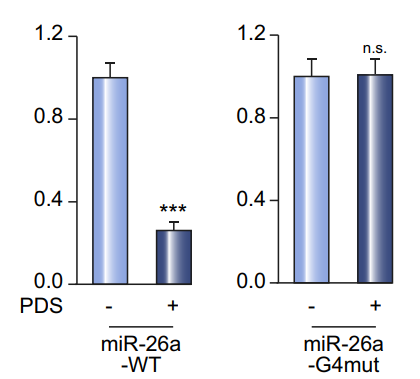
Levels of miR-26a in MPHs transfected with miR-26a-WT or miR-26a-G4mut plasmids and stimulated with Pyridostatin hydrochloride (PDS, 10 μM; 48 h). The results showed that PDS significantly diminished the increase in miR-26a expression induced by miR-26a-WT plasmids, but not by miR-26a-G4mut plasmids, indicating that the G/A mutations are sufficient to abolish the inhibitory effect of PDS on miR-26a expression.
Pyridostatin trihydrochloride purchased from MedChemExpress. Usage Cited in: J Hepatol. 2020 Aug;73(2):371-382. [Abstract]
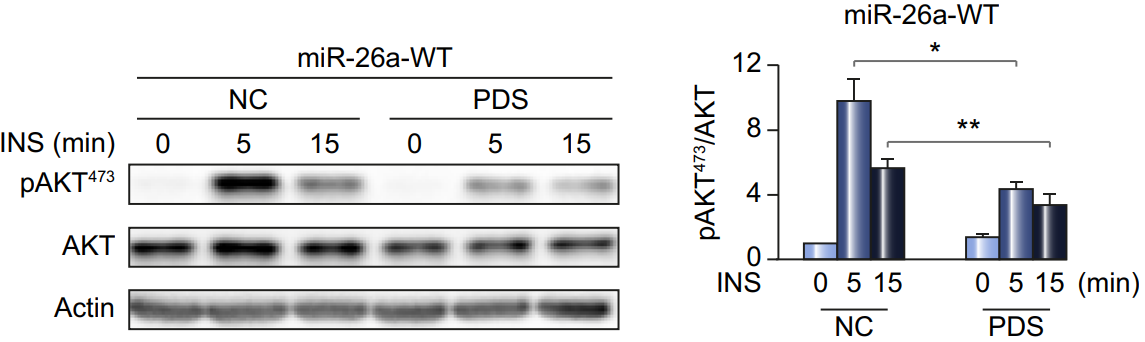
Pyridostatin hydrochloride (PDS, 10 μM; 48 h) markedly inhibited insulin-induced AKT activation, a central hallmark of insulin sensitivity, in MPHs (isolated from C57BL/6 mice) transfected with miR-26a-WT plasmids.
Pyridostatin trihydrochloride purchased from MedChemExpress. Usage Cited in: J Hepatol. 2020 Aug;73(2):371-382. [Abstract]
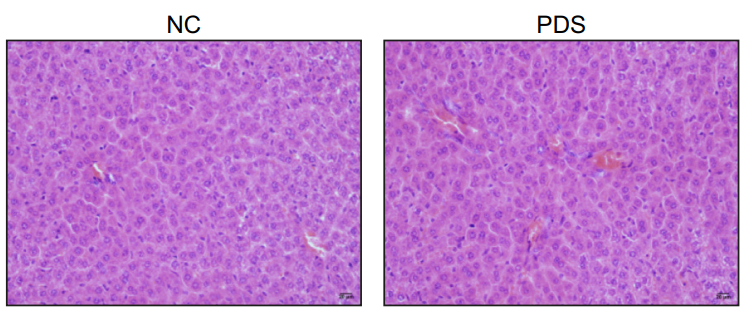
8- to 10-week-old mice were infused with Pyridostatin hydrochloride (PDS, 6 mg/kg body weight) or saline (NC) via caudal vein twice a day (n = 5). 12 h post the second injection, the following measurements were performed. Representative H&E staining of paraffin liver sections. Scale bars: 20 μm. The results showed that no significant differences in histology and morphology were observed between PDS-treated mice and saline-treated mice.
-
Cancer Res
Targeting SUV4-20H Epigenetic Enzymes Enhances Topoisomerase II Poisoning in Prostate Cancer. [Abstract]2025 Oct 1. PMID: 41032740 -
Nat Commun
2026 Feb 23;17(1):3076. PMID: 41730904 -
Nat Commun
WRN promotes bone development and growth by unwinding SHOX-G-quadruplexes via its helicase activity in Werner Syndrome. [Abstract]2022 Sep 16;13(1):5456. PMID: 36114168
Pyridostatin trihydrochloride purchased from MedChemExpress. Usage Cited in: Nat Commun. 2022 Sep 16;13(1):5456. [Abstract]
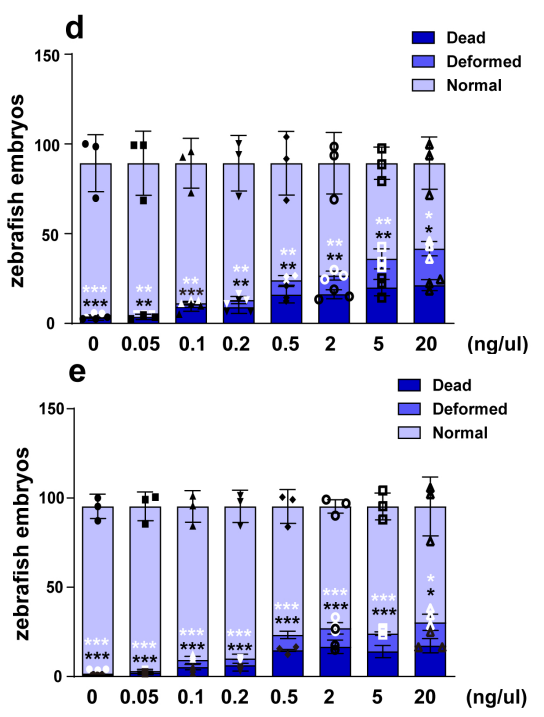
Stacked bar graphs of zebrafish embryos in dead, deformd, and normal status with different G4 stabilizer (Pyridostatin hydrochloride, 0.05-20 ng/μL, 5 nL) concentration at 24 hpf (d) and 48 hpf (e).
Pyridostatin trihydrochloride purchased from MedChemExpress. Usage Cited in: Nat Commun. 2022 Sep 16;13(1):5456. [Abstract]
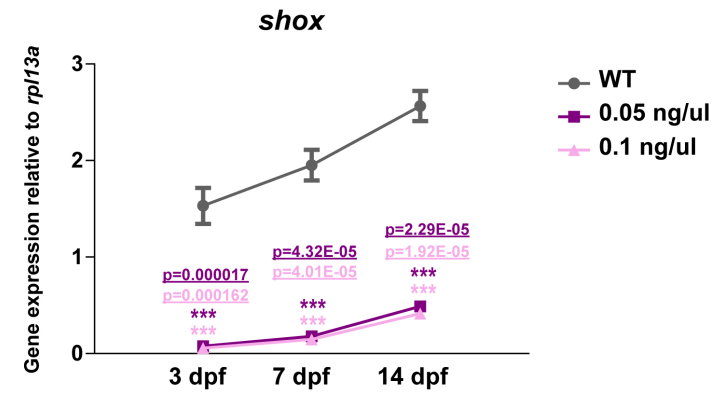
qRT-PCR measurement of shox. The mRNA expression level of the shoxgene was detected at different time points (3, 7, and 14 days post-fertilization; i.e., 3 dpf, 7 dpf, and 14 dpf). The results showed that, compared with wild-type zebrafish, the G4 stabilizer Pyridostatin hydrochloride (0.05-0.1 ng/μL) significantly reduced the shox mRNA expression level in wrn−/− zebrafish.
-
Nat Commun
2022 Mar 17;13(1):1444. PMID: 35301316 -
J Am Chem Soc
Monitoring and Modulating mtDNA G-Quadruplex Dynamics Reveal Its Close Relationship to Cell Glycolysis. [Abstract]2021 Dec 15;143(49):20779-20791. PMID: 34865478 -
Redox Biol
2024 Sep:75:103247. PMID: 39047636 -
Mol Cell
The MYCN oncoprotein is an RNA-binding accessory factor of the nuclear exosome targeting complex. [Abstract]2024 Jun 6;84(11):2070-2086.e20. PMID: 38703770 -
Nat Chem Biol
2025 Aug 7. PMID: 40775047 -
Nucleic Acids Res
2024 Mar 21;52(5):2142-2156. PMID: 38340342 -
Nucleic Acids Res
Unfolding of an RNA G-quadruplex motif in the negative strand genome of porcine reproductive and respiratory syndrome virus by host and viral helicases to promote viral replication. [Abstract]2023 Oct 27;51(19):10752-10767. PMID: 37739415 -
Nucleic Acids Res
DNA G-quadruplex structure participates in regulation of lipid metabolism through acyl-CoA binding protein. [Abstract]2022 Jun 24;50(12):6953-6967. PMID: 35748856 -
Nucleic Acids Res
Identification of LARK as a novel and conserved G-quadruplex binding protein in invertebrates and vertebrates. [Abstract]2019 Aug 22;47(14):7306-7320. PMID: 31165881 -
Int J Biol Macromol
An RNA G-quadruplex within the sclerostin 3' untranslated region enhances sclerostin expression by blocking miR-4648 binding. [Abstract]2025 Jun 20;319(Pt 1):145405. PMID: 40545075 -
Int J Biol Macromol
Diphenylaminothiophen-derived fluorescent ligands targeting mitochondrial DNA G-quadruplexes potentially for triple-negative breast cancer therapy. [Abstract]2025 Apr:302:140556. PMID: 39894118 -
Int J Biol Macromol
2021 Nov 1:190:178-188. PMID: 34461156 -
J Natl Cancer Inst
Suppressing c-FOS expression by G-quadruplex ligands inhibits osimertinib-resistant non-small cell lung cancers. [Abstract]2023 Nov 8;115(11):1383-1391. PMID: 37481710 -
J Med Chem
Novel Tetrahydroxanthylium-Based Ligands Targeting Mitochondrial DNA G-Quadruplex Structures for Concurrent Induction of Apoptosis and Inhibition of Autophagy in Liver Cancer. [Abstract]2026 Feb 12;69(3):2685-2702. PMID: 41582454 -
Anal Chem
2025 Jun 10;97(22):11617-11626. PMID: 40408126 -
Emerg Microbes Infect
SARS-CoV-2 and HCoV-OC43 regulate host m6A modification via activation of the mTORC1 signaling pathway to facilitate viral replication. [Abstract]2025 Dec;14(1):2447620. PMID: 39745173 -
J Ethnopharmacol
The function of Bazhen decoction in rescuing progeroid cell senescence via facilitating G-quadruplex resolving and telomere elongation. [Abstract]2024 Apr 6:323:117694. PMID: 38163559 -
-
ACS Omega
Ratio of the Primers Used in Polymerase Chain Reaction-Stop Analysis Impacts the Resultant Banding Pattern. [Abstract]2023 Sep 25;8(40):37369-37373. PMID: 37841166 -
J Mol Med (Berl)
2019 Aug;97(8):1183-1193. PMID: 31201471 -
PLoS Pathog
2023 Jan 26;19(1):e1011131. PMID: 36701392 -
iScience
Genomic G-quadruplex folding triggers a cytokine-mediated inflammatory feedback loop to aggravate inflammatory diseases. [Abstract]2022 Oct 9;25(11):105312. PMID: 36304116 -
J Med Virol
2023 Jan;95(1):e28299. PMID: 36366981 -
-
Biochemistry
G-Quadruplex-Mediated Transcriptional Regulation of SYT7: Implications for Tumor Progression and Therapeutic Strategies. [Abstract]2024 Oct 15;63(20):2609-2620. PMID: 39320967 -
Biochem Biophys Res Commun
2026 Jan 8:795:153117. PMID: 41380445 -
Biol Pharm Bull
Astragaloside IV Regulates the PI3K/Akt/HO-1 Signaling Pathway and Inhibits H9c2 Cardiomyocyte Injury Induced by Hypoxia-Reoxygenation. [Abstract]2019 May 1;42(5):721-727. PMID: 30867343 -
Biochem Mol Biol Educ
Forster resonance energy transfer for studying nucleic acids denaturation: A chemical and biological sciences laboratory experiment. [Abstract]2020 Jul;48(4):329-336. PMID: 32268010 -
-


Solvent & Solubility
In Vitro:
H2O : 100 mg/mL (141.64 mM; Need ultrasonic)
Please refer to the solubility information to select the appropriate solvent. Once prepared, please aliquot and store the solution to prevent product inactivation from repeated freeze-thaw cycles.
Storage method and period of stock solution: -80°C, 6 months; -20°C, 1 month (stored under nitrogen, away from moisture). When stored at -80°C, please use it within 6 months. When stored at -20°C, please use it within 1 month.
* Note: If you choose water as the stock solution, please dilute it to the working solution, then filter and sterilize it with a 0.22 μm filter before use.
Please refer to the solubility information to select the appropriate solvent. Once prepared, please aliquot and store the solution to prevent product inactivation from repeated freeze-thaw cycles.
Storage method and period of stock solution: -80°C, 6 months; -20°C, 1 month (stored under nitrogen, away from moisture). When stored at -80°C, please use it within 6 months. When stored at -20°C, please use it within 1 month.
* Note: If you choose water as the stock solution, please dilute it to the working solution, then filter and sterilize it with a 0.22 μm filter before use.
Concentration (start) × Volume (start) = Concentration (final) × Volume (final)


Purity & Documentation
-
Data Sheet (281 KB)
-
SDS (254 KB)
- English - EN (254 KB)
- Français - FR (254 KB)
- Deutsch - DE (254 KB)
- Norwegian - NO (254 KB)
- Español - ES (254 KB)
- Swedish - SV (254 KB)
- Italian - IT (254 KB)
- Korean - KR (254 KB)
- Portuguese - PT (254 KB)
-
Handling Instructions (2659 KB)
References
[1]. Rodriguez R, et al. Small-molecule-induced DNA damage identifies alternative DNA structures in human genes. Nat Chem Biol. 2012;8(3):301-310. Published 2012 Feb 5. [Content Brief]
[2]. Koirala D, et al. A single-molecule platform for investigation of interactions between G-quadruplexes and small-molecule ligands. Nat Chem. 2011;3(10):782-787. Published 2011 Aug 28. [Content Brief]


Complete Stock Solution Preparation Table
Please refer to the solubility information to select the appropriate solvent. Once prepared, please aliquot and store the solution to prevent product inactivation from repeated freeze-thaw cycles.
Storage method and period of stock solution: -80°C, 6 months; -20°C, 1 month (stored under nitrogen, away from moisture). When stored at -80°C, please use it within 6 months. When stored at -20°C, please use it within 1 month.
| Optional Solvent | Concentration Solvent Mass | 1 mg | 5 mg | 10 mg | 25 mg |
|---|---|---|---|---|---|
| H2O | 1 mM | 1.4164 mL | 7.0820 mL | 14.1639 mL | 35.4098 mL |
| 5 mM | 0.2833 mL | 1.4164 mL | 2.8328 mL | 7.0820 mL | |
| 10 mM | 0.1416 mL | 0.7082 mL | 1.4164 mL | 3.5410 mL | |
| 15 mM | 0.0944 mL | 0.4721 mL | 0.9443 mL | 2.3607 mL | |
| 20 mM | 0.0708 mL | 0.3541 mL | 0.7082 mL | 1.7705 mL | |
| 25 mM | 0.0567 mL | 0.2833 mL | 0.5666 mL | 1.4164 mL | |
| 30 mM | 0.0472 mL | 0.2361 mL | 0.4721 mL | 1.1803 mL | |
| 40 mM | 0.0354 mL | 0.1770 mL | 0.3541 mL | 0.8852 mL | |
| 50 mM | 0.0283 mL | 0.1416 mL | 0.2833 mL | 0.7082 mL | |
| 60 mM | 0.0236 mL | 0.1180 mL | 0.2361 mL | 0.5902 mL | |
| 80 mM | 0.0177 mL | 0.0885 mL | 0.1770 mL | 0.4426 mL | |
| 100 mM | 0.0142 mL | 0.0708 mL | 0.1416 mL | 0.3541 mL |
* Note: If you choose water as the stock solution, please dilute it to the working solution, then filter and sterilize it with a 0.22 μm filter before use.


Pyridostatin trihydrochloride Related Classifications
HY-15176C Related Classifications
 Powered by Bioz