



ATL3 Protein, Human (His)

Based on 1 Customer Validation
ATL3 protein is a GTPase that mediates homotypic fusion of endoplasmic reticulum (ER) membranes by promoting membrane tethering through the formation of trans homomers.ATL3 is critical for ER tubular network biogenesis, contributing to the organization and dynamics of this important cellular structure.ATL3 Protein, Human (His) is the recombinant human-derived ATL3 protein, expressed by E.coli , with N-His labeled tag.
- Species: Human
- Source: E. coli
-
Storage:Stored at -20°C for 2 years from date of receipt. After reconstitution, it is stable at 4°C for 1 week or -20°C for longer (with carrier protein). It is recommended to freeze aliquots at -20°C or -80°C for extended storage.


To place orders, for customer services and technical support, please contact: MedChemExpress USA
Tel: 609-228-6898 E-mail: [email protected] [email protected]


-
 Biological Activity
-
Technical Parameters
-
Product Properties
- Documentation
- Help & FAQs




Biological Activity
Description
ATL3 protein is a GTPase that mediates homotypic fusion of endoplasmic reticulum (ER) membranes by promoting membrane tethering through the formation of trans homomers.ATL3 is critical for ER tubular network biogenesis, contributing to the organization and dynamics of this important cellular structure.ATL3 Protein, Human (His) is the recombinant human-derived ATL3 protein, expressed by E.coli , with N-His labeled tag.
Background
ATL3 Protein serves as a GTPase that facilitates membrane tethering by forming trans-homooligomers, thereby mediating homotypic fusion of endoplasmic reticulum (ER) membranes. This pivotal protein plays a crucial role in the biogenesis of the tubular network within the endoplasmic reticulum, contributing to the organization and dynamics of this essential cellular structure. Additionally, ATL3 engages in interactions with specific proteins, such as ZFYVE27 and REEP5, suggesting a network of molecular associations that further modulate its functional role in membrane dynamics and ER architecture.
Verified Bioactivity
Measured by its ability to catalyze the substrate GTP. The specific activity is 613.47 μM/min/μg, as measured under the described conditions.
MCE Validation Data
-
Purity - SDS-PAGE
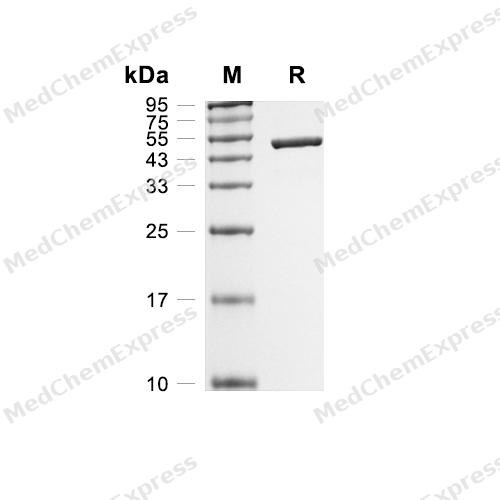
Purity - SDS-PAGE

Assay Procedure
Materials
ATPase/GTPase Detection Kit: Includes detection buffer, Pi standard (1 mM), reagents
GTP: Prepare a 4 mM GTP solution in detection buffer
ATL3 Protein, Human (His-tag) (HY-P75497)
Procedure
1. Dilute Pi Standard with ddH2O to concentrations of 100, 50, 30, 15, 0 μM.
2. Add 40 μL of each standard concentration to the wells.
3. Add 200 μL of Reagent to each well and incubate at room temperature (22-25°C) for 30 minutes.
4. Measure the OD630 using a microplate reader.
5. Plot the measured OD values on the y-axis and the Pi standard concentrations on the x-axis to obtain the standard curve equation.
6. Dilute GTP to 4 mM in assay buffer.
7. Dilute Human ATL3 protein to 2 μg/mL in assay buffer.
8. Add 20 μL of assay buffer to the wells of a 96-well plate, followed by 10 μL of 2 μg/mL Human ATL3 solution, 10 μL of 4 mM GTP solution, and 200 μL of reagent. For blank wells, add 30 μL of assay buffer, 10 μL of 4 mM GTP solution, and 200 μL of reagent.
9. Incubate at room temperature (22-25°C) for 30 minutes.
10. Measure the OD630 using a microplate reader.
11. Calculate enzyme activity:
Enzyme activity = | [Pi]* (μM) x Reaction volume** (μL) |
| Enzyme volume*** (μL) x Reaction time**** (min) |
*Derived from the standard curve
**Reaction volume: 40 μL
***Enzyme volume: 10 μL
****Reaction time: 30min


Technical Parameters
-
Species Human
-
Source E. coli
-
Tag N-10*His
-
Accession
Q6DD88 (M1-A445)
-
Molecular Construction
-
N-term
-
His
-
ATL3 (M1-A445)
Accession # Q6DD88 -
C-term
-
-
Protein Length
Cytoplasmic Domain
-
Synonyms
ATL3; ATL-3; Atlastin GTPase 3; AT3; DKFZP564J0863; HSN1F; Atlastin-3
-
AA Sequence
MLSPQRVAAAASRGADDAMESSKPGPVQVVLVQKDQHSFELDEKALASILLQDHIRDLDVVVVSVAGAFRKGKSFILDFMLRYLYSQKESGHSNWLGDPEEPLTGFSWRGGSDPETTGIQIWSEVFTVEKPGGKKVAVVLMDTQGAFDSQSTVKDCATIFALSTMTSSVQIYNLSQNIQEDDLQQLQLFTEYGRLAMDEIFQKPFQTLMFLVRDWSFPYEYSYGLQGGMAFLDKRLQVKEHQHEEIQNVRNHIHSCFSDVTCFLLPHPGLQVATSPDFDGKLKDIAGEFKEQLQALIPYVLNPSKLMEKEINGSKVTCRGLLEYFKAYIKIYQGEDLPHPKSMLQATAEANNLAAAASAKDIYYNNMEEVCGGEKPYLSPDILEEKHCEFKQLALDHFKKTKKMGGKDFSFRYQQELEEEIKELYENFCKHNGSKNVFSTFRTPA
-
Molecular Weight
Approximately 52.6 kDa
-
Purity
≥ 95%, as determined by reducing SDS-PAGE.


Product Properties
Lyophilized powder.
Lyophilized from a 0.22 μm filtered solution of PBS, pH 7.4.
<1 EU/μg, determined by LAL method.
It is not recommended to reconstitute to a concentration less than 100 μg/mL in ddH2O. For long term storage it is recommended to add a carrier protein (0.1% BSA, 5% HSA, 10% FBS or 5% Trehalose).
Stored at -20°C for 2 years from date of receipt. After reconstitution, it is stable at 4°C for 1 week or -20°C for longer (with carrier protein). It is recommended to freeze aliquots at -20°C or -80°C for extended storage.
Room temperature in continental US; may vary elsewhere.


Documentation
-
Data Sheet (237 KB)
-
SDS (251 KB)
- English - EN (251 KB)
- Français - FR (251 KB)
- Deutsch - DE (251 KB)
- Norwegian - NO (251 KB)
- Español - ES (251 KB)
- Swedish - SV (251 KB)
- Italian - IT (251 KB)
- Korean - KR (251 KB)
- Portuguese - PT (251 KB)
-
Handling Instructions (2659 KB)

Calculators
Concentration (start) × Volume (start) = Concentration (final) × Volume (final)


 Powered by Bioz

