



ATP5F1A Protein, Human (His)

Based on 1 Customer Validation
ATP5F1A is an important component of mitochondrial ATP synthase (complex V) that coordinates ATP production from ADP by utilizing the transmembrane proton gradient. ATP5F1A Protein, Human (His) is the recombinant human-derived ATP5F1A protein, expressed by E. coli , with N-6*His labeled tag.
- Species: Human
- Source: E. coli
-
Storage:Stored at -20°C for 2 years from date of receipt. After reconstitution, it is stable at 4°C for 1 week or -20°C for longer (with carrier protein). It is recommended to freeze aliquots at -20°C or -80°C for extended storage.


To place orders, for customer services and technical support, please contact: MedChemExpress USA
Tel: 609-228-6898 E-mail: [email protected] [email protected]


-
 Biological Activity
-
Technical Parameters
-
Product Properties
- Documentation
- Help & FAQs




Biological Activity
Description
ATP5F1A is an important component of mitochondrial ATP synthase (complex V) that coordinates ATP production from ADP by utilizing the transmembrane proton gradient. ATP5F1A Protein, Human (His) is the recombinant human-derived ATP5F1A protein, expressed by E. coli , with N-6*His labeled tag.
Background
ATP5F1A, a crucial component of the mitochondrial membrane ATP synthase (F(1)F(0) ATP synthase or Complex V), plays a pivotal role in ATP production from ADP by harnessing the proton gradient across the membrane generated by the respiratory chain's electron transport complexes. Comprising the catalytic core (F(1)) and the membrane proton channel (F(0)), F-type ATPases, like ATP5F1A, consist of multiple subunits with distinct functions. The alpha and beta subunits form the catalytic core in F(1), where rotation of the central stalk against surrounding alpha(3)beta(3) subunits facilitates ATP hydrolysis. Intriguingly, ATP5F1A binds the bacterial siderophore enterobactin, promoting the accumulation of enterobactin-derived iron ions within mitochondria. Additionally, ATP5F1A interacts with various proteins, such as ATPAF2, HRG, PLG, BLOC1S1, BCL2L1 isoform BCL-X(L), CLN5, PPT1, S100A1, and ABCB7, influencing diverse cellular processes ranging from metabolic efficiency and iron homeostasis to apoptotic regulation. Furthermore, ATP5F1A is a crucial component of the ATP synthase complex, highlighting its central role in cellular energy production. Understanding these intricate interactions sheds light on the multifaceted functions of ATP5F1A in cellular physiology.
Verified Bioactivity
The enzyme activity of this recombinant protein is testing in progress, we cannot offer a guarantee yet.
MCE Validation Data
-
Purity - SDS-PAGE
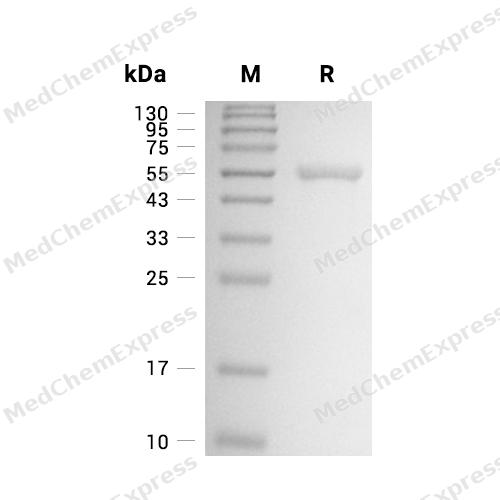
Purity - SDS-PAGE


Technical Parameters
-
Species Human
-
Source E. coli
-
Tag N-6*His
-
Accession
P25705-1 (Q44-A553)
-
Molecular Construction
-
N-term
-
6*His
-
ATP5F1A (Q44-A553)
Accession # P25705 -
C-term
-
-
Protein Length
Full Length of Isoform-1
-
Synonyms
ATP5F1A; ATP Synthase, H+ Transporting, Mitochondrial F1 Complex, Alpha Subunit, Isoform 1, Cardiac Muscle; Prev. ATP5AL2; Mitochondrial ATP Synthetase, Oligomycin-Resistant; Prev. ATP5A1; ATP Synthase Alpha Chain, Mitochondrial; Prev. ATPM; ATP Sythase (
-
AA Sequence
QKTGTAEMSSILEERILGADTSVDLEETGRVLSIGDGIARVHGLRNVQAEEMVEFSSGLKGMSLNLEPDNVGVVVFGNDKLIKEGDIVKRTGAIVDVPVGEELLGRVVDALGNAIDGKGPIGSKTRRRVGLKAPGIIPRISVREPMQTGIKAVDSLVPIGRGQRELIIGDRQTGKTSIAIDTIINQKRFNDGSDEKKKLYCIYVAIGQKRSTVAQLVKRLTDADAMKYTIVVSATASDAAPLQYLAPYSGCSMGEYFRDNGKHALIIYDDLSKQAVAYRQMSLLLRRPPGREAYPGDVFYLHSRLLERAAKMNDAFGGGSLTALPVIETQAGDVSAYIPTNVISITDGQIFLETELFYKGIRPAINVGLSVSRVGSAAQTRAMKQVAGTMKLELAQYREVAAFAQFGSDLDAATQQLLSRGVRLTELLKQGQYSPMAIEEQVAVIYAGVRGYLDKLEPSKITKFENAFLSHVVSQHQALLGTIRADGKISEQSDAKLKEIVTNFLAGFEA
-
Molecular Weight
Approximately 56-59 kDa, based on SDS-PAGE under reducing conditions.
-
Purity
≥ 90%, as determined by reducing SDS-PAGE.


Product Properties
Lyophilized powder
1.Lyophilized from a 0.22 μm filtered solution of 10 mM Tris-HCl, 1 mM EDTA, 6% trehalose.
2.Lyophilized from a 0.22 μm filtered solution of PBS, pH 7.4, 0.1% SKL.
Please refer to the lot-specific COA for specific buffer information.
Note: For SPR assay, please replace the buffer. Primary amine components (e.g., Tris, imidazole) can affect protein-coupled chips.
<1 EU/μg, determined by LAL method.
It is not recommended to reconstitute to a concentration less than 100 μg/mL in ddH2O.
Stored at -20°C for 2 years from date of receipt. After reconstitution, it is stable at 4°C for 1 week or -20°C for longer (with carrier protein). It is recommended to freeze aliquots at -20°C or -80°C for extended storage.
Room temperature in continental US; may vary elsewhere.


Documentation
-
Data Sheet (239 KB)
-
SDS (254 KB)
- English - EN (254 KB)
- Français - FR (254 KB)
- Deutsch - DE (254 KB)
- Norwegian - NO (254 KB)
- Español - ES (254 KB)
- Swedish - SV (254 KB)
- Italian - IT (254 KB)
- Korean - KR (254 KB)
- Portuguese - PT (254 KB)
-
Handling Instructions (2659 KB)

Calculators
Concentration (start) × Volume (start) = Concentration (final) × Volume (final)


 Powered by Bioz

