



BPIFA1 Protein, Human

Based on 1 Customer Validation
BPIFA1 Protein, a lipid-binding protein, exhibits high specificity for the surfactant phospholipid DPPC. It plays a crucial role in the innate immune responses of the upper airways, reducing surface tension, inhibiting biofilm formation by pathogenic bacteria, and negatively regulating proteolytic cleavage of SCNN1G, contributing to airway surface liquid homeostasis. BPIFA1 may also attract macrophages and neutrophils. BPIFA1 Protein, Human is the recombinant human-derived BPIFA1 protein, expressed by E. coli , with tag free.
- Species: Human
- Source: E. coli
-
Storage:Stored at -80°C for 1 year from date of receipt. It is stable at -20°C for 3 months after opening. It is recommended to freeze aliquots at -80°C for extended storage. Avoid repeated freeze-thaw cycles.


To place orders, for customer services and technical support, please contact: MedChemExpress USA
Tel: 609-228-6898 E-mail: [email protected] [email protected]


-
 Biological Activity
-
Technical Parameters
-
Product Properties
- Documentation
- Help & FAQs




Biological Activity
Description
BPIFA1 Protein, a lipid-binding protein, exhibits high specificity for the surfactant phospholipid DPPC. It plays a crucial role in the innate immune responses of the upper airways, reducing surface tension, inhibiting biofilm formation by pathogenic bacteria, and negatively regulating proteolytic cleavage of SCNN1G, contributing to airway surface liquid homeostasis. BPIFA1 may also attract macrophages and neutrophils. BPIFA1 Protein, Human is the recombinant human-derived BPIFA1 protein, expressed by E. coli , with tag free.
Background
BPIFA1 protein, a lipid-binding molecule with a distinct affinity for the surfactant phospholipid dipalmitoylphosphatidylcholine (DPPC), plays a pivotal role in the innate immune responses within the upper airways. By reducing surface tension in airway secretions and impeding biofilm formation by pathogenic Gram-negative bacteria, such as P. aeruginosa and K. pneumoniae, BPIFA1 contributes to the host's defense mechanisms. Furthermore, it negatively regulates the proteolytic cleavage of SCNN1G, a crucial event for the activation of the epithelial sodium channel (ENaC), thereby maintaining airway surface liquid homeostasis and facilitating proper mucus clearance. BPIFA1 also participates in the inflammatory response following exposure to irritants and may attract immune cells like macrophages and neutrophils. Structurally, BPIFA1 functions as a monomer and interacts with SCNN1B, a subunit of the heterotrimeric ENaC, inhibiting its proteolytic activation. This multifaceted role highlights the importance of BPIFA1 in orchestrating various aspects of airway defense and homeostasis.
Verified Bioactivity
Measured by its ability to bind fluorescein-conjugated E. coli Bioparticles. The ED50 for this effect is 3.382 μg/mL.
MCE Validation Data
-
Purity - SDS-PAGE
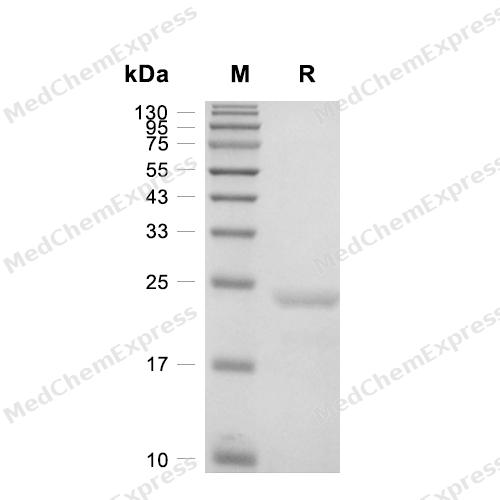
Purity - SDS-PAGE
-
Bioactivity - Biochemical Activity Assay
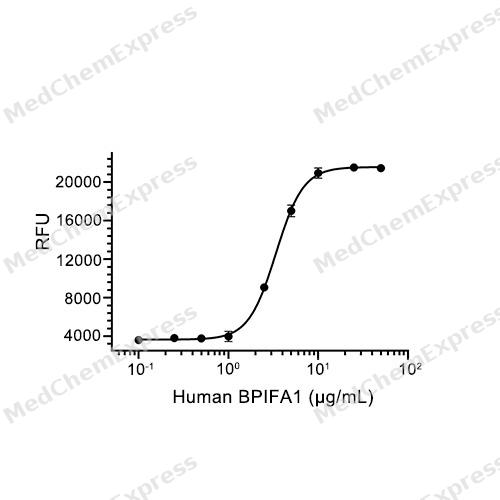
Bioactivity - Biochemical Activity Assay


Technical Parameters
-
Species Human
-
Source E. coli
-
Tag Tag Free
-
Accession
Q9NP55-1 (Q20-V256)
-
Molecular Construction
-
N-term
-
BPIFA1 (Q20-V256)
Accession # Q9NP55-1 -
C-term
-
-
Protein Length
Full Length of Isoform-1
-
Synonyms
BPIFA1; Lung-Specific Protein X; Prev. PLUNC; Short PLUNC1; SPLUNC1; SPURT; LUNX; NASG; BA49G10.5; Palate, Lung And Nasal Epithelium Carcinoma Associated; Palate Lung And Nasal Epithelium Clone Protein; Tracheal Epithelium Enriched Protein; Secretory Prot
-
AA Sequence
QFGGLPVPLDQTLPLNVNPALPLSPTGLAGSLTNALSNGLLSGGLLGILENLPLLDILKPGGGTSGGLLGGLLGKVTSVIPGLNNIIDIKVTDPQLLELGLVQSPDGHRLYVTIPLGIKLQVNTPLVGASLLRLAVKLDITAEILAVRDKQERIHLVLGDCTHSPGSLQISLLDGLGPLPIQGLLDSLTGILNKVLPELVQGNVCPLVNEVLRGLDITLVHDIVNMLIHGLQFVIKV
-
Molecular Weight
Approximately 25 kDa, based on SDS-PAGE under reducing conditions.
-
Purity
≥ 95%, as determined by reducing SDS-PAGE.


Product Properties
Solution
1.Supplied as a 0.22 μm filtered solution of 50 mM Tris, 150 mM NaCl, 10% glycerol, pH 8.5.
2.Supplied as a 0.22 μm filtered solution of PBS, pH 7.4.
Please refer to the lot-specific COA for specific buffer information.
Note: For SPR assay, please replace the buffer. Primary amine components (e.g., Tris, imidazole) can affect protein-coupled chips.
<1 EU/μg, determined by LAL method.
Stored at -80°C for 1 year from date of receipt. It is stable at -20°C for 3 months after opening. It is recommended to freeze aliquots at -80°C for extended storage. Avoid repeated freeze-thaw cycles.
Shipping with dry ice.


Documentation
-
Data Sheet (260 KB)
-
SDS (252 KB)
- English - EN (252 KB)
- Français - FR (252 KB)
- Deutsch - DE (252 KB)
- Norwegian - NO (252 KB)
- Español - ES (252 KB)
- Swedish - SV (252 KB)
- Italian - IT (252 KB)
- Korean - KR (252 KB)
- Portuguese - PT (252 KB)
-
Handling Instructions (2659 KB)

Calculators
Concentration (start) × Volume (start) = Concentration (final) × Volume (final)


 Powered by Bioz

