



C6/Complement component C6 Protein, Human (HEK293, His)

Based on 1 Customer Validation
C6/Complement component C6 Protein is a part of the lytic membrane attack complex formed during complement activation, which has an indispensable role in innate and acquired immune responses by forming pores in the plasma membrane of target cells, as well as cancer immune surveillance. It is a component of the complement cascade which can be incorporated into the cell membrane and cause cell lysis. People with C6 deficiency are prone to bacterial infection. C6/Complement component C6 Protein, Human (HEK293, His) is the recombinant human-derived C6/Complement component C6 protein, expressed by HEK293 , with C-His labeled tag.
- Species: Human
- Source: HEK293
-
Storage:Stored at -20°C for 2 years from date of receipt. After reconstitution, it is stable at 4°C for 1 week or -20°C for longer (with carrier protein). It is recommended to freeze aliquots at -20°C or -80°C for extended storage.


To place orders, for customer services and technical support, please contact: MedChemExpress USA
Tel: 609-228-6898 E-mail: [email protected] [email protected]


-
 Biological Activity
-
Technical Parameters
-
Product Properties
- Documentation
- Help & FAQs




Biological Activity
Description
C6/Complement component C6 Protein is a part of the lytic membrane attack complex formed during complement activation, which has an indispensable role in innate and acquired immune responses by forming pores in the plasma membrane of target cells, as well as cancer immune surveillance. It is a component of the complement cascade which can be incorporated into the cell membrane and cause cell lysis. People with C6 deficiency are prone to bacterial infection. C6/Complement component C6 Protein, Human (HEK293, His) is the recombinant human-derived C6/Complement component C6 protein, expressed by HEK293 , with C-His labeled tag.
Background
Complement component C6 (C6) is a part of the lytic membrane attack complex formed during complement activation, which has an indispensable role in innate and acquired immune responses by forming pores in the plasma membrane of target cells, as well as cancer immune surveillance. It is a component of the complement cascade which can be incorporated into the cell membrane and cause cell lysis. Purified human C6 is unique to the terminal complement pathway and also plays a critical role in inflammatory responses. C6 deficiency is the most common terminal complement component deficiency and can present later in age with N. meningitidis infections[1][2].
Verified Bioactivity
Measured by its ability to inhibit the proliferation of HepG2 cells. The ED50 for this effect is 4.961 μg/mL, corresponding to a specific activity is 201.57 units/mg.
MCE Validation Data
-
Purity - SDS-PAGE
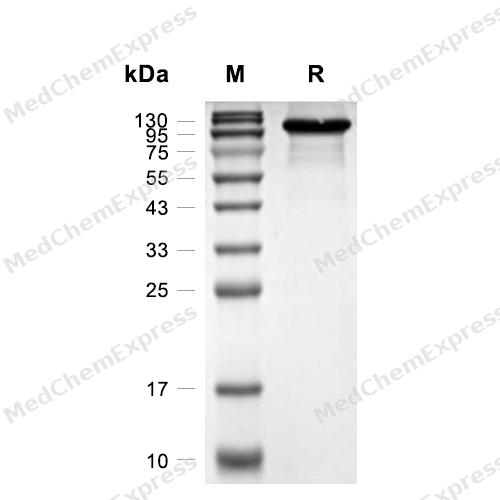
Purity - SDS-PAGE
-
Bioactivity - Cell-Based Assay
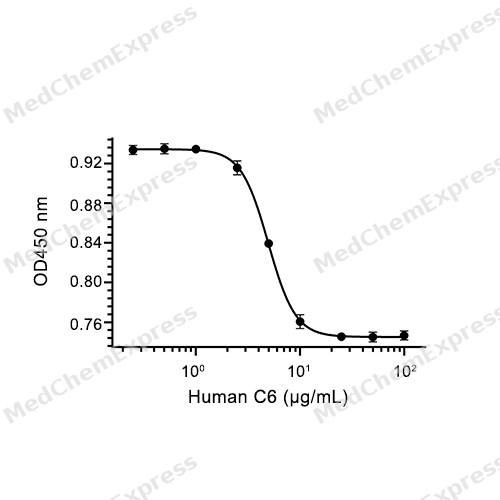
Bioactivity - Cell-Based Assay


Technical Parameters
-
Species Human
-
Source HEK293
-
Tag C-10*His
-
Accession
AAA59668 (C22-A934)
-
Molecular Construction
-
N-term
-
C6 (C22-A934)
Accession # AAA59668 -
His
-
C-term
-
-
Protein Length
Full Length of Mature Protein
-
Synonyms
C6; Complement Component C6; Complement C6; Complement Component 6
-
AA Sequence
CFCDHYAWTQWTSCSKTCNSGTQSRHRQIVVDKYYQENFCEQICSKQETRECNWQRCPINCLLGDFGPWSDCDPCIEKQSKVRSVLRPSQFGGQPCTEPLVAFQPCIPSKLCKIEEADCKNKFRCDSGRCIARKLECNGENDCGDNSDERDCGRTKAVCTRKYNPIPSVQLMGNGFHFLAGEPRGEVLDNSFTGGICKTVKSSRTSNPYRVPANLENVGFEVQTAEDDLKTDFYKDLTSLGHNENQQGSFSSQGGSSFSVPIFYSSKRSENINHNSAFKQAIQASHKKDSSFIRIHKVMKVLNFTTKAKDLHLSDVFLKALNHLPLEYNSALYSRIFDDFGTHYFTSGSLGGVYDLLYQFSSEELKNSGLTEEEAKHCVRIETKKRVLFAKKTKVEHRCTTNKLSEKHEGSFIQGAEKSISLIRGGRSEYGAALAWEKGSSGLEEKTFSEWLESVKENPAVIDFELAPIVDLVRNIPCAVTKRNNLRKALQEYAAKFDPCQCAPCPNNGRPTLSGTECLCVCQSGTYGENCEKQSPDYKSNAVDGQWGCWSSWSTCDATYKRSRTRECNNPAPQRGGKRCEGEKRQEEDCTFSIMENNGQPCINDDEEMKEVDLPEIEADSGCPQPVPPENGFIRNEKQLYLVGEDVEISCLTGFETVGYQYFRCLPDGTWRQGDVECQRTECIKPVVQEVLTITPFQRLYRIGESIELTCPKGFVVAGPSRYTCQGNSWTPPISNSLTCEKDTLTKLKGHCQLGQKQSGSECICMSPEEDCSHHSEDLCVFDTDSNDYFTSPACKFLAEKCLNNQQLHFLHIGSCQDGRQLEWGLERTRLSSNSTKKESCGYDTCYDWEKCSASTSKCVCLLPPQCFKGGNQLYCVKMGSSTSEKTLNICEVGTIRCANRKMEILHPGKCLA
-
Molecular Weight
Approximately 110 kDa, based on SDS-PAGE under reducing conditions.
-
Glycosylation
Yes
-
Purity
≥ 90%, as determined by reducing SDS-PAGE.


Product Properties
Lyophilized powder.
Lyophilized from a 0.22 μm filtered solution of PBS, pH 7.4.
<1 EU/μg, determined by LAL method.
It is not recommended to reconstitute to a concentration less than 100 μg/mL in ddH2O. For long term storage it is recommended to add a carrier protein (0.1% BSA, 5% HSA, 10% FBS or 5% Trehalose).
Stored at -20°C for 2 years from date of receipt. After reconstitution, it is stable at 4°C for 1 week or -20°C for longer (with carrier protein). It is recommended to freeze aliquots at -20°C or -80°C for extended storage.
Room temperature in continental US; may vary elsewhere.


Documentation
-
Data Sheet (265 KB)
-
SDS (251 KB)
- English - EN (251 KB)
- Français - FR (251 KB)
- Deutsch - DE (251 KB)
- Norwegian - NO (251 KB)
- Español - ES (251 KB)
- Swedish - SV (251 KB)
- Italian - IT (251 KB)
- Korean - KR (251 KB)
- Portuguese - PT (251 KB)
-
Handling Instructions (2659 KB)

Calculators
Concentration (start) × Volume (start) = Concentration (final) × Volume (final)


 Powered by Bioz

