



CD40 Protein, Cynomolgus (HEK293, His)

Based on 1 Customer Validation
CD40 Protein, a vital TNFR superfamily member, lacks conserved residue(s) crucial for feature annotation propagation, indicating unique structural attributes. This distinctiveness may influence CD40's functional interactions within the TNFR superfamily, underscoring the need for further exploration to unravel its specific roles and regulatory mechanisms in cellular signaling pathways. CD40 Protein, Cynomolgus (HEK293, His) is the recombinant cynomolgus-derived CD40 protein, expressed by HEK293 , with C-6*His labeled tag.
- Species: Cynomolgus
- Source: HEK293
-
Storage:Stored at -20°C for 2 years from date of receipt. After reconstitution, it is stable at 4°C for 1 week or -20°C for longer (with carrier protein). It is recommended to freeze aliquots at -20°C or -80°C for extended storage.


To place orders, for customer services and technical support, please contact: MedChemExpress USA
Tel: 609-228-6898 E-mail: [email protected] [email protected]


-
 Biological Activity
-
Technical Parameters
-
Product Properties
- Documentation
- Help & FAQs




Biological Activity
Description
CD40 Protein, a vital TNFR superfamily member, lacks conserved residue(s) crucial for feature annotation propagation, indicating unique structural attributes. This distinctiveness may influence CD40's functional interactions within the TNFR superfamily, underscoring the need for further exploration to unravel its specific roles and regulatory mechanisms in cellular signaling pathways. CD40 Protein, Cynomolgus (HEK293, His) is the recombinant cynomolgus-derived CD40 protein, expressed by HEK293 , with C-6*His labeled tag.
Background
CD40, a crucial member of the TNFR superfamily, is characterized by the absence of conserved residue(s) necessary for the propagation of feature annotation. This distinctive feature suggests unique structural attributes in CD40, potentially influencing its functional interactions within the TNFR superfamily. The lack of these conserved residues underscores the specific nature of CD40 and emphasizes the importance of further exploration to unravel its distinct roles and regulatory mechanisms in cellular signaling pathways.
Verified Bioactivity
Measured by its binding ability in a functional ELISA. When Recombinant Cynomolgus CD40/TNFRSF5 is immobilized at 1 µg/mL (100 µL/well) can bind Recombinant Human CD40 Ligand/TNFSF5. The ED50 for this effect is 60.12 ng/mL.
MCE Validation Data
-
Bioactivity - ELISA
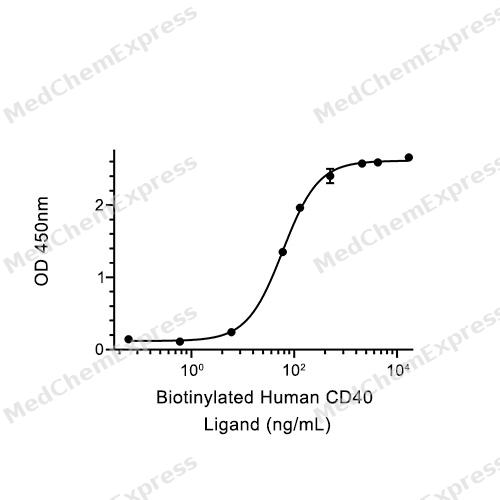
Bioactivity - ELISA


Technical Parameters
-
Species Cynomolgus
-
Source HEK293
-
Tag C-6*His
-
Accession
G7PG38 (E21-R193)
-
Molecular Construction
-
N-term
-
CD40 (E21-R193)
Accession # G7PG38 -
6*His
-
C-term
-
-
Protein Length
Partial
-
Synonyms
CD40; B-Cell Surface Antigen CD40; Prev. TNFRSF5; B Cell Surface Antigen CD40; Bp50; B Cell-Associated Molecule; Tumor Necrosis Factor Receptor Superfamily Member 5; CD40 Antigen; CD40L Receptor; CDW40; P50; CDw40; CD40 Molecule, TNF Receptor Superfamily
-
AA Sequence
EPPTACREKQYLINSQCCSLCQPGQKLVSDCTEFTETECLPCSESEFLDTWNRETRCHQHKYCDPNLGLQVQQKGTSETDTICTCEEGLHCTSESCESCVPHRSCLPGFGVKQIATGVSDTICEPCPVGFFSNVSSAFEKCRPWTSCETKDLVVQQAGTNKTDVVCGPQDRQR
-
Predicted Molecular Mass
20.2 kDa
-
Molecular Weight
Approximately 26-32 kDa, based on SDS-PAGE under reducing conditions, due to the glycosylation.
-
Purity
≥ 95%, as determined by reducing SDS-PAGE.


Product Properties
Lyophilized powder.
Lyophilized from a 0.22 μm filtered solution of PBS, pH 7.4.
<1 EU/μg, determined by LAL method.
It is not recommended to reconstitute to a concentration less than 100 μg/mL in ddH2O. For long term storage it is recommended to add a carrier protein (0.1% BSA, 5% HSA, 10% FBS or 5% Trehalose).
Stored at -20°C for 2 years from date of receipt. After reconstitution, it is stable at 4°C for 1 week or -20°C for longer (with carrier protein). It is recommended to freeze aliquots at -20°C or -80°C for extended storage.
Room temperature in continental US; may vary elsewhere.


Documentation
-
Data Sheet (236 KB)
-
SDS (254 KB)
- English - EN (254 KB)
- Français - FR (254 KB)
- Deutsch - DE (254 KB)
- Norwegian - NO (254 KB)
- Español - ES (254 KB)
- Swedish - SV (254 KB)
- Italian - IT (254 KB)
- Korean - KR (254 KB)
- Portuguese - PT (254 KB)
-
Handling Instructions (2659 KB)

Calculators
Concentration (start) × Volume (start) = Concentration (final) × Volume (final)


 Powered by Bioz

