



CD47 Protein, Rat (HEK293, His)
Based on 1 Customer Validation
The CD47 protein acts as a THBS1 receptor and regulates integrin signaling, promoting cell-cell interactions. It plays a role in signal transduction, cardiovascular homeostasis, inflammation, apoptosis, angiogenesis, immune regulation, and memory formation. CD47 Protein, Rat (HEK293, His) is the recombinant rat-derived CD47 protein, expressed by HEK293 , with C-His labeled tag.
- Species: Rat
- Source: HEK293
-
Storage:Stored at -20°C for 2 years from date of receipt. After reconstitution, it is stable at 4°C for 1 week or -20°C for longer (with carrier protein). It is recommended to freeze aliquots at -20°C or -80°C for extended storage.


To place orders, for customer services and technical support, please contact: MedChemExpress USA
Tel: 609-228-6898 E-mail: [email protected] [email protected]


-
 Biological Activity
-
Technical Parameters
-
Product Properties
- Documentation
- Help & FAQs




Biological Activity
Description
The CD47 protein acts as a THBS1 receptor and regulates integrin signaling, promoting cell-cell interactions. It plays a role in signal transduction, cardiovascular homeostasis, inflammation, apoptosis, angiogenesis, immune regulation, and memory formation. CD47 Protein, Rat (HEK293, His) is the recombinant rat-derived CD47 protein, expressed by HEK293 , with C-His labeled tag.
Background
The CD47 protein is an adhesive protein that facilitates cell-to-cell interactions. It acts as a receptor for thrombospondin THBS1 and modulates integrin signaling through the activation of heterotrimeric G proteins. CD47 is involved in various biological processes, including signal transduction, cardiovascular homeostasis, inflammation, apoptosis, angiogenesis, cellular self-renewal, and immunoregulation. It also plays a role in modulating pulmonary endothelin EDN1 signaling and nitrous oxide (NO) signaling, contributing to blood pressure regulation. Additionally, CD47 is important for memory formation and synaptic plasticity in the hippocampus. It serves as a receptor for SIRPA, preventing maturation of immature dendritic cells and inhibiting cytokine production by mature dendritic cells. Interaction with SIRPG enhances cell-cell adhesion, T-cell proliferation, and T-cell activation. CD47 positively modulates FAS-dependent apoptosis in T-cells and suppresses angiogenesis. It may also be involved in metabolic dysregulation during normal aging and regulate wound healing and stem cell self-renewal. CD47 may play a role in membrane transport, integrin-dependent signal transduction, and prevention of premature elimination of red blood cells. It interacts with THBS1, SIRPA, FAS/CD95, SIRPG, UBQLN1, UBQLN2, and fibrinogen.
Verified Bioactivity
Immobilized Mouse SIRP alpha, Mouse at 10 μg/mL (100 μL/well) can bind Rat CD47 with a linear range of 117.2 ng/mL.
MCE Validation Data
-
Purity - SDS-PAGE
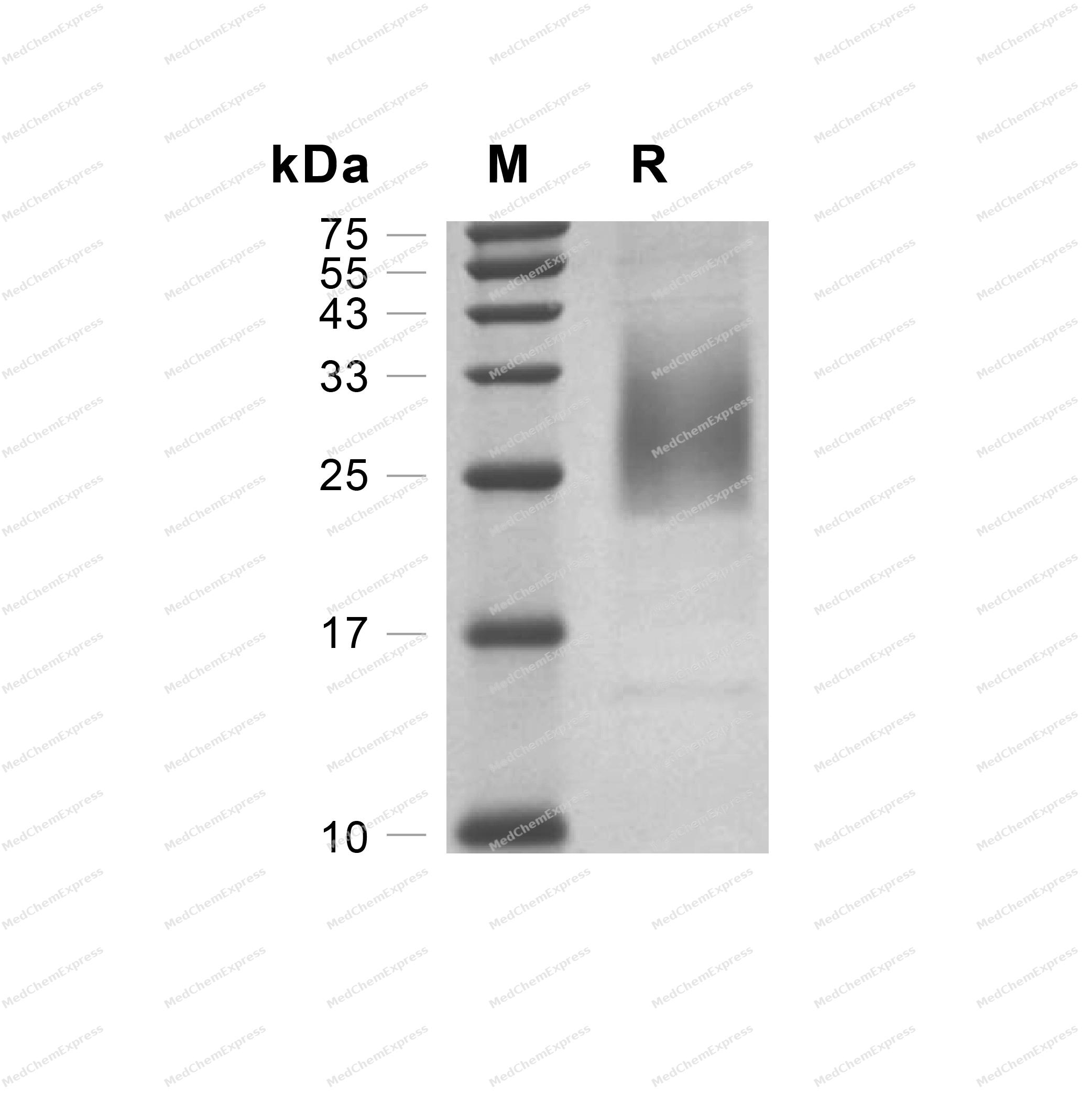
Purity - SDS-PAGE
-
Bioactivity - ELISA
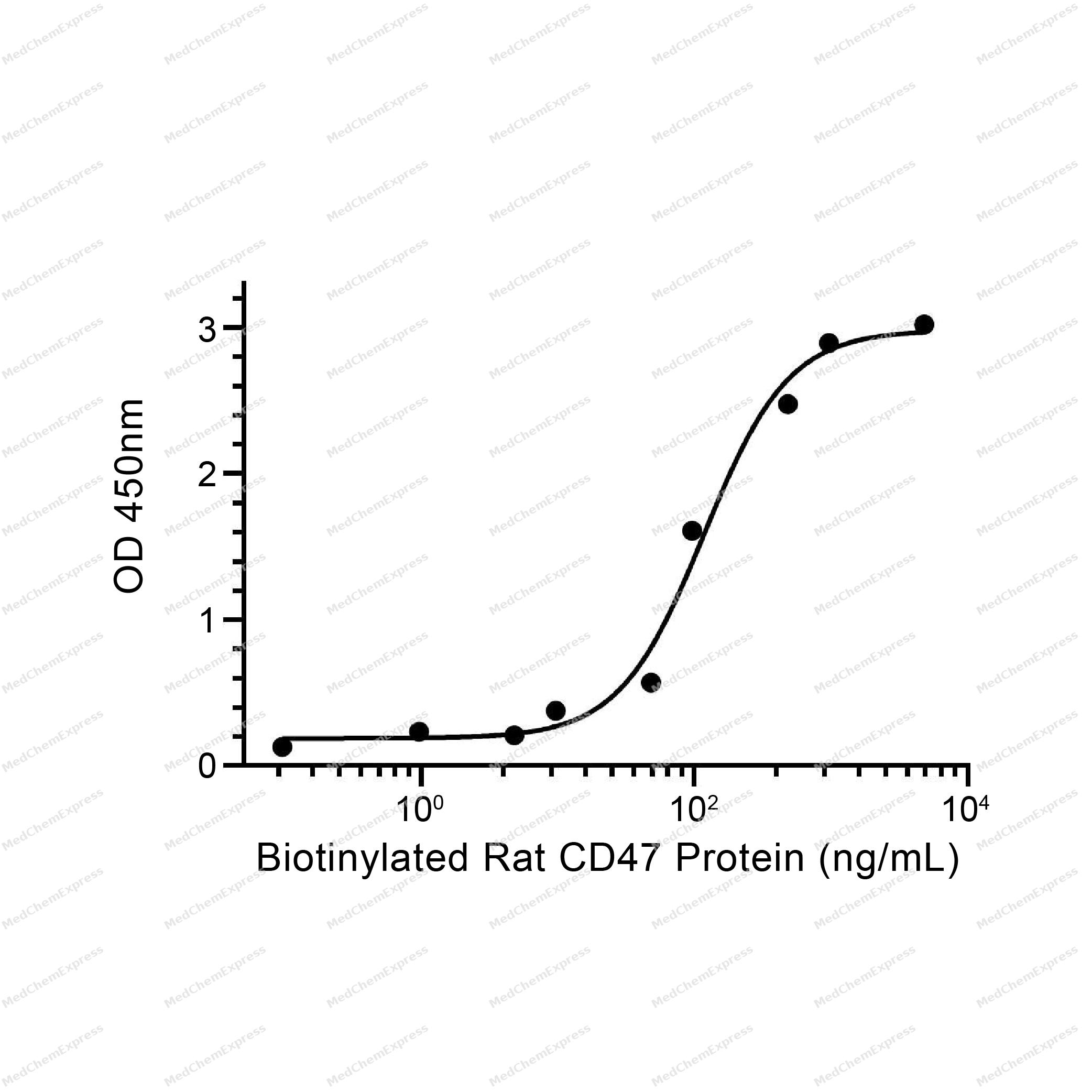
Bioactivity - ELISA


Technical Parameters
-
Species Rat
-
Source HEK293
-
Tag C-His
-
Accession
P97829-1 (Q19-K140)
-
Molecular Construction
-
N-term
-
CD47 (Q19-K140)
Accession # P97829-1 -
His
-
C-term
-
-
Protein Length
Extracellular Domain
-
Synonyms
CD47; Antigen Identified By Monoclonal Antibody 1D8; Prev. MER6; Integrin-Associated Protein; Leukocyte Surface Antigen CD47; Rh-Related Antigen; IAP; CD47 Glycoprotein; Antigenic Surface Determinant Protein OA3; Integrin-Associated Signal Transducer; OA3
-
AA Sequence
QLLLSKVKSVEFTSCNDTVVIPCKVLNVEAQSTDEMFVKWKLNKSYIFIYDGNKNSTTREQNFTSAKISVSDLLKGIASLTMDTHEAVVGNYTCEVTELSREGKTVIELKNRPVSWFSTNEK
-
Molecular Weight
Approximately 27-35 kDa, based on SDS-PAGE under reducing conditions, due to the glycosylation.
-
Glycosylation
Yes
-
Purity
≥ 90%, as determined by reducing SDS-PAGE.


Product Properties
Lyophilized powder.
Lyophilized from a 0.22 μm filtered solution of PBS, pH 7.4.
<1 EU/μg, determined by LAL method.
It is not recommended to reconstitute to a concentration less than 100 μg/mL in ddH2O. For long term storage it is recommended to add a carrier protein (0.1% BSA, 5% HSA, 10% FBS or 5% Trehalose).
Stored at -20°C for 2 years from date of receipt. After reconstitution, it is stable at 4°C for 1 week or -20°C for longer (with carrier protein). It is recommended to freeze aliquots at -20°C or -80°C for extended storage.
Room temperature in continental US; may vary elsewhere.


Documentation
-
Data Sheet (236 KB)
-
SDS (251 KB)
- English - EN (251 KB)
- Français - FR (251 KB)
- Deutsch - DE (251 KB)
- Norwegian - NO (251 KB)
- Español - ES (251 KB)
- Swedish - SV (251 KB)
- Italian - IT (251 KB)
- Korean - KR (251 KB)
- Portuguese - PT (251 KB)
-
Handling Instructions (2659 KB)

Calculators
Concentration (start) × Volume (start) = Concentration (final) × Volume (final)


 Powered by Bioz

