



CD63 Protein, Human/Cynomolgus (HEK293, His)

Based on 1 Customer Validation
The CD63 protein serves as a cell surface receptor for TIMP1 and is critical for activating signaling cascades. It contributes to ITGB1 and integrin signaling, activating AKT, FAK/PTK2 and MAP kinases to promote cell survival, cytoskeletal reorganization, adhesion, spreading and migration. CD63 Protein, Human/Cynomolgus (HEK293, His) is the recombinant cynomolgus-derived CD63 protein, expressed by HEK293 , with C-His labeled tag.
- Species: Cynomolgus; Human
- Source: HEK293
-
Storage:Stored at -20°C for 2 years from date of receipt. After reconstitution, it is stable at 4°C for 1 week or -20°C for longer (with carrier protein). It is recommended to freeze aliquots at -20°C or -80°C for extended storage.


To place orders, for customer services and technical support, please contact: MedChemExpress USA
Tel: 609-228-6898 E-mail: [email protected] [email protected]


-
 Biological Activity
-
Technical Parameters
-
Product Properties
- Documentation
- Help & FAQs




Biological Activity
Description
The CD63 protein serves as a cell surface receptor for TIMP1 and is critical for activating signaling cascades. It contributes to ITGB1 and integrin signaling, activating AKT, FAK/PTK2 and MAP kinases to promote cell survival, cytoskeletal reorganization, adhesion, spreading and migration. CD63 Protein, Human/Cynomolgus (HEK293, His) is the recombinant cynomolgus-derived CD63 protein, expressed by HEK293 , with C-His labeled tag.
Background
CD63 protein serves as a cell surface receptor for TIMP1, playing a crucial role in the activation of cellular signaling cascades. It contributes to the activation of ITGB1 and integrin signaling, leading to the activation of AKT, FAK/PTK2, and MAP kinases. Its involvement promotes cell survival, actin cytoskeleton reorganization, cell adhesion, spreading, and migration by activating AKT and FAK/PTK2. CD63 is also implicated in VEGFA signaling through its regulation of KDR/VEGFR2 internalization. Additionally, it plays a role in intracellular vesicular transport processes and is essential for the normal trafficking of the PMEL luminal domain, crucial for melanocyte development and maturation. CD63 is further involved in leukocyte adhesion to endothelial cells by regulating SELP trafficking. While it may participate in mast cell degranulation in response to Ms4a2/FceRI stimulation, its role in degranulation in response to other stimuli remains limited. CD63 interacts with TIMP1 and ITGB1, recruiting TIMP1 to ITGB1, forms a complex with CD9 and ITGB3, and interacts with PMEL, KDR/VEGFR2, and SYT7.
Verified Bioactivity
Measured by its binding ability in a functional ELISA. Immobilized Human BST2 at 2.5μg/mL (100μL/well) can bind Cynomolgus CD63. The ED50 for this effect is 2.509 μg/mL.
MCE Validation Data
-
Purity - SDS-PAGE
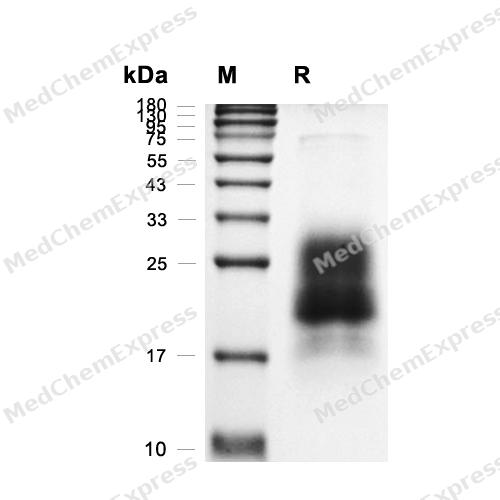
Purity - SDS-PAGE
-
Bioactivity - ELISA
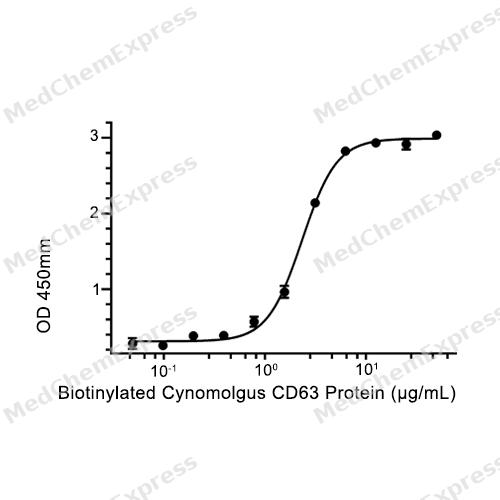
Bioactivity - ELISA


Technical Parameters
-
Species Cynomolgus; Human
-
Source HEK293
-
Tag C-6*His
-
Accession
P08962-1/NP_001253224 (A103-V203)
-
Molecular Construction
-
N-term
-
CD63 (A103-V203)
Accession # P08962-1/NP_001253224 -
His
-
C-term
-
-
Protein Length
Extracellular Domain
-
Synonyms
CD63; Tetraspanin-30; Prev. MLA1; AD1 Antigen; TSPAN30; Tspan-30; CD63 Antigen; OMA81H; Pltgp40; Limp1; HOP-26; Lysosomal-Associated Membrane Protein 3; ME491; Lysosome Integral Membrane Protein 1; AD1; Melanoma-Associated Antigen MLA1; Ocular Melanoma-As
-
AA Sequence
AGYVFRDKVMSEFNNNFRQQMENYPKNNHTASILDRMQADFKCCGAANYTDWEKIPSMSKNRVPDSCCINVTVGCGINFNEKAIHKEGCVEKIGGWLRKNV
-
Molecular Weight
Approximately 22 kDa & 19 kDa, based on SDS-PAGE under reducing conditions.
-
Glycosylation
Yes
-
Purity
≥ 95%, as determined by reducing SDS-PAGE.


Product Properties
Lyophilized powder.
Lyophilized from a 0.22 μm filtered solution of PBS, pH 7.4.
<1 EU/μg, determined by LAL method.
It is not recommended to reconstitute to a concentration less than 100 μg/mL in ddH2O. For long term storage it is recommended to add a carrier protein (0.1% BSA, 5% HSA, 10% FBS or 5% Trehalose).
Stored at -20°C for 2 years from date of receipt. After reconstitution, it is stable at 4°C for 1 week or -20°C for longer (with carrier protein). It is recommended to freeze aliquots at -20°C or -80°C for extended storage.
Room temperature in continental US; may vary elsewhere.


Documentation
-
Data Sheet (236 KB)
-
SDS (251 KB)
- English - EN (251 KB)
- Français - FR (251 KB)
- Deutsch - DE (251 KB)
- Norwegian - NO (251 KB)
- Español - ES (251 KB)
- Swedish - SV (251 KB)
- Italian - IT (251 KB)
- Korean - KR (251 KB)
- Portuguese - PT (251 KB)
-
Handling Instructions (2659 KB)

Calculators
Concentration (start) × Volume (start) = Concentration (final) × Volume (final)


 Powered by Bioz

