



CD64 Protein, Rat (HEK293, His)
Based on 1 Customer Validation
CD64 Protein, with leukotriene receptor binding, crucially regulates processes like phagocytosis and pain perception, responding to epinephrine. Located in membrane rafts, CD64, encoded by FCGR1A, shows biased expression, especially in Spleen (RPKM 177.3) and Lung (RPKM 93.7). This emphasizes its importance in immune responses and sensory functions across diverse physiological contexts. CD64 Protein, Rat (HEK293, His) is the recombinant rat-derived CD64 protein, expressed by HEK293 , with C-His labeled tag.
- Species: Rat
- Source: HEK293
-
Storage:Stored at -20°C for 2 years from date of receipt. After reconstitution, it is stable at 4°C for 1 week or -20°C for longer (with carrier protein). It is recommended to freeze aliquots at -20°C or -80°C for extended storage.


To place orders, for customer services and technical support, please contact: MedChemExpress USA
Tel: 609-228-6898 E-mail: [email protected] [email protected]


-
 Biological Activity
-
Technical Parameters
-
Product Properties
- Documentation
- Help & FAQs




Biological Activity
Description
CD64 Protein, with leukotriene receptor binding, crucially regulates processes like phagocytosis and pain perception, responding to epinephrine. Located in membrane rafts, CD64, encoded by FCGR1A, shows biased expression, especially in Spleen (RPKM 177.3) and Lung (RPKM 93.7). This emphasizes its importance in immune responses and sensory functions across diverse physiological contexts. CD64 Protein, Rat (HEK293, His) is the recombinant rat-derived CD64 protein, expressed by HEK293 , with C-His labeled tag.
Background
CD64 Protein, characterized by its leukotriene receptor binding activity, plays a crucial role in various biological processes, including the positive regulation of phagocytosis and the sensory perception of pain, as well as the response to epinephrine. Situated in membrane rafts, CD64, encoded by the FCGR1A gene, exhibits a biased expression pattern with notable levels in the Spleen (RPKM 177.3), Lung (RPKM 93.7), and nine other tissues. This underlines its significance in immune responses and sensory functions across diverse physiological contexts.
Verified Bioactivity
Measured by its binding ability in a functional ELISA. Immobilized Rat CD64-his at 10 μg/mL (100 μL/well) can bind biotinylated human IgG1. The ED50 for this effect is 0.0754 μg/mL.
MCE Validation Data
-
Purity - SDS-PAGE
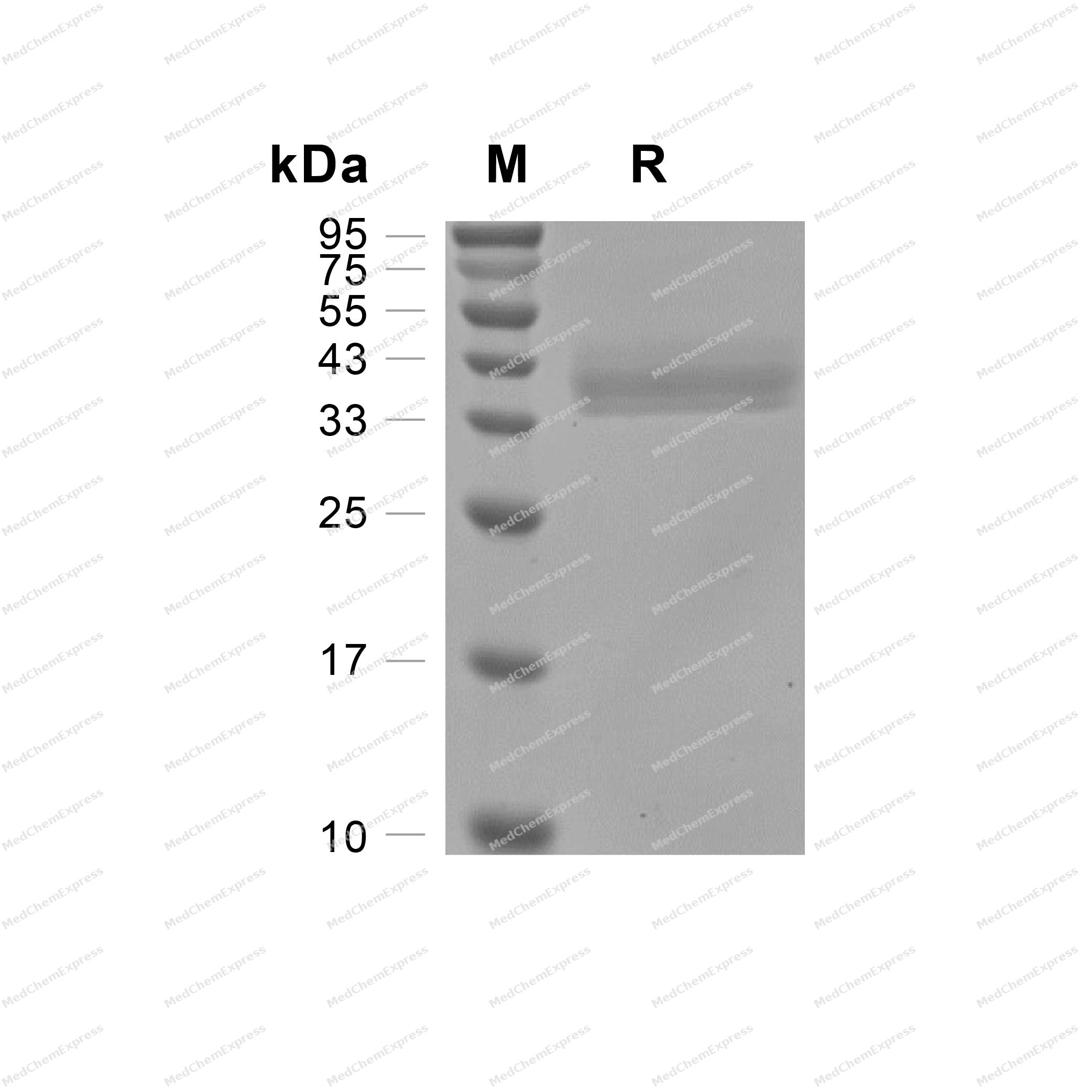
Purity - SDS-PAGE
-
Bioactivity - ELISA
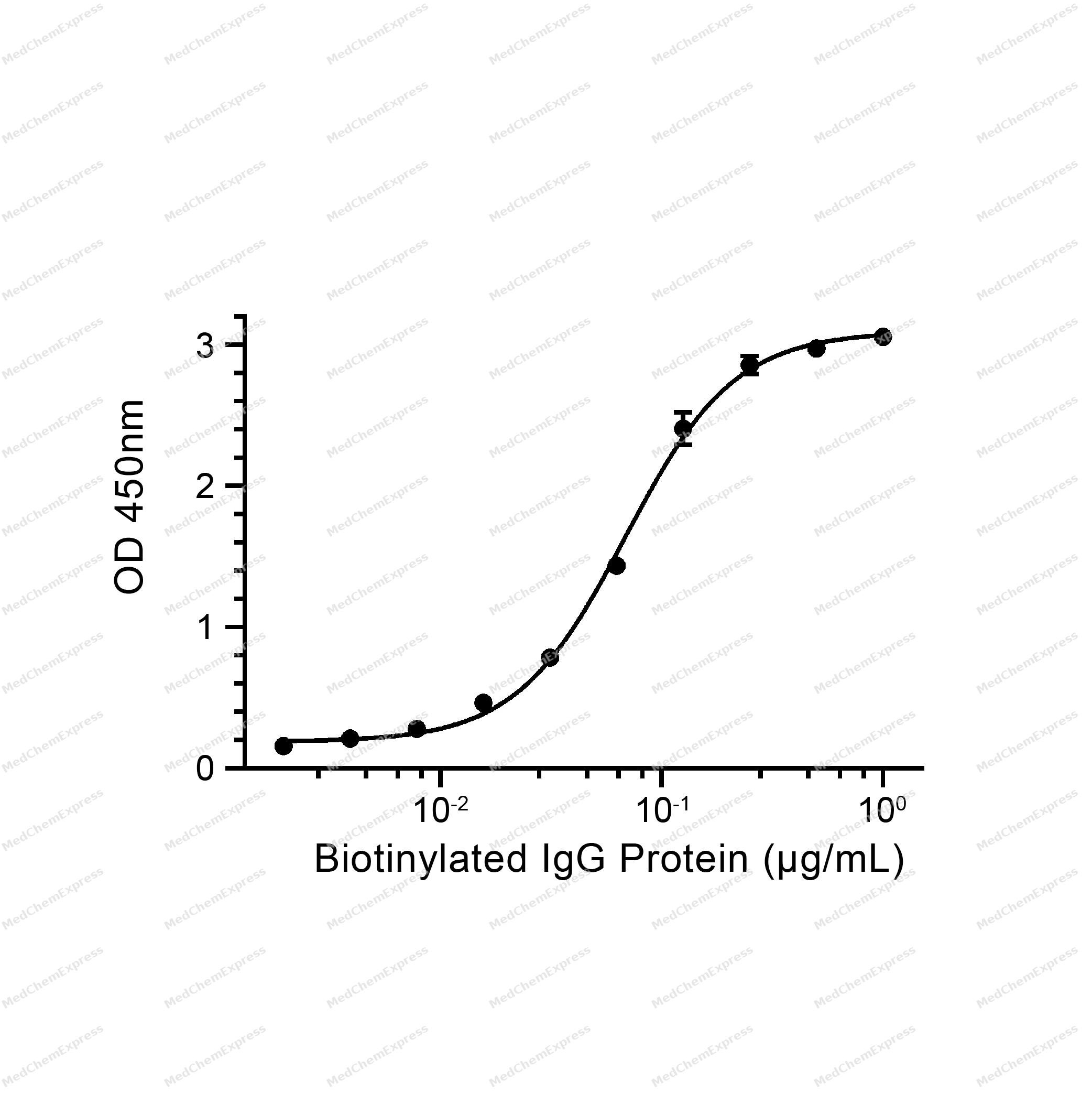
Bioactivity - ELISA


Technical Parameters
-
Species Rat
-
Source HEK293
-
Tag C-His
-
Accession
NP_001094306 (V17-P285)
-
Molecular Construction
-
N-term
-
CD64 (V17-P285)
Accession # NP_001094306 -
His
-
C-term
-
-
Protein Length
Partial
-
Synonyms
Fc Gamma Receptor Ia; FcgammaRIa; FCGR1; FCG1; FcgammaRI; CD64A; CD64; Fc Fragment Of IgG, High Affinity Ia, Receptor For (CD64); Fc Fragment Of IgG, High Affinity Ia, Receptor (CD64); High Affinity Immunoglobulin Gamma Fc Receptor I; Fc Fragment Of IgG R
-
AA Sequence
VVNATKAVVTLQPPWLSIFQEENVTLLCEGPHLGDSSTKWFINSTAIQISTPTYSILKASFKDSGEYKCQTGLSMPSDPVQLEIYRDWLLLQTSHRVLTEGEPLALRCHPWQNKKVYNVAFYRNGESLDFSQGSEVTILKTNLSHSGIYHCSAMGKKLFKSAGVSVTVKELFATPVLRVSLSSPFPEGSLVILNCETRLFLQSPGLRLYFSFYVGSKILEDRSTSSEYHIPRAEREDDGSYWCEVATEDGRVLKRSTKLELFGPQSSDP
-
Molecular Weight
Approximately 40-42 kDa, based on SDS-PAGE under reducing conditions, due to the glycosylation.
-
Purity
≥ 95%, as determined by reducing SDS-PAGE.


Product Properties
Lyophilized powder.
Lyophilized from a 0.22 μm filtered solution of PBS, pH 7.4.
<1 EU/μg, determined by LAL method.
It is not recommended to reconstitute to a concentration less than 100 μg/mL in ddH2O. For long term storage it is recommended to add a carrier protein (0.1% BSA, 5% HSA, 10% FBS or 5% Trehalose).
Stored at -20°C for 2 years from date of receipt. After reconstitution, it is stable at 4°C for 1 week or -20°C for longer (with carrier protein). It is recommended to freeze aliquots at -20°C or -80°C for extended storage.
Room temperature in continental US; may vary elsewhere.


Documentation
-
Data Sheet (237 KB)
-
SDS (251 KB)
- English - EN (251 KB)
- Français - FR (251 KB)
- Deutsch - DE (251 KB)
- Norwegian - NO (251 KB)
- Español - ES (251 KB)
- Swedish - SV (251 KB)
- Italian - IT (251 KB)
- Korean - KR (251 KB)
- Portuguese - PT (251 KB)
-
Handling Instructions (2659 KB)

Calculators
Concentration (start) × Volume (start) = Concentration (final) × Volume (final)


 Powered by Bioz

