



CD84/SLAMF5 Protein, Mouse (HEK293, His, solution)
Based on 1 Customer Validation
CD84/SLAMF5 is an autoligand receptor of the SLAM family that regulates immune cell activation and differentiation through homotypic or heterotypic interactions. Its activity is affected by SH2D1A/SAP and SH2D1B/EAT-2. CD84/SLAMF5 Protein, Mouse (HEK293, His, solution) is the recombinant mouse-derived CD84/SLAMF5 protein, expressed by HEK293 , with C-10*His labeled tag.
- Species: Mouse
- Source: HEK293
-
Storage:Stored at -80°C for 1 year from date of receipt. It is stable at -20°C for 3 months after opening. It is recommended to freeze aliquots at -80°C for extended storage. Avoid repeated freeze-thaw cycles.


To place orders, for customer services and technical support, please contact: MedChemExpress USA
Tel: 609-228-6898 E-mail: [email protected] [email protected]


-
 Biological Activity
-
Technical Parameters
-
Product Properties
- Documentation
- Help & FAQs




Biological Activity
Description
CD84/SLAMF5 is an autoligand receptor of the SLAM family that regulates immune cell activation and differentiation through homotypic or heterotypic interactions. Its activity is affected by SH2D1A/SAP and SH2D1B/EAT-2. CD84/SLAMF5 Protein, Mouse (HEK293, His, solution) is the recombinant mouse-derived CD84/SLAMF5 protein, expressed by HEK293 , with C-10*His labeled tag.
Background
CD84, a member of the signaling lymphocytic activation molecule (SLAM) family, functions as a self-ligand receptor involved in the intricate regulation of immune responses. Through homo- or heterotypic cell-cell interactions, SLAM receptors, including CD84, modulate the activation and differentiation of diverse immune cells, contributing to the coordination of both innate and adaptive immune responses. The activities of CD84 are intricately controlled by the presence or absence of small cytoplasmic adapter proteins, such as SH2D1A/SAP and SH2D1B/EAT-2. CD84 plays a role in natural killer (NK) cell cytotoxicity, T-cell proliferation, interferon gamma (IFNG) secretion, platelet stimulation, and is implicated as a marker for hematopoietic progenitor cells. Furthermore, CD84 is essential for T-cell:B-cell interactions, optimal T follicular helper function, germinal center formation, and maintenance of B cell tolerance in germinal centers, preventing autoimmunity. In mast cells, CD84 negatively regulates high-affinity immunoglobulin epsilon receptor signaling, while in macrophages, it positively regulates LPS-induced MAPK phosphorylation and NF-kappaB activation. Additionally, CD84 plays a role in enhancing macroautophagy in primary dendritic cells by stabilizing IRF8. CD84 forms homodimers via its extracellular domain and engages in head-to-tail dimers with CD48 molecules from other cells. It interacts with various proteins, including SH2 domain-containing proteins, tyrosine-protein phosphatases, and is subject to complex regulatory mechanisms involving phosphorylation and adapter proteins.
Verified Bioactivity
1. Measured by its ability to bind human SH2D1A in a functional ELISA.
2. Measured by its ability to induce IFN-gamma secretion in CTLL-2 cells. The ED50 for this effect is 0.9762 μg/mL in the presence of 500 ng/mL anti-CD3. Corresponding to a specific activity is 1024.38 U/mg.
MCE Validation Data
-
Purity - SDS-PAGE
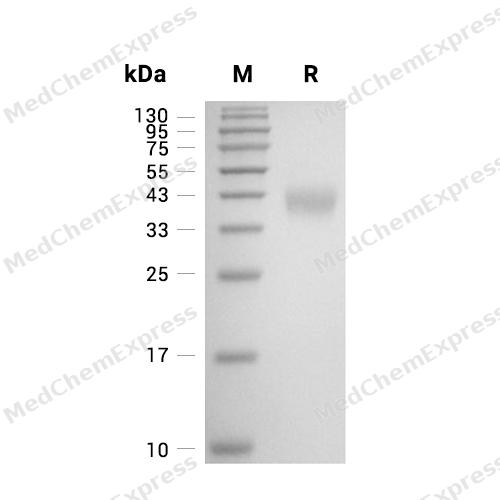
Purity - SDS-PAGE
-
Bioactivity - Cell-Based Assay
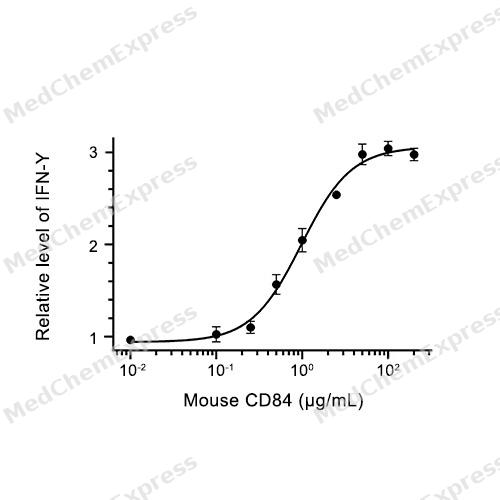
Bioactivity - Cell-Based Assay


Technical Parameters
-
Species Mouse
-
Source HEK293
-
Tag C-10*His
-
Accession
Q18PI6-1 (K22-V221)
-
Molecular Construction
-
N-term
-
CD84 (K22-V221)
Accession # Q18PI6-1 -
10*His
-
C-term
-
-
Protein Length
Extracellular Domain
-
Synonyms
CD84; Cell Surface Antigen MAX.3; CD84 Molecule; SLAM Family Member 5; SLAMF5; Hly9-Beta; HCD84; Alternative Protein CD84; MCD84; Leukocyte Antigen CD84; Signaling Lymphocytic Activation Molecule 5; Leucocyte Differentiation Antigen CD84; CD84 Antigen; Le
-
AA Sequence
KDADPMVMNGILGESVTFLLNIQEPKKIDNIAWTSQSSVAFIKPGVNKAEVTITQGTYKGRIEIIDQKYDLVIRDLRMEDAGTYKADINEENEETITKIYYLHIYRRLKTPKITQSLISSLNNTCNITLTCSVEKEEKDVTYSWSPFGEKSNVLQIVHSPMDQKLTYTCTAQNPVSNSSDSVTVQQPCTDTPSFHPRHAV
-
Predicted Molecular Mass
24 kDa
-
Molecular Weight
Approximately 37-42 kDa, based on SDS-PAGE under reducing conditions, due to the glycosylation.
-
Glycosylation
Yes
-
Purity
≥ 95%, as determined by reducing SDS-PAGE.


Product Properties
Solution
Supplied as a 0.22 μm filtered solution of PBS, pH 7.4.
<1 EU/μg, determined by LAL method.
Stored at -80°C for 1 year from date of receipt. It is stable at -20°C for 3 months after opening. It is recommended to freeze aliquots at -80°C for extended storage. Avoid repeated freeze-thaw cycles.
Shipping with dry ice.


Documentation
-
Data Sheet (237 KB)
-
SDS (254 KB)
- English - EN (254 KB)
- Français - FR (254 KB)
- Deutsch - DE (254 KB)
- Norwegian - NO (254 KB)
- Español - ES (254 KB)
- Swedish - SV (254 KB)
- Italian - IT (254 KB)
- Korean - KR (254 KB)
- Portuguese - PT (254 KB)
-
Handling Instructions (2659 KB)

Calculators
Concentration (start) × Volume (start) = Concentration (final) × Volume (final)


 Powered by Bioz

